
Pry, Ramp and Hoist
LESS FORCE, MORE DISTANCE — the great trick behind simple machines is one shared bargain: Pry (lever), Ramp (inclined plane), and Hoist (pulley) each let you move a heavy load with less force — by making you move a longer distance in exchange. Same work, spread out, so it feels easy
A story read by Pry, Ramp and Hoist
Loading audio…
Press play to listen along. The line being read lights up as you go.
Show full transcript
Loading transcript…
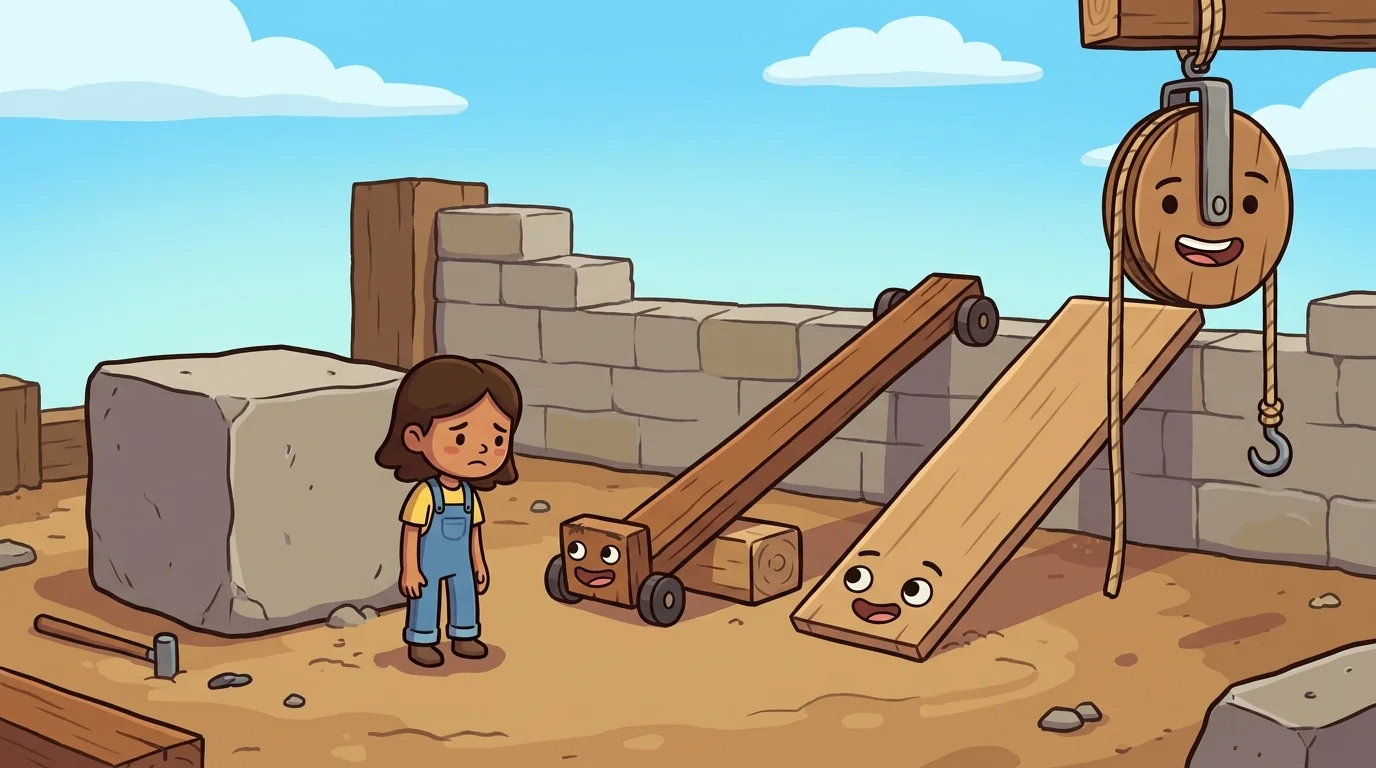
There was a great stone block to be moved up onto a wall, and a girl stood staring at it, certain it was hopeless. It weighed more than she did. She could no more lift it straight up than she could lift a house.
Three machines rolled up beside her, and they were grinning, because they knew a secret that made the impossible block suddenly possible — and it was the same secret, shared three ways.
Pry was a long sturdy bar, resting on a little block.
Ramp was a long gentle slope leaning up against the wall.
Hoist was a wheel with a rope looped over it, hanging above.
"You're trying to lift it straight up, all at once," said Pry. "Of course that's impossible. Watch us cheat."
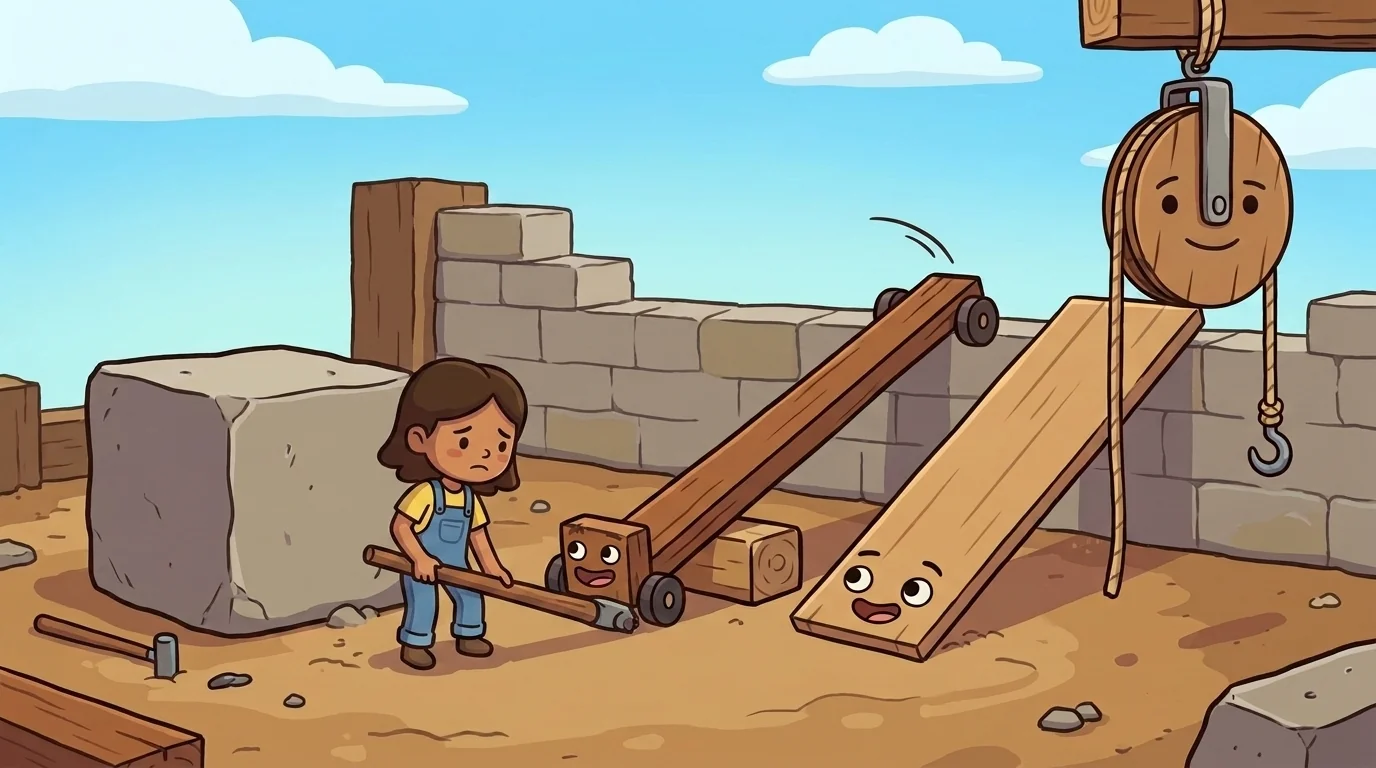
Pry went first, sliding the long bar under the block — because a lever lets you push longer to lift heavier.
"Put the block on my short end," said Pry, "and push down on my long end — way out here, far from the balance point." And the girl pushed the long end down, a big sweeping push through a long arc — and the short end, moving only a tiny bit, heaved the great block up. "There," said Pry. "You just lifted something you couldn't budge. But notice the bargain: your end moved a long way down, and the block moved only a little way up. That's the whole trick. I let you use less force — but you have to apply it over a longer distance. Push far to lift near. You didn't get stronger. You just spread your push out along my arm, and the spreading-out is what made the heavy thing light."
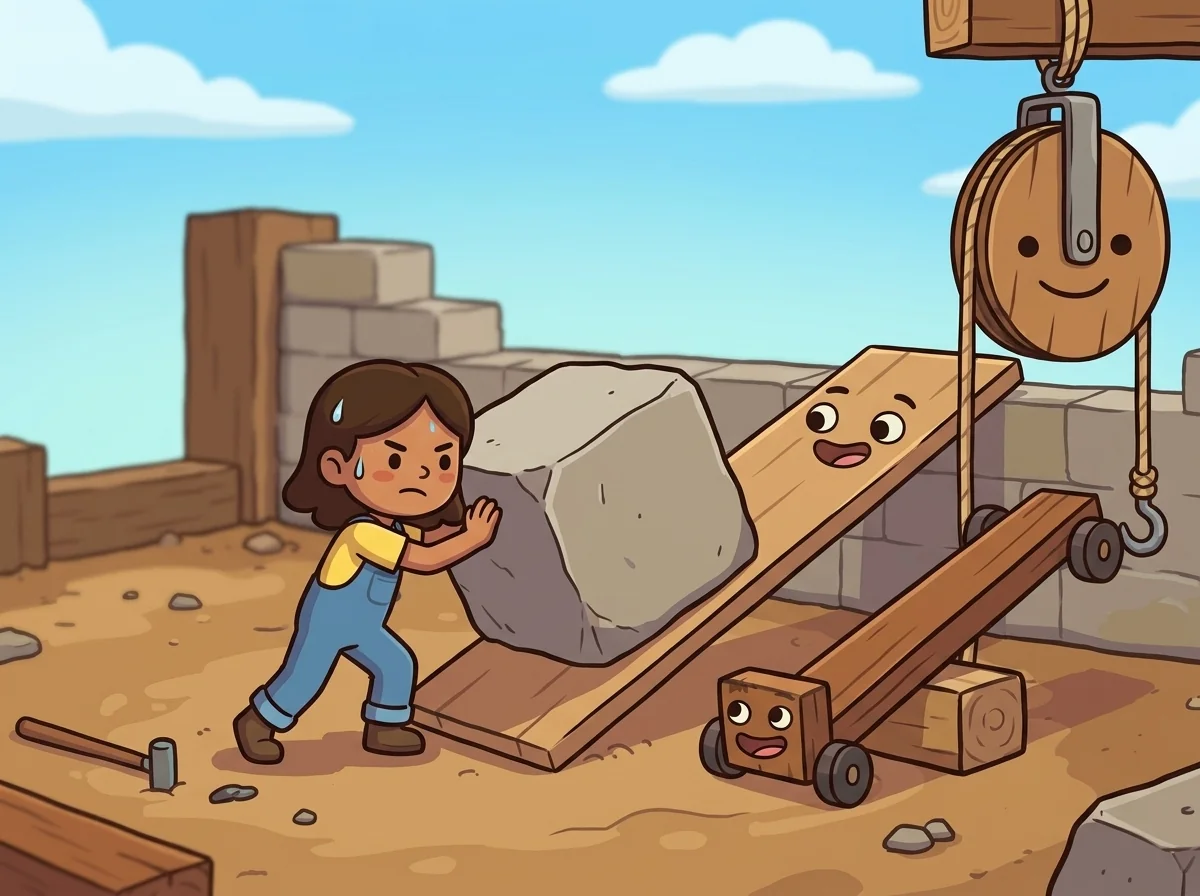
Then Ramp leaned its long slope against the wall, because you can also trade distance for force by going the long way up.
"You can't lift the block straight to the top of the wall," said Ramp. "So don't. Roll it up me instead." And the girl pushed the block up the long gentle slope — and it went, steadily, without the impossible strain of a straight lift. "See what happened?" said Ramp. "Straight up would've been short but impossibly hard. Up my slope is long but easy. You did the same job — the block ended up just as high — but you spread the effort along my whole length instead of cramming it into one impossible vertical heave." Ramp stretched out proudly. "The gentler and longer I am, the easier the push — but the farther you have to travel. Same work, spread thin enough to fit your strength. A mountain road switchbacks for exactly this reason: the long way up is the only way a heavy thing gets up at all."
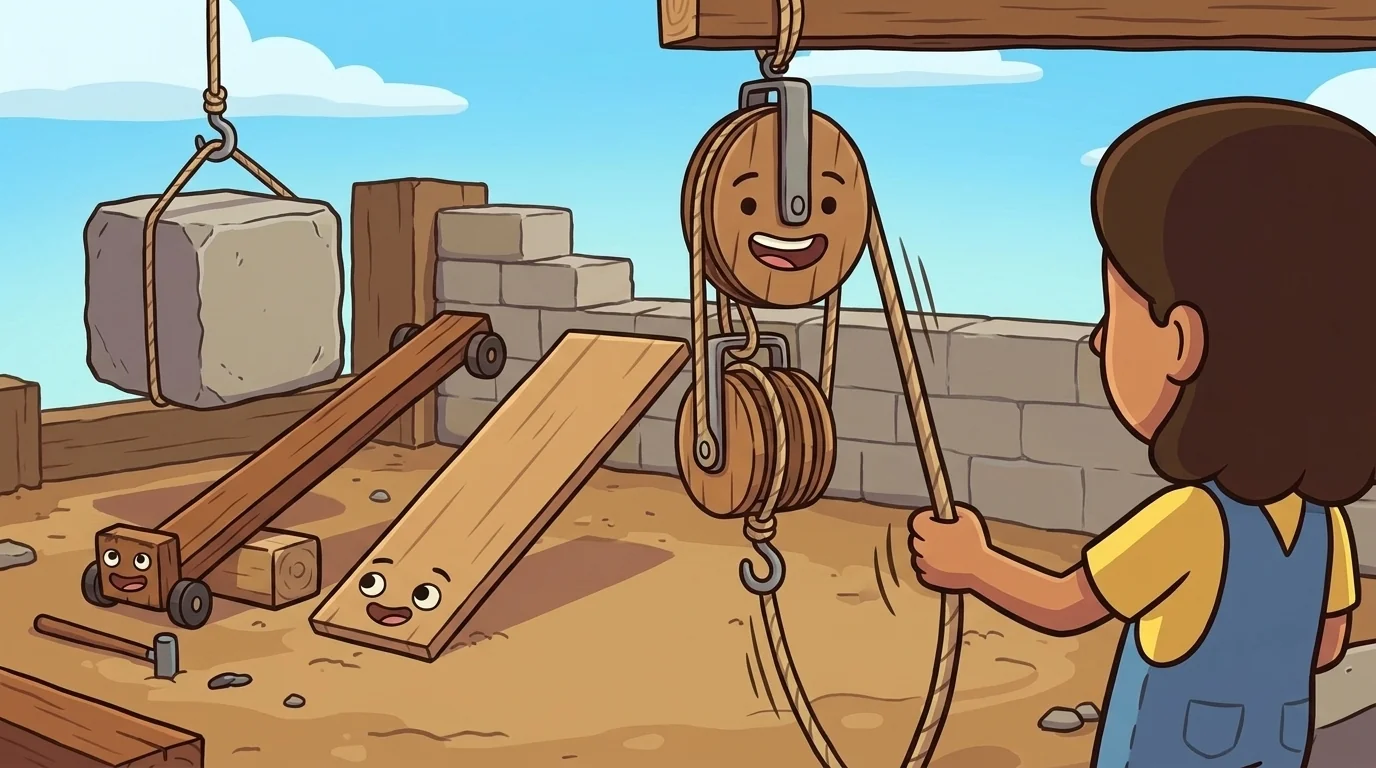
And then Hoist dropped its rope down from the wheel above, and did the same trick with a twist — redirecting the force so you could pull in the easy direction.
"Here's mine," said Hoist. "Loop the rope under the block, up over my wheel, and now — instead of lifting up, you pull down." And the girl pulled down on her end, using her whole weight, and the block rose. "Pulling down is so much easier than lifting up — you can hang your whole body on it. That's my first gift: I redirect the force to whatever direction suits you." Hoist spun its wheel. "And add more wheels, more loops of rope, and I do the lever's trick too: you pull a long length of rope with little force, and the block rises a short way with great force. Same bargain as the others, dressed differently: more distance pulled, less force needed. I just let you pull it in the friendliest direction."
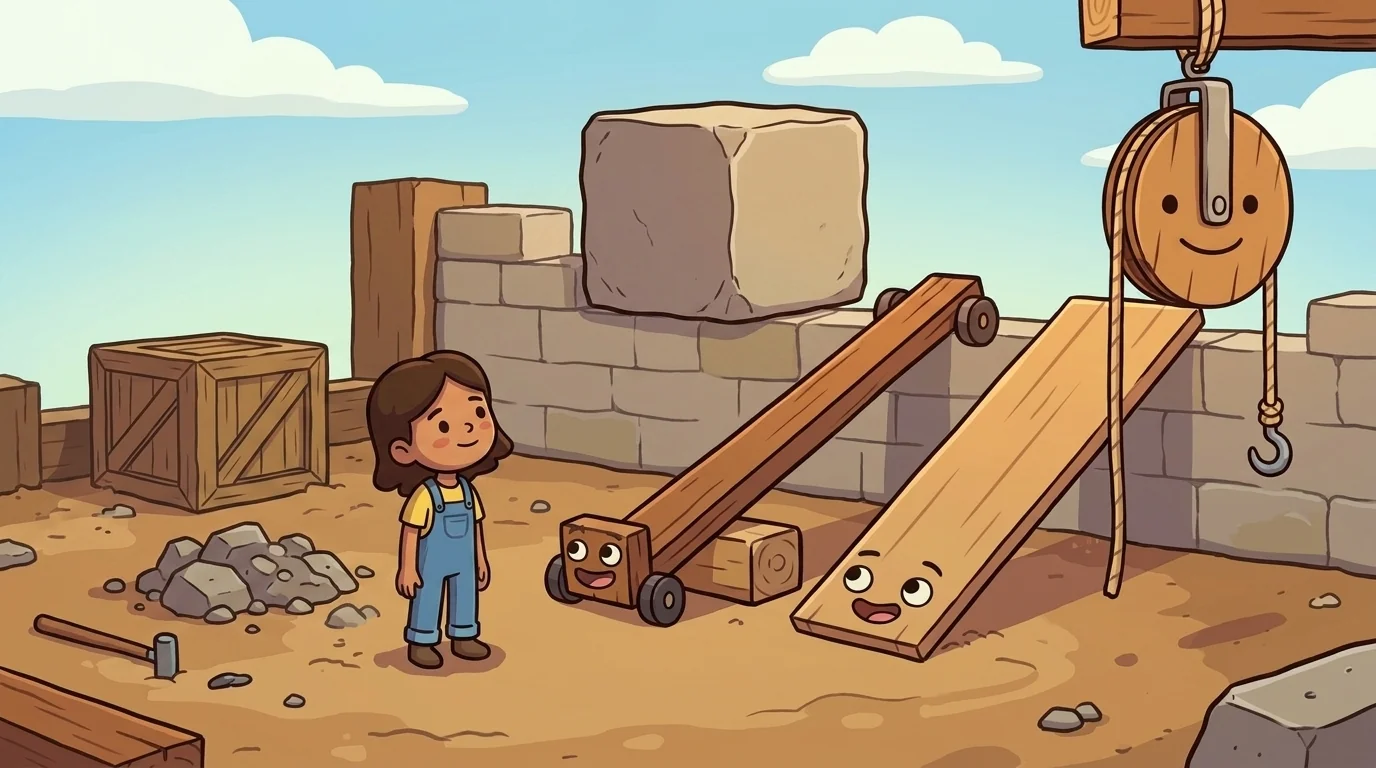
The great block sat up on the wall at last, and the girl stared at it, then at her own ordinary arms, hardly believing she'd done it.
"Good leverage," said Ramp.
"Good slope," said Hoist.
"Good pull," said Pry.
And here was the secret the three of them shared, the one worth carrying far beyond this one stone block: not one of them made free power. None of them let you do less work — the block went just as high, the job was just as big. What they did was rearrange the work — spread it out over more distance so it needed less force at any one moment, until it fit inside your own ordinary strength. The impossible thing was never really about being weak. It was about the work being badly arranged. And the girl stood there by the wall, looking at the block she'd been so sure she could never move, feeling something warm and steadying rise up in her chest — not pride at being strong, but the quiet, hopeful wonder of realizing she was capable of far more than she'd believed a moment ago. That feeling — oh, I can do more than I thought — is the real gift the three machines leave behind, and it stays with you long after the block is set: the steady, lightening sense that a job which looks hopeless head-on is very often just waiting for you to find the longer, easier, cleverer way through.
The MachineForge ensemble
Pry, Ramp and Hoist is part of MachineForge's distributed-narrative cast. Each character embodies a different curricular primitive; together they teach the full subject.
-
Pry
Lever — push longer to lift heavier; the trade between force and distance
-
Hoist
Pulley — pull down here and watch it go up there; redirecting force
-
Ramp
Inclined plane — climb the long slow way; less force, same work
-
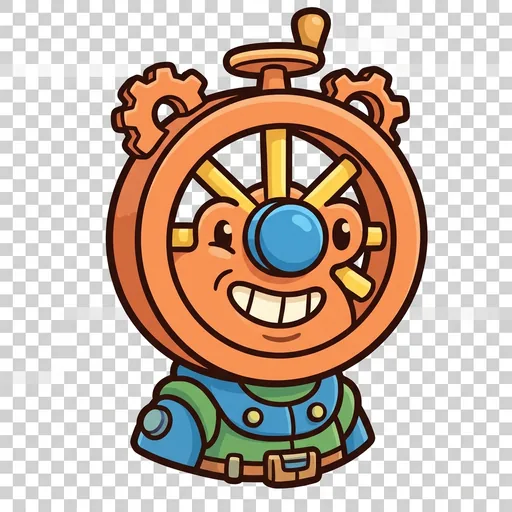
Spoke
Wheel-and-axle — one turn of the hub, many turns of the rim
-
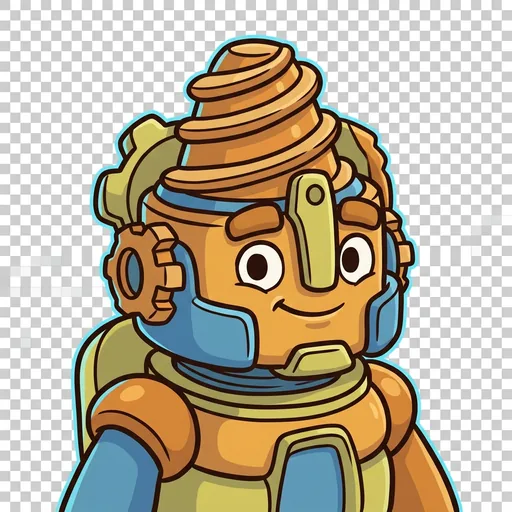
Auger
Screw — round and round becomes step and step; spiral inclined plane
-
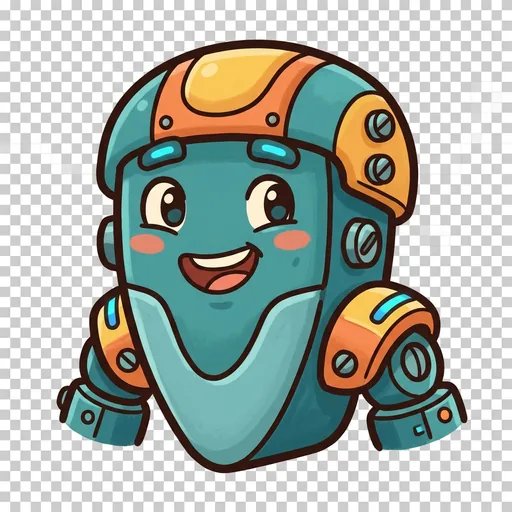
Cleave
Wedge — push forward and split it apart; force concentrated to a sharp edge
-
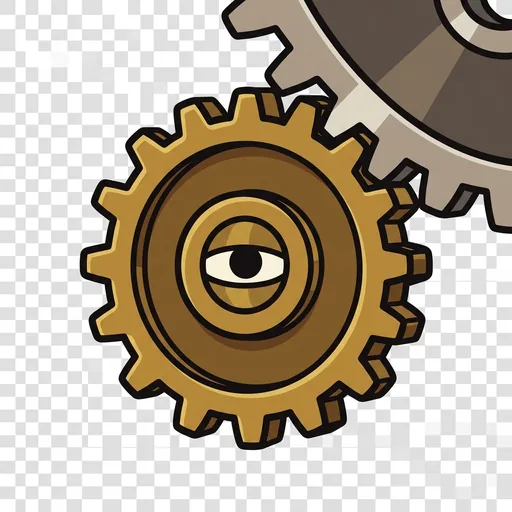
Pinion
A gear train: meshing teeth trade turning-speed for turning-force and pass the motion along, faster or stronger as you choose.
-
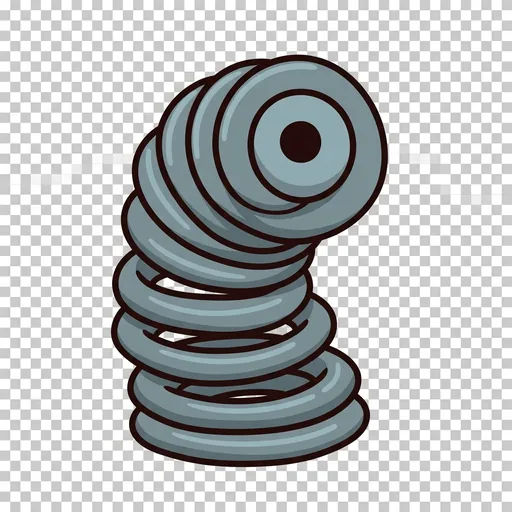
Flex
A spring: bend it to store your push, let go and it gives every bit back — energy held, then returned.
-
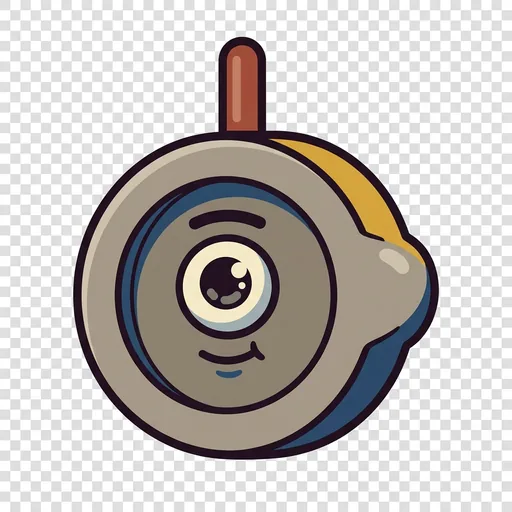
Lobe
A cam: a spinning shape with a bump that turns steady spinning into a repeating push, like a music box keeping a beat.
-
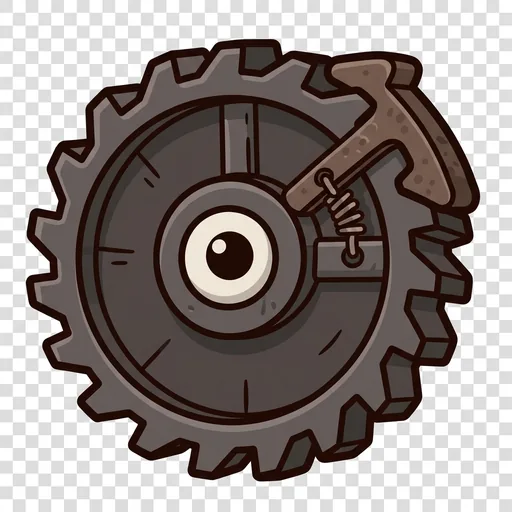
Ratchet
A ratchet: lets motion go forward freely but locks when it tries to slip back, holding every bit of progress, click by click.

