
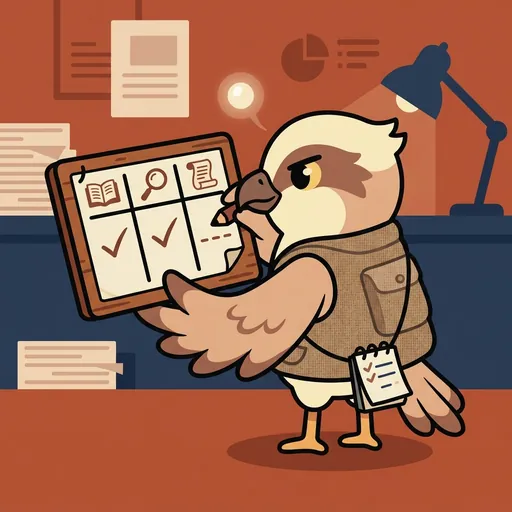
Crosscheck
CROSSCHECK — *three sources say the same thing; now I have something.*
Listen along — Crosscheck
Loading audio…
Press play to listen along. The line being read lights up as you go.
Show full transcript
Loading transcript…
Chapter 3 — Crosscheck and the Three Sources That Become a Fact
Crosscheck was a small osprey, still a tween. Her feathers were warm cream, with soft brown on her back. She wasn’t scary, not like some birds of prey. Instead, she looked like a chunky cartoon, with sharp, intelligent eyes. She always wore a little investigator vest. Tucked under her wing was her most important tool: a small triangulation board.
This board was her secret weapon. It had three columns, labeled Source 1, Source 2, and Source 3. Crosscheck believed in taking her time. She wouldn’t write anything in her notebook until three different sources confirmed it. This was her way of doing things, her method for finding the truth. She called it verification and triangulation.
Most people just listened to the first interesting story they heard. They might even repeat it, making it sound like a fact. But Crosscheck knew that was how rumors spread. A real journalist, she often said, checked every important detail. Not just once, but with at least three independent sources. Independent meant they hadn’t copied from each other. They had found the information on their own. If sources disagreed, she noted that disagreement. If they all said the same thing, then she had something solid. This careful checking was the bedrock of journalism.
Crosscheck was clear and firm about her rules. “Three sources say the same thing,” she’d announce, “and now I have something.” She’d tap her board. “One person says it? That’s a rumor. Two people say it? Maybe a fact, but still shaky. Three independent sources say it? That’s a fact you can publish.”
She taught her students how to build a solid story, piece by careful piece. The first step was always the triangulation rule: three independent sources. She explained that if Source A heard something from Source B and just repeated it, they weren’t truly independent. It was like hearing the same story twice from the same person. Real independence meant each source found the information on their own, through different paths.
She also taught about different types of sources. Primary sources were people directly involved, who saw or did something firsthand. Secondary sources got their information from primary sources, like reading a report. Primary sources were usually better, she said, but secondary sources were often easier to find. A good journalist used both, weighing them carefully. And documents – like official records, photos, or recordings – could either prove or disprove what someone said in an interview.
“When sources disagree,” Crosscheck would say, “that’s not a problem. Disagreement is data. Don’t just pick the answer you like best. The story might be: ‘Sources disagree on whether…’ That’s a valid line to write.” She warned against relying too much on anonymous sources, too. They were important for protecting people who might be in danger, but even anonymous claims needed to be checked by other sources. Anonymity wasn’t an excuse to skip verification.
Crosscheck grew up by the wide, winding river that fed the village of InkQuest. Her family had always been the village’s fish-watchers. They were ospreys, known for their incredible eyesight. For generations, they had taught their young a crucial lesson: “What looks like a fish might be a shadow.”
Her great-great-grandparents had learned it the hard way. They’d dive for a shimmering shape, only to come up empty, or worse, with a mouthful of weeds. So they developed a method. Before a dive, they’d circle high, then drop lower, checking the water from different angles. They’d watch for movement, for the glint of scales, for the ripple of a real fish. Only when three different views confirmed it was a fish, not just a trick of light or a floating leaf, would they plunge.
Crosscheck carried this lesson in her bones. She understood that checking from multiple angles saved you from mistakes. It saved you from wasted effort. When she turned twelve, she walked to InkQuest, ready to learn more. Caret, the wise old mentor, looked at her with knowing eyes.
“What is verification, young osprey?” Caret asked, her voice soft but deep.
Crosscheck stood tall. “Three sources say the same thing,” she replied, “and now I have something. You triangulate. You verify. You never publish what only one source claims.”
Caret smiled slowly. “You are appointed,” she said.
In her workshop, the air smelled faintly of old paper and ink. Crosscheck stood before a group of young students, her triangulation board propped on an easel. “Watch closely,” she said, her sharp eyes scanning their faces. “Today, we’re investigating a claim.”
She wrote it clearly on a large piece of paper: Claim: The school cafeteria is running out of food.
“This is what someone told us,” she explained. “It sounds important, right? But is it true? We can’t just repeat it. We need to verify.”
She turned to the first column on her board. “Source 1,” she announced. “I spoke with a cafeteria worker. Someone who actually prepares the meals every day. A primary source.” She wrote ‘Cafeteria Worker’ in the first column. “They told me, ‘Yes, supplies have been short. We’ve had to make do with less for weeks.’” Crosscheck nodded, filling in the details. The students leaned forward, scribbling in their own notebooks.
“Now, for Source 2,” she continued, moving to the next column. “I went to the school administrator. This person oversees the budget and ordering. They’re also a primary source, in a different way.” She wrote ‘School Administrator’ in column two. “The administrator said, ‘No, supplies are at normal levels. Everything is fine.’”
A ripple went through the students. “But they disagree!” one student blurted out.
Crosscheck smiled dryly. “Exactly. This is where many people stop. They pick the source they like, or the one that sounds more official. But we don’t do that. We look for a third, independent source.”
She tapped the third column. “What kind of source could tell us about food supplies without talking to either the worker or the administrator?” she asked.
A student raised a hand. “Invoice records?”
“Excellent!” Crosscheck praised. “Documentary evidence. Numbers don’t have opinions.” She wrote ‘Invoice Records (Last Month)’ in the third column. “I looked at the official orders placed with the food suppliers. These are hard facts.”
She paused for effect. “The records showed a fifteen percent reduction in food orders over the last month. Fifteen percent less food coming in.”
She pointed to her board. “Think about it. The cafeteria worker said supplies were short. The invoice records show fewer orders. These two sources are compatible. They tell a similar story.” She then pointed to the administrator’s column. “But the administrator said supplies were normal. The documents contradict that.”
“So, what’s our story now?” Crosscheck asked, looking at her students. “Is the cafeteria running out of food? Not exactly. But we have something much more concrete.”
She wrote on a fresh piece of paper: “Official records show a fifteen percent reduction in food orders for the last month, contradicting administrator claims that supplies are normal. A cafeteria worker confirms ongoing shortages.”
“See?” she said, holding up the paper. “The disagreement is part of the story. We didn’t ignore the administrator. We just showed what the other sources said. This is how we build a fact, piece by careful piece. This is verification and triangulation.”
She looked at each student. “My name is Crosscheck. The lesson I teach is simple: use three independent sources. Remember that disagreement is data. And always, always verify before you publish anything.”
Crosscheck was gentle, but her words were firm. “Don’t publish anything you haven’t verified,” she insisted. “A rumor, even if it sounds believable, is not a fact. The true foundation of journalism is built on facts checked from multiple angles.” She paused, her gaze serious. “You need both trust and skepticism to do this work well.”
She finished, as always, with her signature phrase. “Three sources say the same thing; now I have something.”
The InkQuest ensemble
Crosscheck is part of InkQuest's distributed-narrative cast. Each character embodies a different curricular primitive; together they teach the full subject.
-

Lede
Story-from-data — finding the angle; what's the story under the numbers?
-

Pad
Field-capture + interview craft — open the question; let the answer breathe
-

Margin
Data-table + chart-annotation craft — label the axes; caption the chart; credit the data
-

Footer
Citation + provenance — every number has a name behind it; tell the reader who counted