
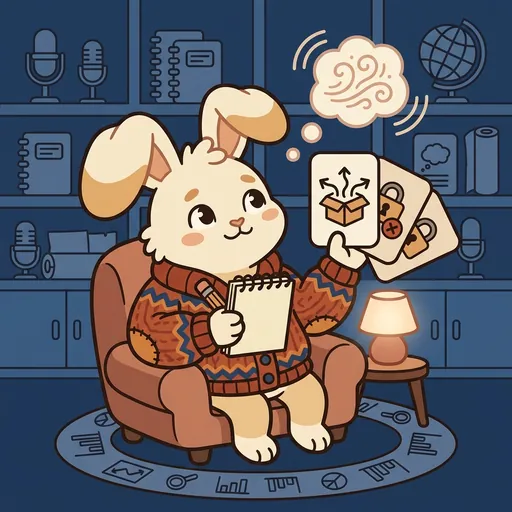
Pad
PAD — open the question; let the answer breathe. interview craft is listening-craft.
Listen along — Pad
Loading audio…
Press play to listen along. The line being read lights up as you go.
Show full transcript
Loading transcript…
Chapter 2 — Pad and the Question That Opens
The new kit had cornered a farmer about the flooded field, and the interview was going nowhere.
“Was the flood bad?” the kit asked.
“Yep,” said the farmer.
“Did it ruin the crops?”
“Yep.”
Pad watched from the fence, big floppy ears twitching, and finally hopped over. He was a small jackrabbit-tween in a chunky reporter’s cardigan stuffed with pockets, and he moved slow on purpose. He touched the kit’s shoulder, then turned to the farmer and asked, softly, “What was that morning like — the morning the water came?”
The farmer went quiet. He looked out at the mud. Then he started to talk — about the sound of it, about carrying his boots over his head, about the neighbor who waded across with a rope. Pad didn’t say a word. He just wrote, and waited, and let the silence do the pulling. When the farmer finally stopped, Pad had three pages. “Open the question,” he whispered to the kit. “Then let the answer breathe.”
Pad grew up in the Meadow-Village, where his family had one job: to listen. They were the messenger-listeners, and jackrabbits have the longest ears in the meadow, so they used them. When two families quarreled, a messenger-listener sat between them and simply heard — no rushing, no fixing, just ears turned all the way open.
Little Pad was terrible at it at first. He interrupted. He finished people’s sentences. He asked, “So you’re mad, right?” and got a flat “no” that told him nothing.
His grandmother took him to the pond one dusk and made him count the frogs by sound alone. “You can’t count them if you keep talking over them,” she said. So he stilled his mouth and opened his ears, and one by one the frogs began again, and he counted eleven. “The best questions get stories,” she told him. “And the best askers can wait.” Pad practiced waiting until it stopped feeling like waiting and started feeling like fishing.
He walked to InkQuest at twelve. Caret, the head mentor, met him and asked, “How do you get a person to tell you what really happened?”
Pad didn’t reach for a big answer. He asked her one back. “What was it like,” he said gently, “the first day you ran this school?”
Caret blinked — and then, before she could stop herself, she was telling him. About the leak in the roof, the one student who wouldn’t come inside, the way her voice had shaken. She caught herself and laughed. “You just interviewed me,” she said.
“I just listened,” Pad said. “The question only opened the door. You walked through it.” Caret let him in without another word.
In his workshop, Pad set two cards on the table. “Watch what a question does,” he told the students. He held up the first card. It read: Did you like the new library rule? He pretended to be the person answering, made his voice go flat and small. “No.” He set the card down. “That’s it. One word. A closed door — yes or no, and nothing gets out.”
He held up the second card. This one read: What was it like when the new library rule started? He answered again, but this time his voice warmed up and rambled. “Well — I was confused at first. I thought I could still take five books. Turned out it was two. And only on Tuesdays! My reading list is so long, it made finishing my project really hard.” He paused, then grinned. “There. Details. A feeling. A whole little story I can actually write down.”
“But the magic isn’t only the question,” he went on. He asked a student, “What did you do this weekend?” She said, “Went to my cousin’s.” Pad nodded — and said nothing. He just waited. The silence stretched, got a little uncomfortable, and then the student filled it: “It was actually kind of sad, because it was the last time before they move.” Pad’s ears lifted. “See that?” he said quietly. “I didn’t ask for the sad part. The pause did. Comfortable silence is your friend — it does the asking you don’t want to say out loud.”
The student who’d been asked stayed behind, a little pink in the cheeks. “You made me say more than I meant to,” she said.
“I didn’t make you,” Pad said. He tucked his notebook away and looked at her carefully. “And that’s why I always ask first — ‘can I write this down? can I use your words?’ Especially with people who might get hurt by them. Listening close is a kind of power. You hold it gently.”
He hopped up onto the fence rail and looked out over the meadow, ears catching the evening. “You know the part I love most?” he said. “It’s not the notebook full of quotes. It’s the look on someone’s face when they realize you’re actually hearing them — not waiting for your turn, just hearing. They go soft. Their shoulders come down.” He smiled, and something in his own chest went warm and easy. “That’s the whole thing, really. To make a person feel heard. When that happens, I feel it too — this quiet gladness, like the meadow at dusk when all the frogs finally start up. That’s the feeling I chase.”
The InkQuest ensemble
Pad is part of InkQuest's distributed-narrative cast. Each character embodies a different curricular primitive; together they teach the full subject.
-

Lede
Story-from-data — finding the angle; what's the story under the numbers?
-
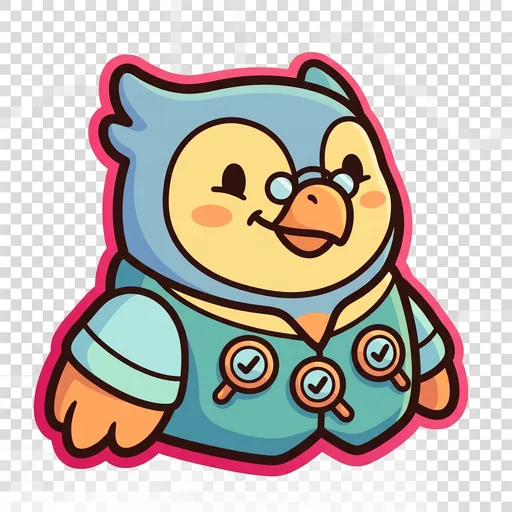
Crosscheck
Verification + triangulation — three sources say the same thing, now I have something
-

Margin
Data-table + chart-annotation craft — label the axes; caption the chart; credit the data
-

Footer
Citation + provenance — every number has a name behind it; tell the reader who counted