Notch
IMPOSSIBLE FIGURE — locally coherent; globally cannot exist. the figure that breaks 3D logic at the joins.
Loading audio…
Press play to listen along. The line being read lights up as you go.
Show full transcript
Loading transcript…
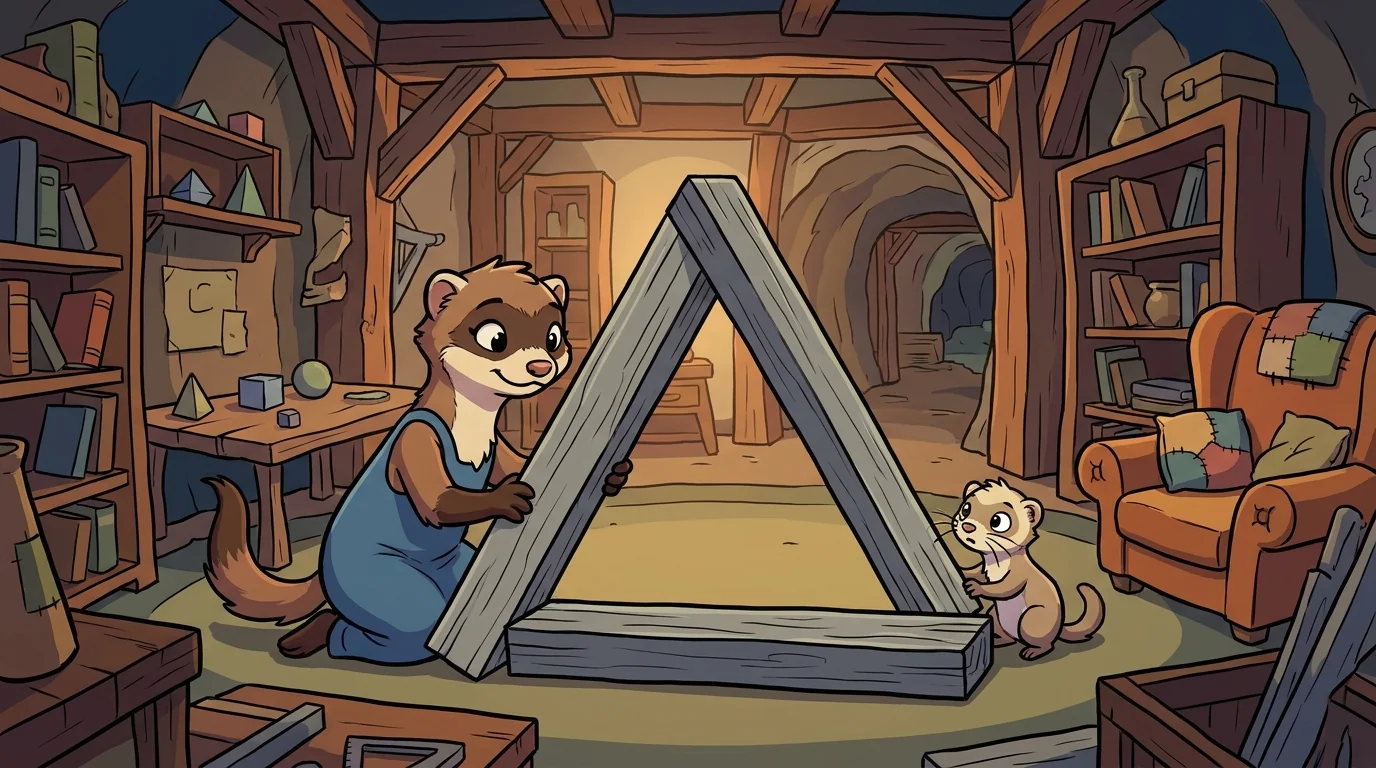
In the crooked drawing-room at the bottom of the tunnel-village, a ferret-tween named Notch was building a triangle that could not exist.
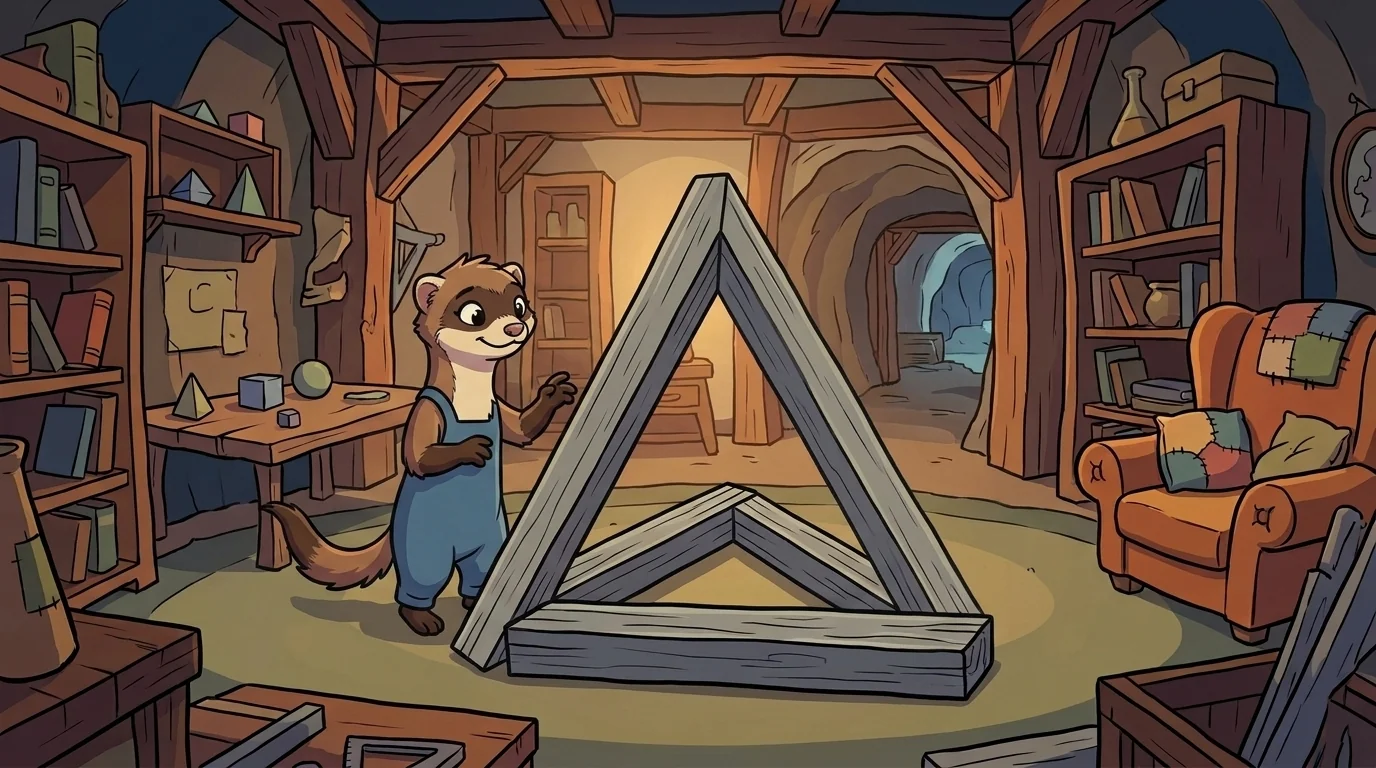
She had three long grey beams laid out on the floor, and she was fitting them together, corner by corner. First corner: a clean right angle, the kind you'd find on any table leg. Notch nodded. Second corner: another tidy right angle, the beam rising away toward the ceiling. She nodded again. Third corner, joining the top beam back down to the first — and here she went very slow, easing the ends together with her paws until, from exactly where she was crouched, the three beams seemed to close into a neat, solid triangle.
A younger tunnel-kit poked his head in. "That's just a triangle."
"Come stand where I'm standing," Notch said.
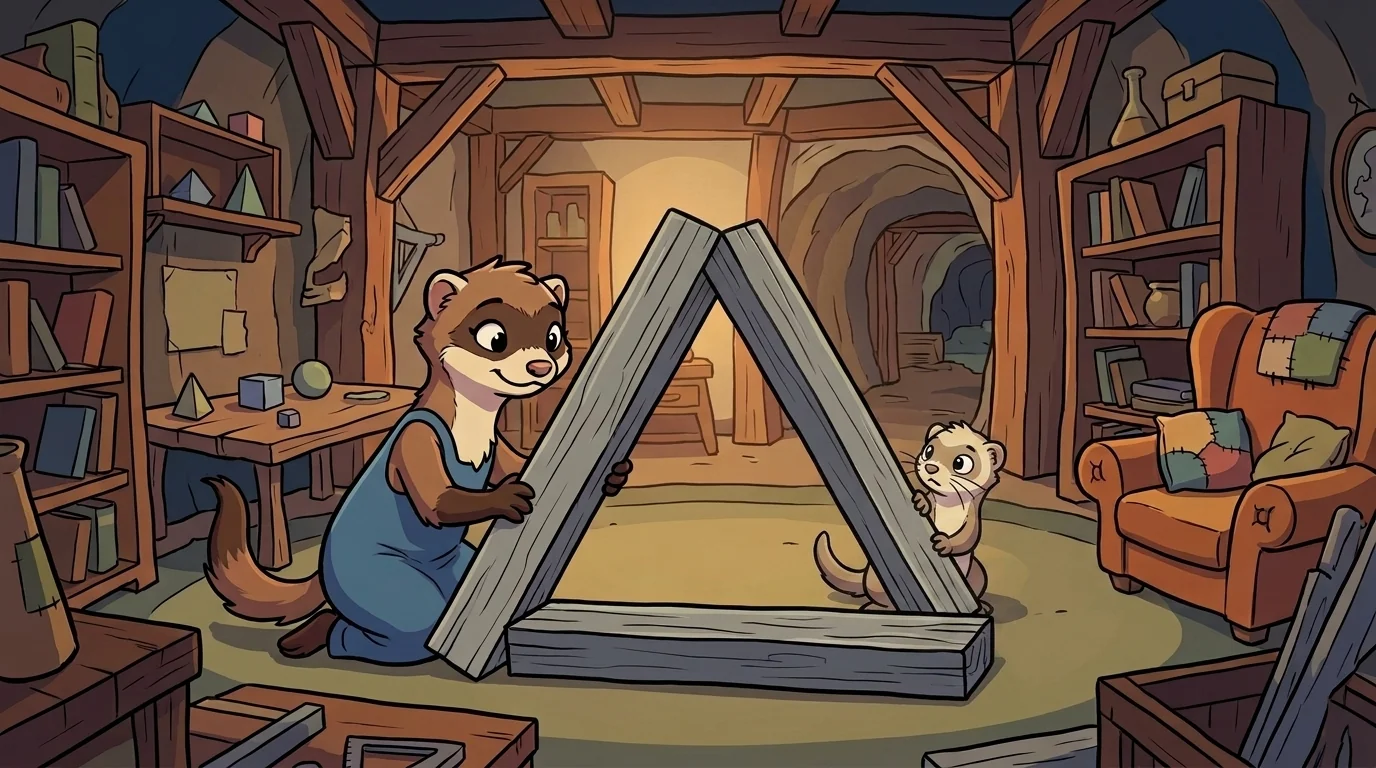
He crouched beside her. From that one spot, the beams locked into a perfect three-cornered shape. Then Notch reached out and tapped the top beam — and it swung freely in the air, attached to nothing on the far end. The triangle had no far end. It only looked closed from that single crouching angle.
The kit's whiskers twitched. "But — I saw it close."
"You saw each corner behave," Notch said, grinning. "Every join looked honest on its own. It's the whole thing that lies." She traced the three beams around with one claw. "Follow it all the way around and it never actually meets itself. Up close, everything's fine. Step back, and it can't be real."
Notch had learned to trust that feeling underground, long before she could name it.
Her family were passage-mappers — the ferrets who kept the tunnel-village's twisty warren straight in their heads so nobody got lost in the dark. The first time she'd mapped a passage alone, she'd done everything right. Turn left, she wrote. Slope down, she wrote. Each step, on its own, was true. She was certain.
Then she came out into a chamber she'd already mapped an hour ago, from the wrong side, when the map said that was impossible.
Her chest went tight and hot. She felt tricked — furious at herself, sure she'd made some dumb mistake. Every single step had been correct. How could correct steps add up to something that couldn't be?
Her great-aunt, an old mapper with a slow voice, found her there. She didn't scold. She looked at Notch's map and said, "Every turn here is honest, little one. I believe each one." She tapped the whole page. "But honest turns can still curl into a shape that lies. That's not your failure. That's the tunnels. You checked each step. You forgot to check the shape."
The furious-tricked feeling loosened. It had a name now: local's fine, it's the global that fools you. Somehow that made the strange chamber feel less like a mistake and more like a puzzle worth keeping.
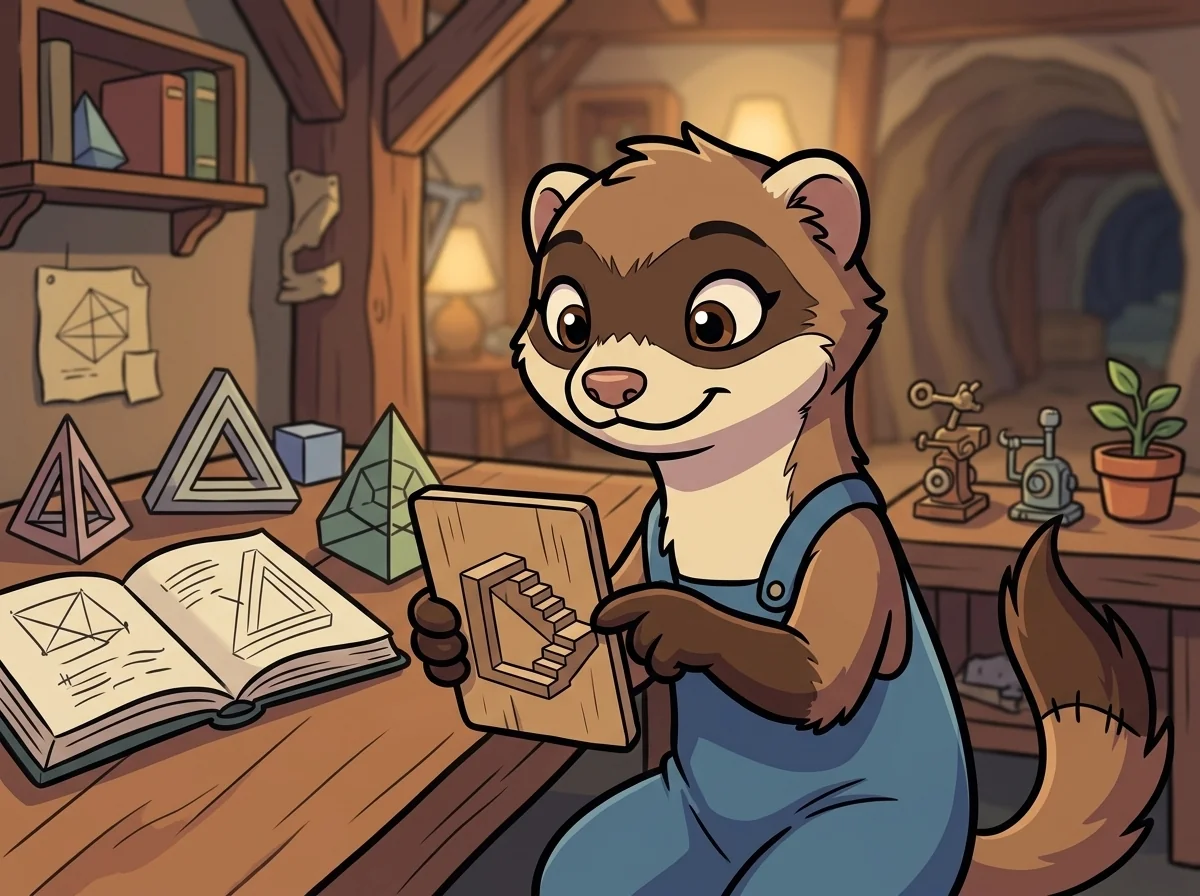
She walked to IllusionForge at twelve, because a place that studied how eyes get fooled ought to understand the kind of trick her tunnels had taught her.
Veil, the mentor who ran the drawing-rooms, met her at the gate. He didn't ask her to prove she was clever. He asked one question. "What makes a figure impossible?"
Notch didn't answer with words. She pulled a card from her vest — a staircase drawn climbing in a square loop — set it on the table, and put her claw on the bottom step. "Up," she said, moving to the next. "Up. Up. Up." She went all the way around the loop, every step honestly higher than the last, until her claw arrived back exactly where it had started. "Four flights up," she said, "and I'm standing where I began."
Veil looked at the little staircase that climbed forever without going anywhere. "Each step was true," he said quietly.
"Each step was true," Notch agreed. "The whole staircase is a lie. The stairs are honest. The loop is impossible." She tucked the card away. "The eye checks one step at a time. It never checks the whole climb — unless you make it."
Veil was quiet a long moment. Then: "You belong here."
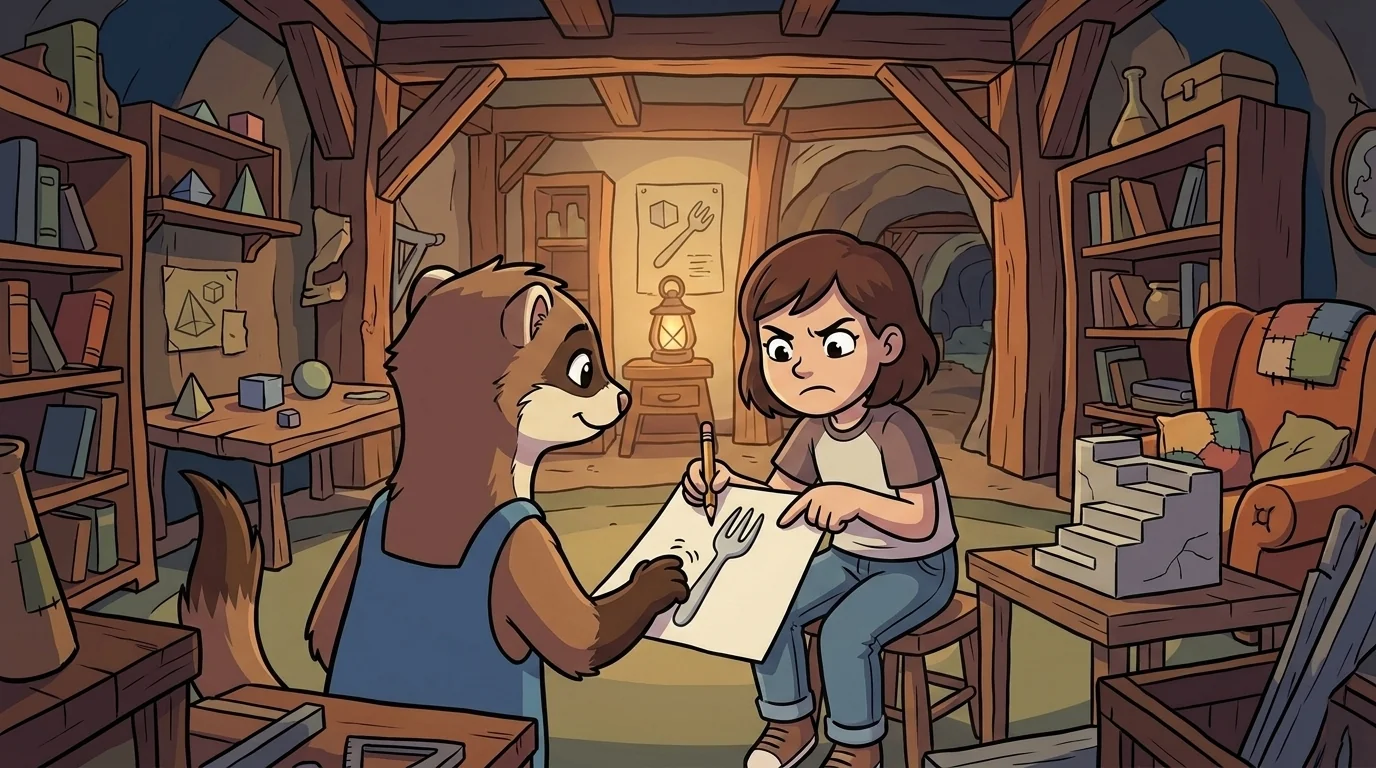
Notch's drawing-room filled up with figures that were honest everywhere and impossible on the whole.
A girl came in one afternoon, scowling at a fork she'd drawn — three prongs at one end that somehow melted into two at the other. "I ruined it," she said. "I can't figure out where the drawing went wrong."
"Show me where it's wrong," Notch said.
The girl pointed at the three-prong end. "That's fine." She pointed at the two-prong end. "That's fine too."
"So point at the wrong part."
The girl's claw hovered over the middle — then drifted, unsure, unable to land. Every inch of the fork looked correct. There was no single wrong spot to point at.
"You can't find it," Notch said gently, "because it isn't in any one place. It's in the travel between the ends. Three prongs, honestly drawn. Two prongs, honestly drawn. But you can't get from one to the other in anything real." She tapped the paper. "That's not a ruined drawing. That's a made one. You built a shape your eye accepts corner by corner and rejects all at once. That's the hardest thing to draw on purpose."
The girl stared. "So it's... supposed to break?"
"It's supposed to be honest up close and impossible far away," Notch said. "Move your eye slow, it works. Take in the whole thing, it snaps. That snap is the art." The girl laughed, delighted, and started a fresh one.
Later, when the room had emptied, the girl came back with a smaller question. She was quieter now.
"When every part looks right," she said, "how do you ever catch the lie?"
Notch thought about the chamber underground, and the tight-hot feeling, and her great-aunt's slow voice.
"You feel it before you see it," she said. "There's a moment where everything's checked out — every corner, every step, every prong — and something in your chest still tips, like the floor of a tunnel curling under you. That wobble isn't you being wrong. It's the part of you that finally looked at the whole thing." She glanced toward the dark mouth of the passage she'd grown up in. "The eye trusts one corner at a time. It has to — that's how it moves fast. But every so often you stop, you step back, and you let the whole shape land at once. And when it doesn't fit, you get that lovely dizzy tip." She smiled. "That tip's not a mistake. It's your mind, waking up to the join where the lie was hiding."
The girl nodded slowly, and Notch watched the scowl slide off her, the way, years ago, her own had.
The IllusionForge ensemble
Notch is part of IllusionForge's distributed-narrative cast. Each character embodies a different curricular primitive; together they teach the full subject.
-

Fade
The afterimage / persistence-of-vision — the visual trace left after a stimulus is removed (the foundation of animation, film, and many magic tricks)
-
Stack
The perspective trap — the geometric arrangement that misleads size and depth judgments (Müller-Lyer, Ponzo, Ebbinghaus, vanishing-point depth cues)
-

Cue
The auditory illusion — the sound-perception mechanism (Shepard tones, McGurk effect, phantom-melody, missing-fundamental)
-

Loop
The perceptual loop — the recursive / endless / barber-pole motion illusion (the mechanism that makes the brain see motion that can't end)