Cue
AUDITORY ILLUSION — sound-perception mechanism. Shepard tones, McGurk effect, phantom-melody, missing-fundamental.
Loading audio…
Press play to listen along. The line being read lights up as you go.
Show full transcript
Loading transcript…
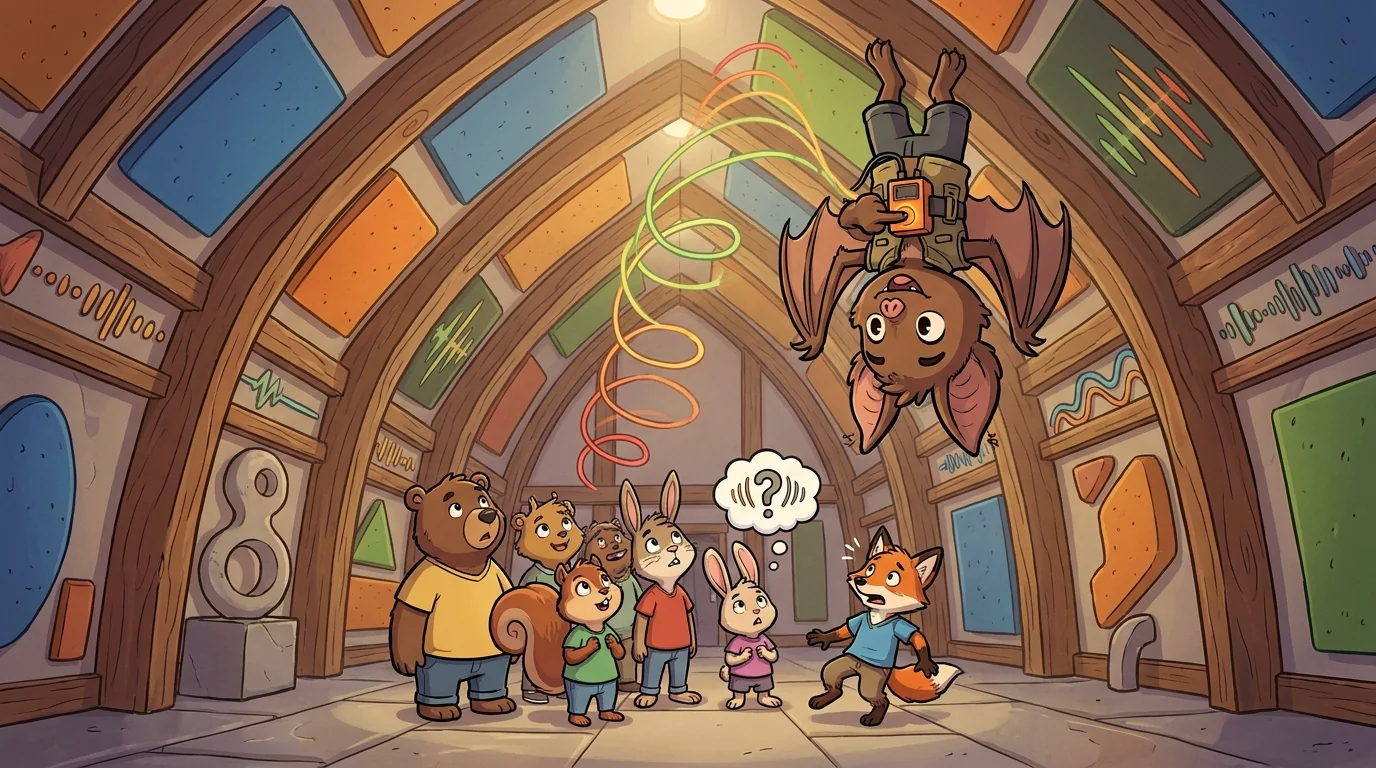
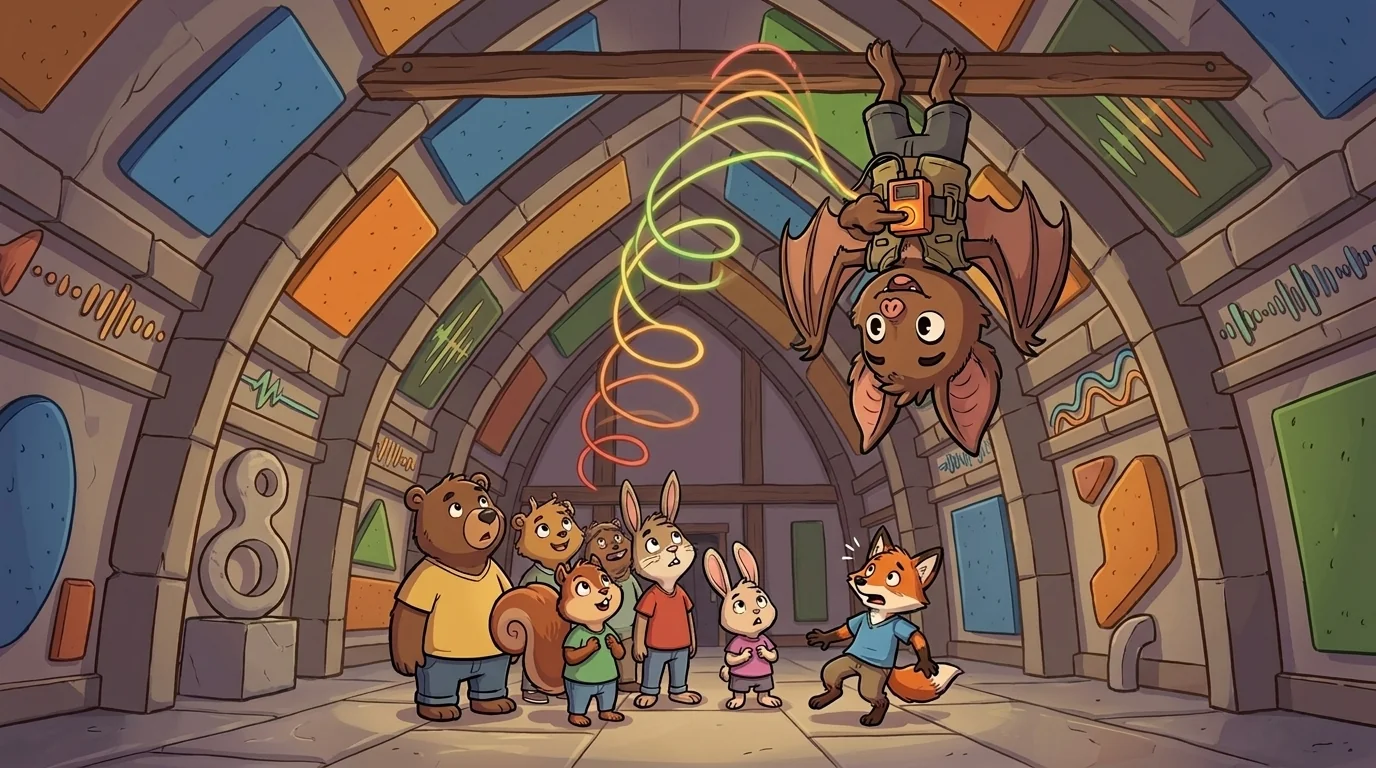
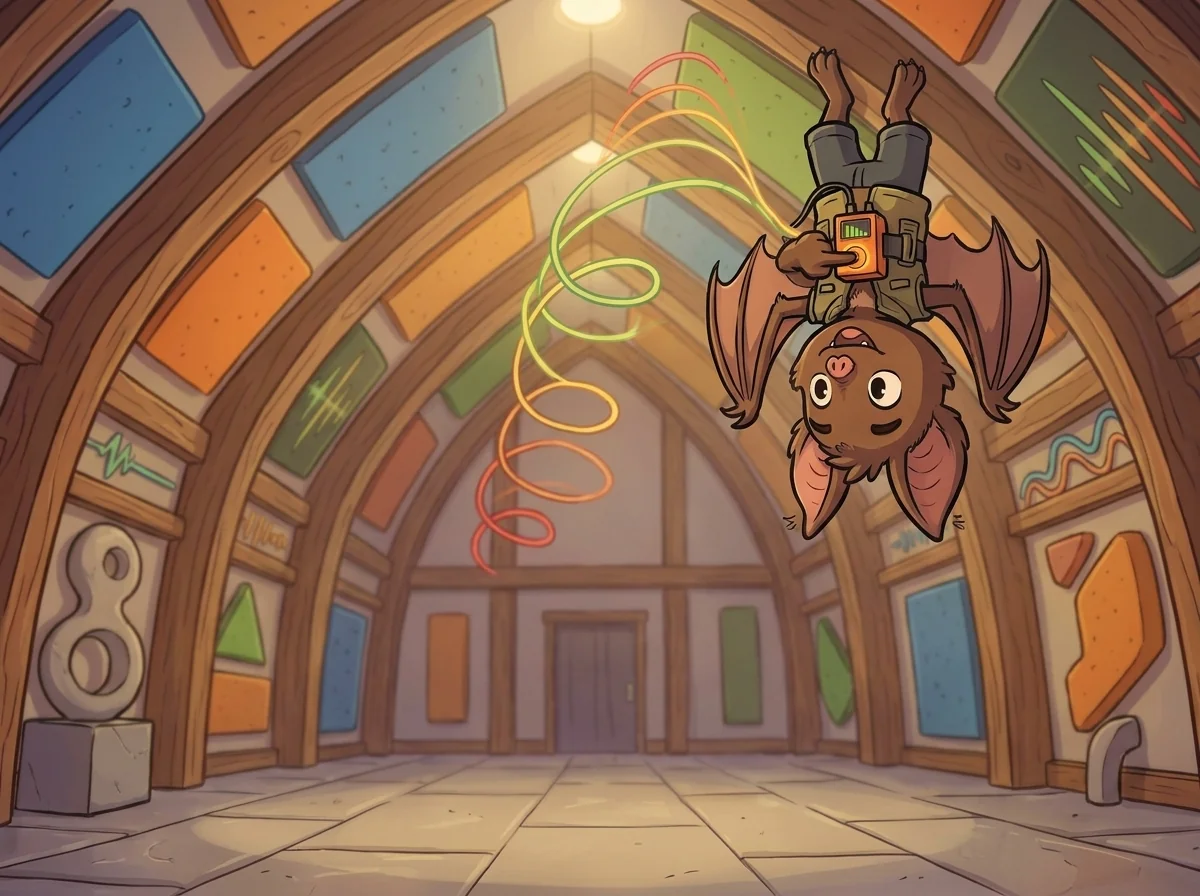
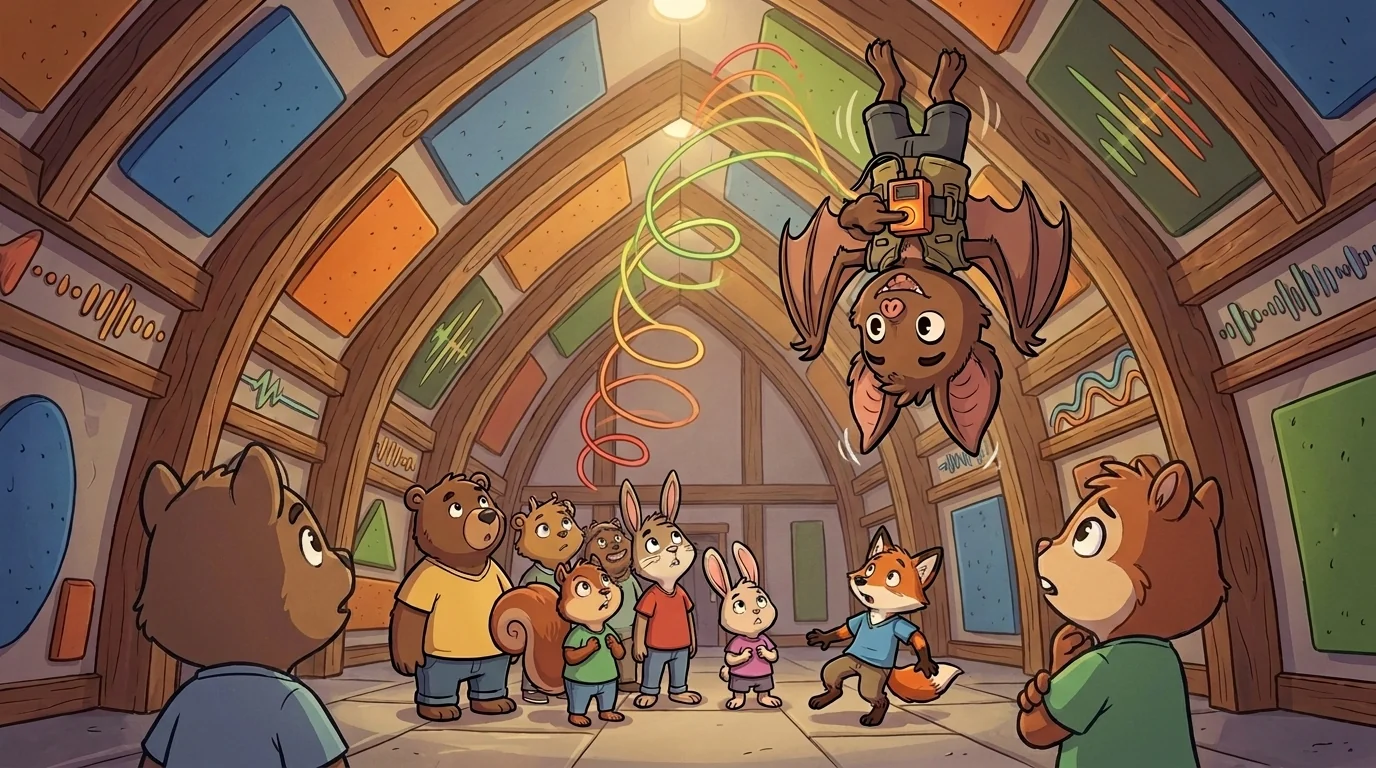
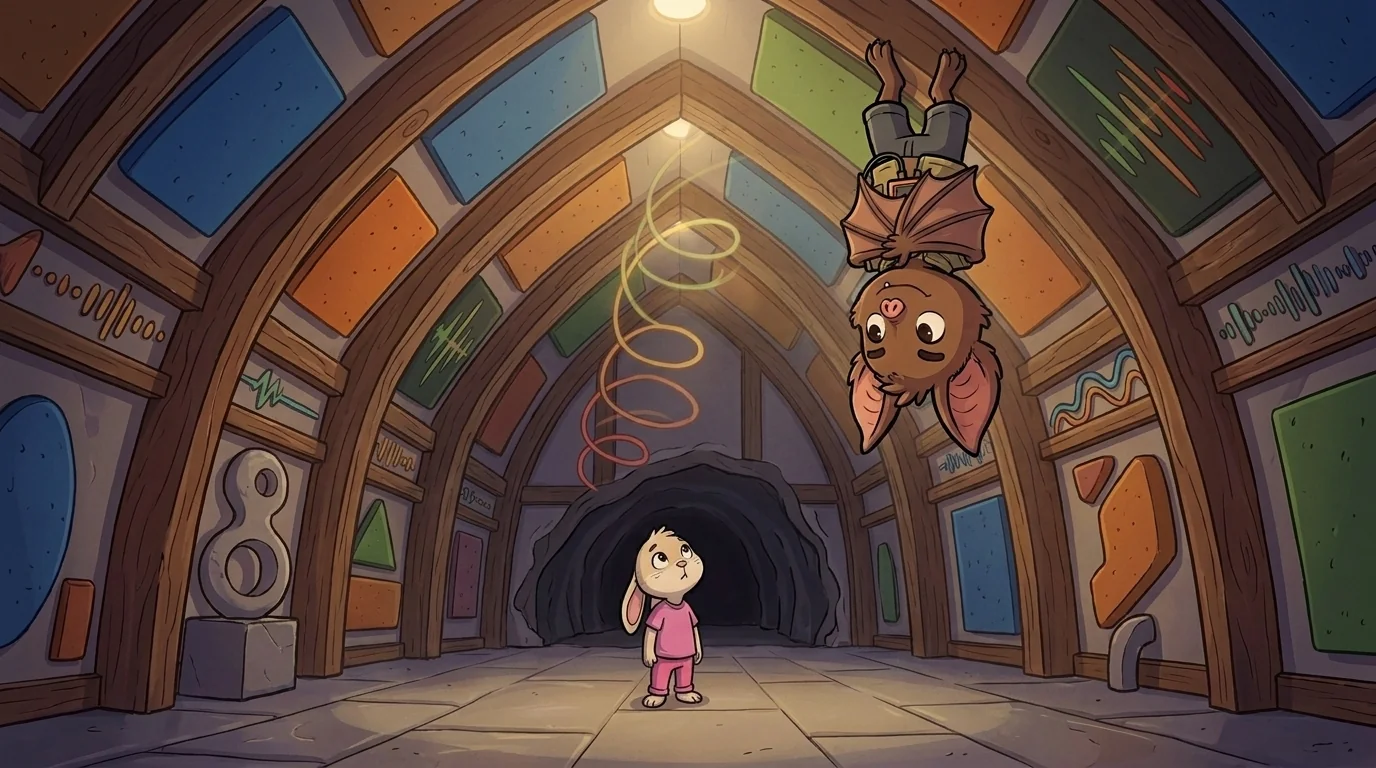
In the echo-hall at IllusionForge, a small fruit-bat-tween named Cue hung upside-down from a beam and played a single tone that climbed, and climbed, and would not stop climbing.
He tapped the little box strapped to his audio-vest. The note slid upward — higher, higher, straining toward some ceiling it never reached. Cue let it run for a full minute. A cluster of students below tipped their heads back, following the tone up like it was a staircase into the rafters.
"When does it stop?" one of them whispered.
"It doesn't," Cue said, still hanging, soft ear-tufts twitching. "It only sounds like it's going up. Overall, it hasn't gone anywhere at all. It's the same handful of pitches, layered so your ear keeps grabbing the rising one and letting the low one fade out." He flicked the box off mid-climb. The tone vanished, and the students flinched like a stair had been pulled out from under them.
"You heard it climbing," Cue said gently. "But your ears didn't measure a climb. They built one. That's the whole secret of my workshop, and I've been chasing it since I was very small: your ears don't just catch the world. They guess it. And sometimes they guess something that was never in the air at all."
Cue had learned that in the dark, before he could fly properly.
His family were echo-readers for the cave-village — fruit-bats who sent little clicks into the black and listened to what came back. One night, small and clumsy, he'd sent a click down a tunnel and heard a wall right in front of him. He'd stopped cold, heart hammering, certain he was about to smack his nose into stone.
There was no wall. Just open air, and further down, a bend that had folded the echo back strangely.
"I heard it," he'd told his grandmother afterward, embarrassed and a little scared. "I heard a wall. It felt so real. Was I lying to myself?"
She'd hung beside him, warm and unbothered. "You weren't lying. You were listening honestly. But listening isn't catching, little one. Your ears took the echo and built a picture — and this time the picture was wrong." She clicked once, softly. "That doesn't make your ears broken. It makes them builders. Every wall you ever hear, you're building. Most of the time you build it right and you never notice you were building at all."
Cue had sat with that a long time. The scared, tricked feeling didn't go away, but it changed shape. It stopped being I can't trust myself and became something stranger and better: my ears are making the world, all the time, and I never even catch them doing it.
He walked to IllusionForge at twelve, because a place that studied how senses fool people ought to know that the ear fools you too.
Veil, the mentor, met him at the door and asked one question. "What are auditory illusions?"
Cue didn't lecture. He unclipped a small speaker, played six thin overtone notes stacked together, and looked up. "What note is that?"
"A low one," Veil said. "A deep bass note."
"There's no bass note in there." Cue turned the speaker so Veil could see the readout — only the high overtones lit, the low fundamental dark and silent. "The deep note you're hearing isn't playing. Your brain heard all its overtones and filled in the bass that should be under them. You inferred a sound that isn't there. Your hearing is construction, same as your seeing."
Veil was quiet, listening to a note that didn't exist. "You belong here," he said.
Cue's workshop was full of sounds that weren't quite what they seemed.
A girl came in one afternoon, arms crossed, skeptical. "My eyes get fooled, sure. But ears just hear what's there. Sound is sound."
"Watch a screen with me," Cue said. He played a clip: a face saying ga, ga, ga. "What do you hear?"
"Da," she said. "Da, da, da."
"Now close your eyes. Same clip." She did. Her face shifted. "...Ba? It's saying ba now."
"The audio never changed," Cue said. "It was always ba. But with your eyes open, you watched the lips make a ga shape — and your brain smashed the two together and handed you da, something neither one ever said. Open your eyes: your eyes rewrote your ears. Close them: your ears got their say back."
The girl uncrossed her arms slowly. "That's — I did that? I made up da?"
"Your brain did, in about a tenth of a second, without asking you." Cue tapped a rhythmic pulse of frequencies, and a faint melody seemed to swim up out of it. "There's no tune in that. Just pulses. But hang around long enough and you'll swear you hear a song — your ear stitching the beats into a shape it likes." He grinned. "Every sense you've got is doing this. Not just your eyes. Hearing, touch, taste — none of them are pure measuring. They're all guessing, all building, all the time. The world you live in is a really, really good guess."
Later, when the hall was empty, the girl came back with a quieter question.
"If my ears just make stuff up," she said, "how am I supposed to trust anything I hear?"
Cue folded his wings and thought about the tunnel, and the wall that wasn't there, and how scared he'd been.
"You trust it the way you trust a good friend who's usually right," he said. "Your ears build the world for you almost perfectly, almost every time. The illusions aren't proof they're broken. They're the seams — the little places where you catch your own brain in the middle of making something. And honestly?" He looked out toward the dark of the caves. "The first time you feel it — that jolt of wait, that wasn't real, I built that — it's scary. Then it turns into the best feeling I know. Because it means the whole rich, loud, beautiful world isn't just landing on you. You're helping make it. Every sound you've ever loved, you built a little of it yourself."
The girl smiled, uncertain and delighted at once, and Cue watched the same wonder settle onto her that had settled onto him in the dark, years ago — the strange comfort of a mind that never stops quietly building.
The IllusionForge ensemble
Cue is part of IllusionForge's distributed-narrative cast. Each character embodies a different curricular primitive; together they teach the full subject.
-

Fade
The afterimage / persistence-of-vision — the visual trace left after a stimulus is removed (the foundation of animation, film, and many magic tricks)
-
Stack
The perspective trap — the geometric arrangement that misleads size and depth judgments (Müller-Lyer, Ponzo, Ebbinghaus, vanishing-point depth cues)
-
Notch
The impossible figure — the figure that locally reads as coherent but globally cannot exist (Penrose triangle, Escher staircase, blivet)
-

Loop
The perceptual loop — the recursive / endless / barber-pole motion illusion (the mechanism that makes the brain see motion that can't end)