Loop
PERCEPTUAL LOOP — the recursive / endless / barber-pole motion illusion. the brain sees motion that can't end.
Loading audio…
Press play to listen along. The line being read lights up as you go.
Show full transcript
Loading transcript…
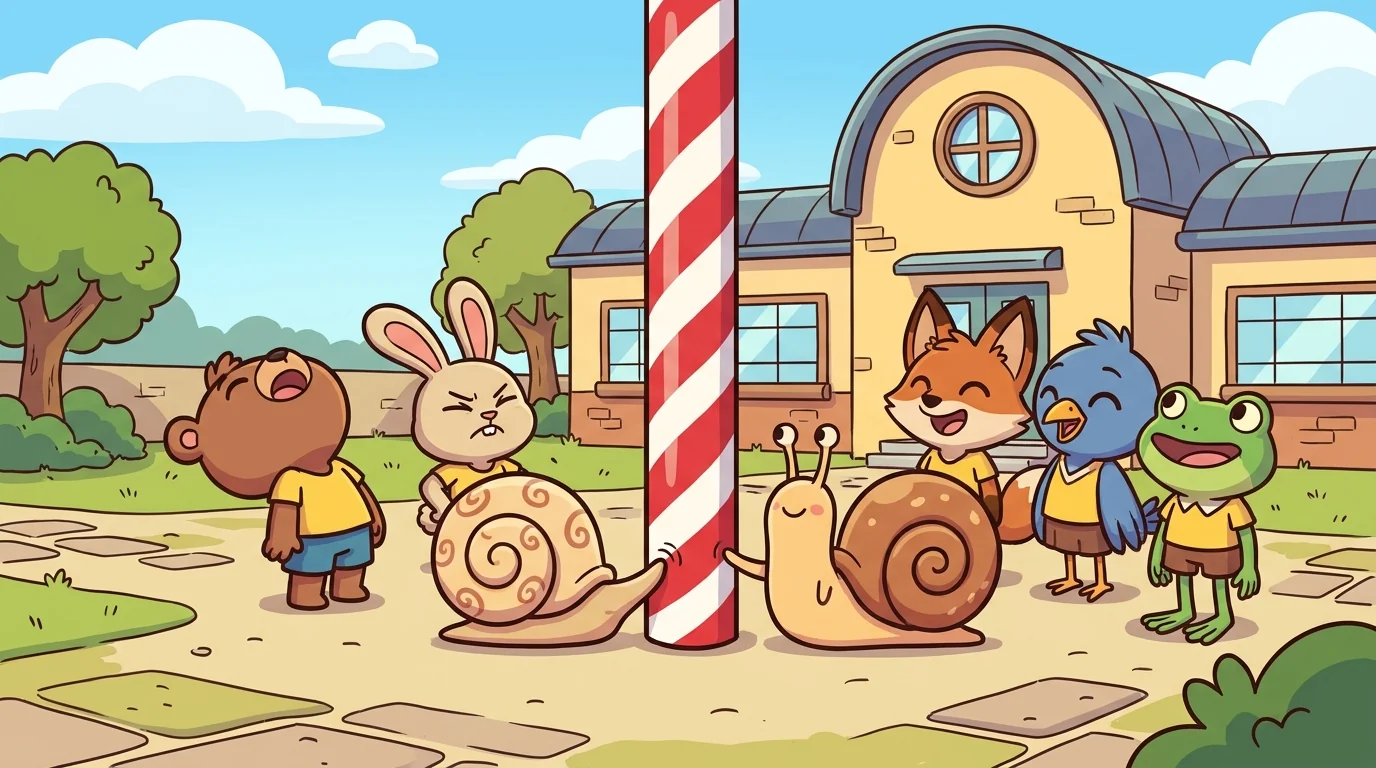
In the middle of the courtyard, a small snail with a spiral-marked shell was making a striped pole climb into the sky, even though the pole wasn't going anywhere.
Loop had propped the pole upright and set it slowly spinning. Diagonal stripes wound up around it like a candy cane. And as it turned, the stripes seemed to march upward — up and up, off the top, forever, feeding an endless supply of stripe out of thin air.
A cluster of younger students had stopped to gawk. One of them tipped his head back and back, following the climb, until he nearly fell over.
"It's going up," he said. "Where's it all going?"
"Nowhere," Loop said. "It's a pole. It's spinning in a circle. Nothing on it is moving up at all."
"But I can see it—"
"I know." She sounded delighted, not sorry. "Keep watching. Try to make it stop climbing."
He tried. He squinted, he frowned, he ordered his own eyes to knock it off. The stripes kept climbing. He made a small strangled noise and everyone laughed.
"You can't switch it off, can you?" Loop said gently. "Your eyes have their own little watchers inside — motion-catchers. They don't see the whole pole. They see one small patch, and the stripe in that patch is sliding sideways-and-up. So they shout up! And they keep shouting it, patch after patch, and your whole head believes them." She reached out and stilled the pole with one soft tap. The climbing stopped instantly. "There is no top. There is no bottom. There's just a circle, dressed up to feel like forever."

Loop had grown up in the spiral-shell village, where every snail carried a curl of endlessness on its own back.
When she was small, she used to trace the line of her own shell with a fingertip, round and round, following the spiral inward. It went in, and in, and in — tighter, smaller — and there was never a place where it ended. It just got too small for her finger to follow. It made her chest go funny. A line with no end, right there on her own body, and she was carrying it everywhere.
"Grandmother," she'd said once, dizzy from tracing, "does my shell stop somewhere? Or does it go forever?"
Her grandmother had been an old snail with a slow, warm way of talking. She'd looked at Loop's shell for a long moment. "It stops, little one. Everything real stops. But the pattern doesn't need to." She traced her own spiral, round and inward. "The shape is just a curl that keeps curling. Your eye follows the curl and expects more curl — so it feels endless, even though the shell is small enough to hold in a hand." She smiled. "The endlessness isn't in the shell. It's in the way you follow it."
Loop stopped feeling dizzy after that, mostly. The no-end feeling still came, but now it had a shape she could hold: the endlessness lived in the following, not in the thing. That, somehow, made it something to enjoy instead of something to fall into.
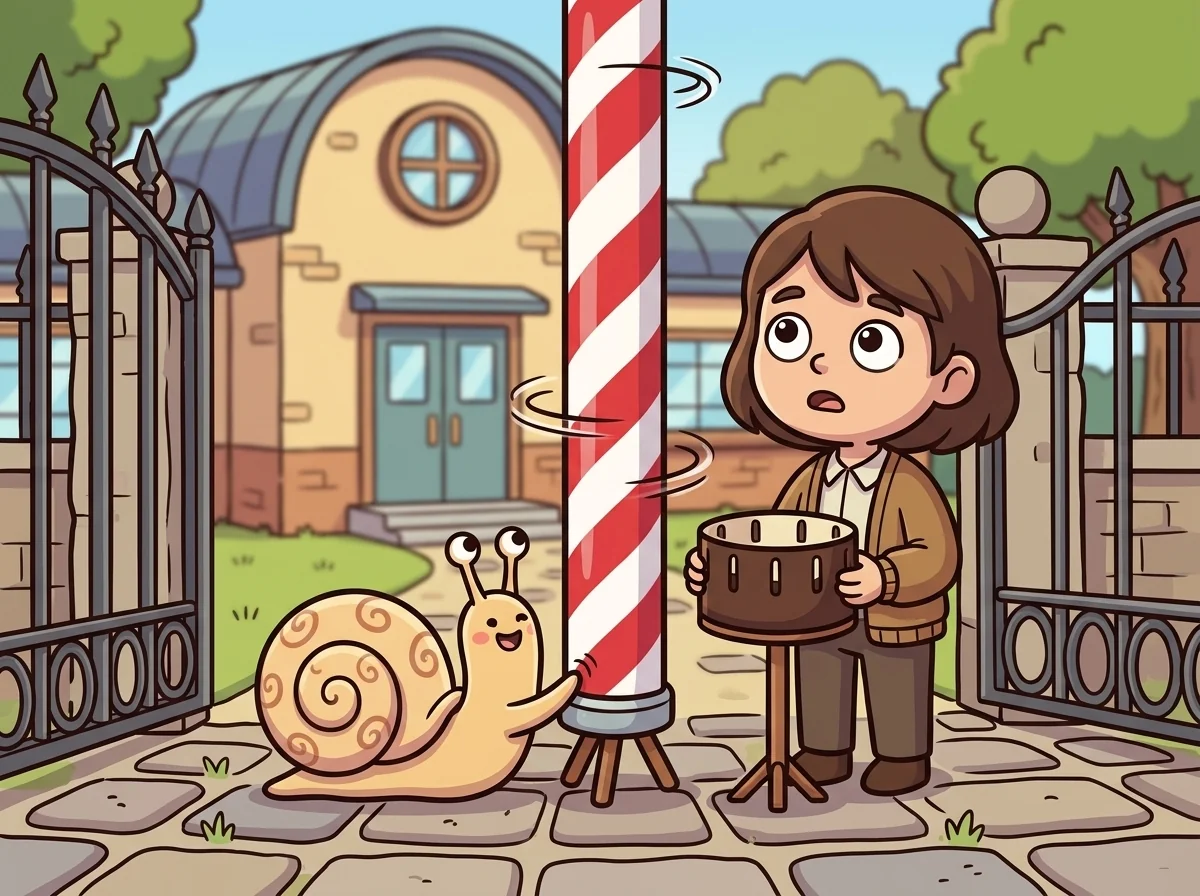
She walked to IllusionForge at twelve, carrying a spinning barber-pole and a little slotted drum, because a place that studied how eyes get fooled ought to understand the trick of forever.
Veil, the mentor who ran the studios, met her at the gate and asked one question. "What is a perceptual loop?"
Loop didn't explain. She set the striped pole spinning between them and let it climb. Veil's eyes went up with it, up and up, and stayed there.
"It's climbing," Veil said.
"It's turning," Loop said. "Your motion-catchers see the stripe slide in one small spot and cry up. Do it enough spots at once and the whole thing looks like it's pouring upward with nowhere to pour from." She stopped the pole. Veil's gaze snapped back down, a little startled. "The forever isn't real. It's built — one small honest signal at a time, stacked into a lie your eyes love."
Veil watched the still pole for a long moment, then looked at the snail who'd made forever out of a circle. "You belong here," she said.
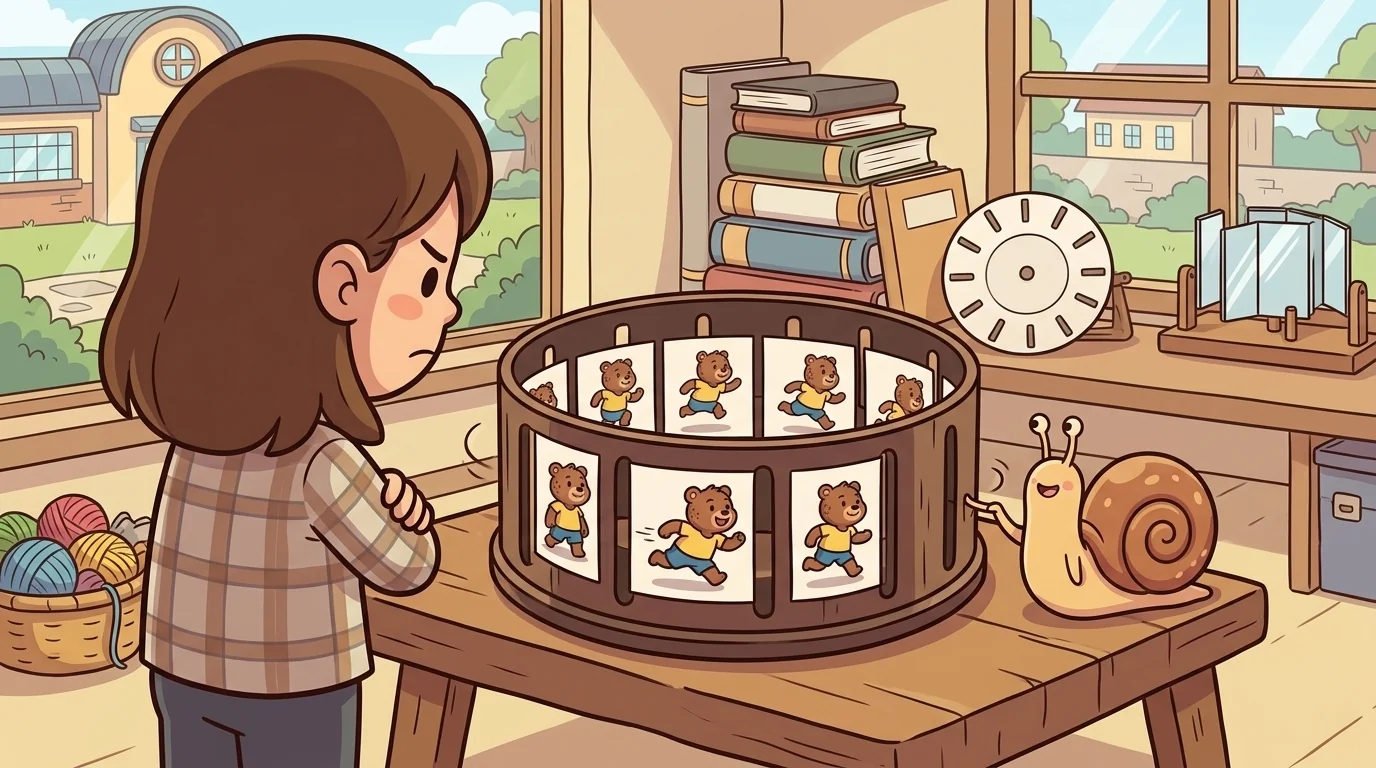
Loop's studio was full of things that seemed to move and didn't.
A girl came in one afternoon, arms crossed, cross about it. She'd been staring at a spinning slotted drum full of little drawings, and now she felt tricked and a bit sick. "It looked like a horse running," she said. "It's just paper. There's no horse. I feel stupid for believing it."
Loop knew that particular crossness. She'd felt it, dizzy, tracing her own shell.
"Spin it again," she said, "but this time, don't look through the slots. Look at the drawings straight on."
The girl did. Just a ring of still paper horses, each frozen in a slightly different pose. No running. No motion. Nothing.
"Now the slots."
The girl leaned in through the slits — and the horse galloped. She jerked back. "How—"
"Each slit shows you one still horse for a blink, then hides it, then shows you the next one. Your eyes hold each blink a heartbeat too long, so they overlap." Loop tapped the drum. "Still picture, still picture, still picture — and your brain sews them into a run. You didn't believe a lie. Your eyes did exactly their job, and their job is to fill in the moving." She grinned. "That's not being fooled. That's the same trick every cartoon you've ever loved is built from. You just caught it with the lights on."
The girl looked back through the slits, at her galloping paper horse, and this time she laughed instead of flinching.
Later, when the studio was quiet, the girl came back with one more question, softer now.
"When it looks like it's moving," she said, "and I know it isn't — which one do I believe?"
Loop thought about her shell. About the spiral with no end, and the dizzy chest, and her grandmother's slow warm voice.
"Both, a little," she said. "Your eyes aren't lying to you — they're telling you the honest, patch-by-patch truth they can see. It's just that the whole picture is bigger than any one patch, and the whole picture is a circle, or a stack of stills, or a curl that keeps curling. The forever-feeling is real as a feeling. It's just not out there in the world." She looked toward the window, where her barber-pole stood quiet. "That funny pull in your stomach when something climbs and climbs with nowhere to go — that's your eyes and your knowing having a friendly argument. You don't have to win it. You can just stand in the middle and enjoy the fact that you get to see the seams."
The girl nodded slowly, and Loop watched the crossness slide off her shoulders — the way, years ago, her own dizziness had finally settled into wonder.
The IllusionForge ensemble
Loop is part of IllusionForge's distributed-narrative cast. Each character embodies a different curricular primitive; together they teach the full subject.
-

Fade
The afterimage / persistence-of-vision — the visual trace left after a stimulus is removed (the foundation of animation, film, and many magic tricks)
-

Stack
The perspective trap — the geometric arrangement that misleads size and depth judgments (Müller-Lyer, Ponzo, Ebbinghaus, vanishing-point depth cues)
-
Notch
The impossible figure — the figure that locally reads as coherent but globally cannot exist (Penrose triangle, Escher staircase, blivet)
-

Cue
The auditory illusion — the sound-perception mechanism (Shepard tones, McGurk effect, phantom-melody, missing-fundamental)