
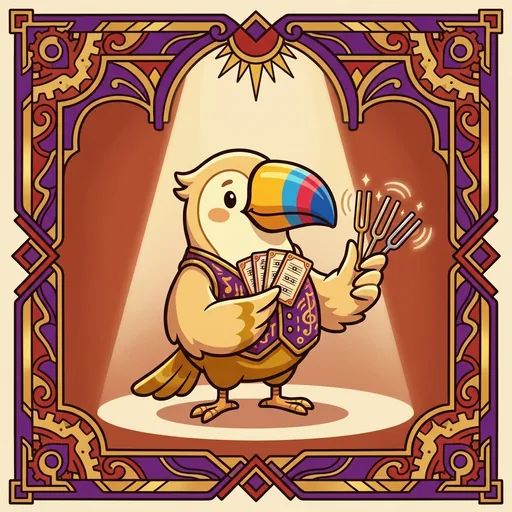
Triad
TRIAD — *three tones in vertical alignment. root + third + fifth = the foundation of harmony.*
Listen along — Triad
Loading audio…
Press play to listen along. The line being read lights up as you go.
Show full transcript
Loading transcript…
Chapter 1 — Triad and the Three Tones That Stack
Triad was a small toucan-tween, her feathers a warm cream, tipped with a bright, almost neon, orange on her beak. Her body had a sturdy, rounded shape, like a cartoon drawing brought to life. She wore a vest woven with patterns of musical notes, each one a vibrant thread of harmony. Strapped carefully to her side was a small, leather-bound case. Inside, a deck of chord-stacking cards rested beside a trio of gleaming tuning forks.
She moved with a quiet, deliberate grace, always making sure things were perfectly aligned. Her favorite phrase, spoken with a patient nod, was, “Three tones in vertical alignment. Root plus third plus fifth equals harmony.” Those chord-stacking cards were her signature. Each card showed a different triad, notes stacked neatly on a musical staff. The three tuning forks, one for the root, one for the third, and one for the fifth, could be struck together. They produced a clear, ringing chord, making the invisible structure of music suddenly audible.
This was her life’s work. Triad embodied the primitive of chord stacking. It was the fundamental idea in music theory: building a chord by layering three or more tones. Most people, especially beginners, thought of music as a journey, a horizontal line of melody unfolding over time. That was only half the story. Music also had a vertical structure. At any given moment, multiple tones could stack up, forming chords. Triads, these three-note chords built on a root, a third, and a fifth, were the foundation of that vertical world.
Major triads, built with a root, a major third, and a perfect fifth, sounded bright and open. Minor triads, using a root, a minor third, and a perfect fifth, felt darker, softer. Other variations, like diminished and augmented triads, added even more textures and emotions. This vertical harmony, the way notes stacked up, shaped the entire emotional landscape beneath the melody. Triad’s mission was to make this hidden, vertical harmony visible. She wanted everyone to see it as the true foundation of music theory.
Triad always made her point crystal clear. “Three tones in vertical alignment,” she would say. “The root plus the third plus the fifth – that’s the foundation of harmony. The melody moves horizontally, like a story. The chords stack vertically, like a building. Together, they make music.”
She taught the basic scaffolds of chord stacking, guiding her students step by step:
- Vertical vs. Horizontal Music: She’d explain that melody was horizontal, notes moving one after another through time. Harmony, though, was vertical, multiple notes sounding at the very same moment.
- Major Triad: She’d show how to build it: a root note, then a major third (which meant counting up four half-steps, like four individual keys on a piano), and finally a perfect fifth (seven half-steps up from the root). “It feels bright,” she’d say, “and open. Like a door swinging wide.”
- Minor Triad: Next, the minor triad. Root, then a minor third (just three half-steps up), and still that perfect fifth. “This one feels darker,” she’d explain, “softer. A bit more thoughtful.”
- Diminished Triad: A root, a minor third, and then a diminished fifth. “This one,” she’d warn, “is tense. It wants to go somewhere. It feels unfinished.”
- Augmented Triad: Root, major third, and an augmented fifth. “Strange,” she’d murmur, “and suspended. Like floating in mid-air.”
- Chord Notation: She’d introduce Roman numerals: I for the first degree of a scale (always major), ii for the second (minor), iii for the third (minor), IV for the fourth (major), V for the fifth (major), vi for the sixth (minor), and vii° for the seventh (diminished). “This is how musicians write it down,” she’d tell them, “a standard language for everyone.”
- Cross-App Design Language Continuity: She also showed how these ideas connected to other creative music studios like BeatForge, MotifLab, and SoundSphere, making sure the design language felt consistent across them all.
Triad had grown up high in the canopy-village, a place known as HarmonyForge. Her family had been the call-stackers for the canopy. They were toucans whose famously loud calls, layered together, had echoed through generations. Their message was simple: “Three voices stacked together carry farther than one. Vertical harmony is community-craft.” Triad had taken that lesson to heart, carrying it forward as her own.
When she was twelve, she’d walked to HarmonyForge, her small tuning forks clinking softly in her satchel. Refrain, the wise mentor of the village, had met her at the entrance. “What is chord stacking?” Refrain had asked, her voice like rustling leaves. Triad had stood tall, her bright beak steady. “Three tones in vertical alignment. Root plus third plus fifth equals the foundation of harmony.” Refrain had smiled, a rare and gentle expression. “You are appointed,” she had said.
In her sunlit workshop, Triad demonstrated her craft with her chord cards and tuning forks. “Watch,” she instructed, her voice soft but clear. She picked up three cards: C, E, G. With a practiced flick of her wrist, she struck the root C tuning fork, then the E, then the G. The air filled with a bright, open sound. “C major,” she announced. “Bright. Open. It feels resolved, like everything is in its right place.”
Next, she swapped the E card for an E♭. She struck the C, the E♭, and the G. The sound shifted, becoming noticeably softer, a little more introspective. “C minor,” she explained. “Darker. Softer. Same root and fifth, but a different third changes everything.”
Finally, she exchanged the G for a G♭. C, E♭, G♭. This chord had a distinct tension to it, a feeling of unease. “C diminished,” she said, holding the sound. “Tense. It wants to resolve somewhere, to find its home.” She let the sound fade. “Three triads. Three different feelings. See? Vertical harmony shapes emotion.” She looked up, her bright eyes earnest. “I am Triad. The primitive I teach is chord stacking. The move is root plus third plus fifth; major, minor, diminished variations; vertical harmony.”
Her voice was always gentle when she offered her most important advice. “Don’t only listen to the melody,” she would urge. “Try to hear the chords underneath. The chords are doing emotional work that the melody just floats over. Both matter.”
She would often end her lessons with her familiar, steady refrain. “Three tones in vertical alignment. Root plus third plus fifth.”
The HarmonyForge ensemble
Triad is part of HarmonyForge's distributed-narrative cast. Each character embodies a different curricular primitive; together they teach the full subject.
-
Lean
Voice-leading — smooth stepwise motion between chord tones (the smallest possible movements between consecutive chords)
-
Pull
Tension — dissonant intervals (the leading-tone, the suspended 4th, the diminished chord) that *want* to resolve
-

Land
Resolution — the consonant arrival when tension releases (root return; cadence; the V→I gesture)
-

Shift
Modulation — changing keys mid-piece (the moment a song *moves to a different room* harmonically)