
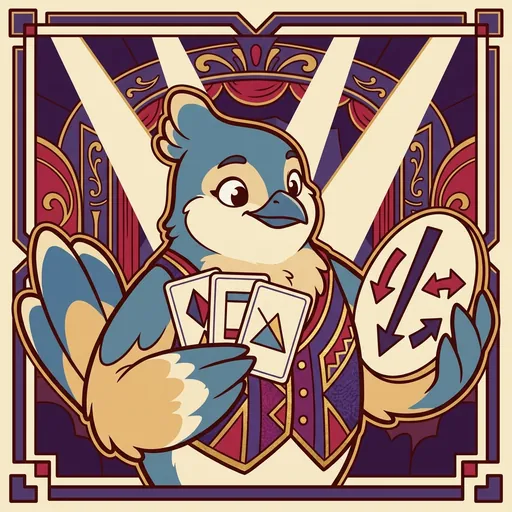
Pull
PULL — *dissonant intervals that want to resolve. tension is the engine of harmonic motion.*
Listen along — Pull
Loading audio…
Press play to listen along. The line being read lights up as you go.
Show full transcript
Loading transcript…
Chapter 3 — Pull and the Sound That Wants Somewhere
Pull leaned over her chime-harp and struck one bright note, then another right beside it. The two sounds rubbed together and made a small, itchy buzz that filled the workshop. A younger bird near the door winced.
“You feel that?” Pull asked, not looking up. She was a little bowerbird with soft blue and cream feathers and a crest that stood up when she got excited. It was standing up now. “That buzz. Everybody thinks it’s a mistake.”
She let the two notes hang for one more second — long enough that the whole room shifted in their seats — then she moved the higher note up a step. The buzz melted into a warm, round hum. Shoulders dropped all around the room. Somebody let out a breath.
“It’s not a mistake,” Pull said, grinning. “It’s a magnet.”
Pull had learned about magnets a long time before she ever touched a harp. She grew up in the bower-glade, where her whole family built nests — not plain nests, but wild, glittering ones, stacked with blue bottle-caps and shiny leaves and one crooked spoon.
“Why the crooked spoon?” she’d asked her grandmother once, when she was very small.
Her grandmother had tilted her head. “Because it doesn’t fit,” she said. “Watch who stops to look.”
And birds did stop. They flew past a hundred tidy nests without slowing, then froze mid-hop at the one that had something a little off in it — a little tension, a little wrongness that pulled the eye. Pull remembered standing beside the finished bower, feeling the itch of that crooked spoon herself. It bugged her. And because it bugged her, she couldn’t look away.
That was the day she understood: the thing that doesn’t quite settle is the thing that makes you lean in.
When Pull was twelve, she walked the long path to HarmonyForge with her dissonance cards tucked under one wing. Her mentor, Refrain, met her at the gate and asked only one question.
“What makes music move forward?”
Pull thought of the crooked spoon. “Something that wants to go somewhere,” she said. “A note that clashes a little, so your ear leans toward the calm one.”
Refrain didn’t smile right away. “Show me.”
Pull pulled out a card, hummed a low note, then hummed a second one a hair too close. The gate-post air went tight and buzzy. She held it. Refrain’s feathers ruffled. Then Pull slid the second note down, and the buzz dissolved into a sigh.
Now Refrain smiled. “Come in,” she said. “You’ll be teaching the ones who think the buzz is broken.”
In her workshop, Pull spread three cards on the table and called the students close.
“Three magnets,” she said. “Watch the first one.” She played a single high note that sounded bright but lonely, like it was reaching for something. “That’s the leading tone — the seventh step. In C major it’s a B, and it is dying to get to the C above it. Listen.” She played the C. The lonely note snapped home like a key into a lock. A girl in front whispered, “Ohh.”
“Second one.” Pull played a chord, then let one note from it hang over into the next chord, where it didn’t belong. It clashed, gentle and strange. “That’s a suspension. It’s holding its breath.” She held it, and held it, until a boy in the back squirmed — and then she let the note drop one step. Everybody exhaled at the same time. “There. Let go.”
“Third.” She played a chord that wobbled, thin and unstable, like a tower of blocks tipping. The whole room tensed. “This one’s begging,” Pull said. “It’ll fall toward anything steady.” She played a solid chord underneath it and the wobble caught, settled, held. Shoulders came down all around the table.
“Three itches,” Pull said softly. “Three places they wanted to land. Three little sighs of finally.”
The girl in front raised a wing. “But if it clashes… isn’t that the wrong note?”
Pull sat down on her stool so she was eye-level with her. She thought about the crooked spoon, and the birds that couldn’t fly past it.
“Here’s a secret,” she said. “The clash is the reason you kept listening. If everything was calm the whole time, your ear would fall asleep. The buzz is what makes you lean in and wonder — where’s it going to go? And then, when it lands—” she played the leading tone and let it rise home one more time “—that feeling in your chest, the little unclench, the ahh—”
She stopped. Her crest settled slowly down.
“That’s it,” she said quietly. “That warm drop in your shoulders when the sound finally arrives. That’s the whole reason I love the itchy notes. You can’t feel the landing if you never felt the reach.”
The room was quiet. Somewhere a chime-harp was still humming, calm and steady, and every bird in it felt lighter than they had a minute before.
The HarmonyForge ensemble
Pull is part of HarmonyForge's distributed-narrative cast. Each character embodies a different curricular primitive; together they teach the full subject.
-

Triad
Chord-stacking — three tones in vertical alignment (root + third + fifth = the foundation of harmony)
-

Lean
Voice-leading — smooth stepwise motion between chord tones (the smallest possible movements between consecutive chords)
-

Land
Resolution — the consonant arrival when tension releases (root return; cadence; the V→I gesture)
-

Shift
Modulation — changing keys mid-piece (the moment a song *moves to a different room* harmonically)