
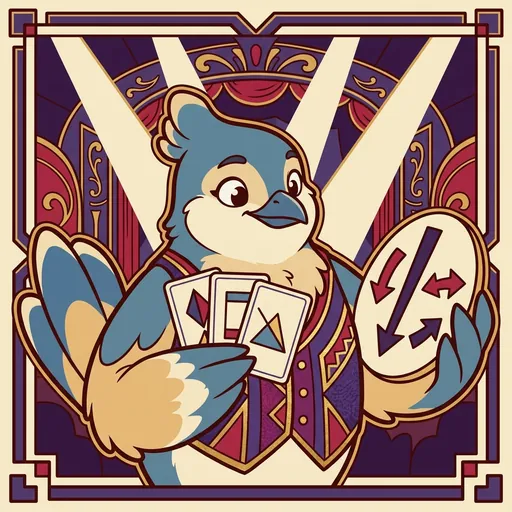
Pull
PULL — *dissonant intervals that want to resolve. tension is the engine of harmonic motion.*
Listen along — Pull
Loading audio…
Press play to listen along. The line being read lights up as you go.
Show full transcript
Loading transcript…
Chapter 3 — Pull and the Sound That Wants Somewhere
The first thing anyone noticed about Pull was her vest. It was a patchwork of bright, primary colors, sturdy and vibrant, like a character sprung from a favorite animation. Her small, warm-blue-and-cream feathers, topped with a soft crest, seemed to vibrate with a deep curiosity. She wasn’t just curious about anything; Pull was fascinated by tension—the way things pulled against each other, the way sounds yearned for a landing.
She always carried her tools: a small set of dissonance-cards and a tension-arrow-board. The cards weren’t just pretty pictures. Each one showed a dissonant interval—a leading-tone, a suspended fourth, a diminished chord. These were the notes that didn’t quite fit, the ones that made your ears perk up. And on her arrow-board, tiny, glowing indicators showed the exact direction that tension wanted to move. Up, down, or just anywhere stable.
Pull believed tension was the engine of everything. “Tension is the engine of harmonic motion,” she would often say, her voice clear and firm. “Dissonance wants to resolve.” She didn’t see dissonance as a mistake, like many beginners did. For Pull, it was a deliberate choice, a powerful force. It was the craft of using those unsettling notes intentionally to create movement, to push the music forward. Without that push, music would just sit still, a pretty but lifeless thing.
She knew this deep in her bones. Pull had grown up near the bower-glade, a place where bowerbirds built elaborate structures to attract mates. Her family had been bower-builders for generations. They understood that to draw attention, you had to create something interesting, something that held a little tension. A perfect, symmetrical bower was nice, but one with a surprising twist, an unexpected curve, or a brightly colored object placed just so—that was what truly captured the eye. It created a pull, a curiosity that demanded attention.
“Grandma Wren always said,” Pull remembered, her eyes distant for a moment, “If it’s too neat, no one looks. You need a little something that makes them wonder. That’s the tension. It creates motion, and then the resolution satisfies. The dance between is the song.” Pull had carried that lesson forward, applying it to the world of sound.
When she was twelve, Pull walked to HarmonyForge. Refrain, the wise mentor, had met her at the gate. “What is tension?” Refrain asked, her voice like wind chimes.
Pull didn’t hesitate. “Dissonant intervals that want to resolve,” she answered, holding up a card. “Tension is the engine of harmonic motion.”
Refrain smiled, a slow, knowing expression. “You are appointed,” she said.
In her workshop, Pull loved to demonstrate. She stood before a small keyboard, her dissonance-cards fanned out on a stand. “Watch,” she said, her finger hovering over the keys. She pressed a B, the seventh note of the C major scale. It hung in the air, bright and clear, but with a subtle lean, a feeling of incompleteness. “Hear it?” she asked. “That B is the leading tone. It wants to land on C. It pulls strongly, like a magnet.” Then she pressed the C. The sound settled, a sigh of arrival. “Tension built; resolution earned.”
Next, she played a chord, then held one note, an F, over a change to a new chord. The F clashed, a gentle but definite rub against the new harmony. “This is a suspension,” she explained. “The note is held over, creating dissonance.” She let the F hang, creating a moment of expectation, before resolving it smoothly down to an E. “Suspended, then released. A different kind of pull, a gentle letting go.”
Finally, she struck a diminished chord. The sound was sharp, brittle, almost unstable. It felt like it couldn’t stay where it was, like a house of cards about to tumble. “Highly unstable,” Pull said, her eyes gleaming. “It wants anywhere stable. It’s a strong pull, a real yearning for solid ground.” She then played a C major chord, and the diminished sound melted into it, finding its peace.
“Three tensions,” Pull said, gesturing to her cards. “Three resolutions. And three different feelings of arrival. That’s how music tells emotional stories. It creates expectation, then delivers satisfaction.” She looked at her students, her expression earnest. “I am Pull. The primitive I teach is tension / dissonance. The move is: tension creates motion; resolution satisfies; the dance is the song.”
She picked up a dissonance-card, turning it in her fingers. “Don’t ever think dissonance is ‘wrong’,” she said gently. “It’s intentional. The composer uses tension to drive the music forward. Tension is your friend.”
She tapped her tension-arrow-board, the little lights glowing. “Tension is the engine. Dissonance wants to resolve.”
The HarmonyForge ensemble
Pull is part of HarmonyForge's distributed-narrative cast. Each character embodies a different curricular primitive; together they teach the full subject.
-

Triad
Chord-stacking — three tones in vertical alignment (root + third + fifth = the foundation of harmony)
-
Lean
Voice-leading — smooth stepwise motion between chord tones (the smallest possible movements between consecutive chords)
-

Land
Resolution — the consonant arrival when tension releases (root return; cadence; the V→I gesture)
-

Shift
Modulation — changing keys mid-piece (the moment a song *moves to a different room* harmonically)