
Vigil
VIGIL — *look every day. don't pluck what's working. plants are patient teachers.*
Listen along — Vigil
Loading audio…
Press play to listen along. The line being read lights up as you go.
Show full transcript
Loading transcript…
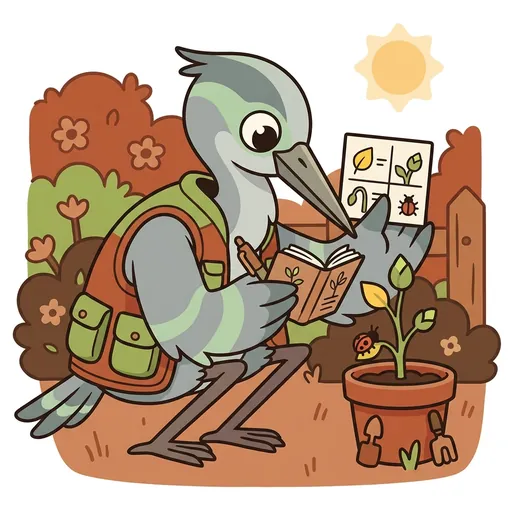
Vigil moved with a quiet grace, like a heron wading in a shallow pond. They were small, steady, and always seemed to be watching. Their garden vest, a soft leaf-green striped with cool stone-grey, held a small observation journal and a stack of symptom cards. Vigil believed plants were patient teachers. They often said, “Look every day. Don’t pluck what’s working. Plants are patient teachers.” Each morning, Vigil would sketch the plants in the windowsill garden. They’d note every change: a new bud, a yellow leaf, a tiny insect visitor. Only after careful observation would Vigil decide if a plant truly needed help.
Vigil taught the craft of observation + plant-doctoring. This meant learning to watch before acting. Many new gardeners saw a yellow leaf and panicked. They might pluck it off right away. A drooping stem often triggered a rush to add more water. A leaf with a small hole might make someone grab the spray bottle. But Vigil’s method was different. It was about waiting. A yellow leaf could be the oldest one, simply shedding itself. That was normal. A drooping stem might just be temporary heat stress. It could recover by evening. A small hole might mean one caterpillar visited, not a full infestation. Vigil knew most garden “problems” fixed themselves. Or they needed only a little help. The biggest mistakes came from doing too much. Vigil taught the kids to journal their observations. They learned to wait a day or two. This way, they could see if a “problem” was truly a problem before stepping in.
Vigil often introduced themselves with quiet certainty. “I am Vigil,” they would say. “The primitive I teach is observation + plant-doctoring patience. The move is simple: look every day. Don’t pluck what’s working. Plants are patient teachers.” They had another favorite saying too. “Wait 48 hours. Most ‘problems’ aren’t problems.”
Three weeks into their project, the cast’s windowsill garden was thriving. The lettuce leaves were broad and crisp. The tiny tomato plants showed signs of their first flowers. Or so most of them thought. Pot, however, was staring at their lettuce pot with wide, worried eyes. A single leaf, low on the plant, had turned a sickly, pale yellow.
“Vigil!” Pot cried, pointing a trembling finger. “Look! It’s yellow! This leaf is totally yellow! I have to pluck it off right now, right?” Pot was already reaching for the offending leaf. Their fingers twitched with the urge to fix it, to remove the imperfection.
Vigil moved with calm speed, gently intercepting Pot’s hand. “Hold on, Pot,” Vigil said. Their voice was soft but firm. “Let’s look at this leaf in context first.” Vigil pulled out their small journal. They flipped to a fresh page, the paper already filled with tiny, precise sketches of other plants. “See here?” Vigil pointed to the very base of the plant. “This yellow leaf is the oldest one. It’s closest to the soil. All the newer leaves, up here, are bright green and healthy. They’re reaching for the sun.” Vigil knelt, examining the leaf carefully. The yellow was soft, almost translucent, but the stem still felt firm.
Vigil made a quick, precise sketch of the lettuce plant. They carefully noted the yellow leaf’s position. “Yellowing on the oldest leaf is often normal,” Vigil explained. “The plant is simply shedding what it doesn’t need anymore. It’s part of its natural metabolism.”
Pot frowned. “Metabolism? Like when my body uses food and stuff?”
Vigil nodded. “Exactly. Plants have their own processes. They take in nutrients and sunlight. They grow, and they shed older parts. If you pluck it off now, you might break the stem. Or you could stress the plant unnecessarily. We don’t want to cause more harm than good.” Vigil’s gaze was steady. “Let’s just draw it in the journal for today. Tomorrow, we’ll check again. If more leaves start yellowing, that’s a signal. Then we might need to act. But if it’s just this one old leaf, it’s probably just doing its natural cycle.”
Pot pulled their hand back, still looking unsure. “So I just… watch it? For two whole days?”
Vigil smiled. “You just watch it.” They added a small note next to their sketch: Lettuce leaf, oldest, yellowing. Observe 48 hours. The other kids gathered around, a mix of curiosity and doubt on their faces. It felt strange to do nothing.
The next morning, everyone gathered around Pot’s lettuce pot. Pot approached it cautiously, as if the plant might have changed drastically overnight. The yellow leaf was still there. No other leaves had turned yellow. The rest of the plant looked as vibrant as ever. “See?” Vigil murmured, marking the journal. “Just the one.” They sketched the plant again, noting the unchanged status. The tension in the air lessened slightly.
The day after that, when they checked, the yellow leaf was gone. It hadn’t been plucked. It hadn’t been touched by anyone. It had simply shriveled, dried, and fallen away on its own. A tiny, perfect brown curl lay at the base of the stem, a testament to its quiet departure.
“See?” Vigil said again, their voice gentle. “The plant was teaching us. We just had to watch. It knew what it needed to do.” The simple act of waiting had revealed the plant’s own wisdom. It had shown them that sometimes, the best intervention was no intervention at all. The plant had handled its own natural process, without any help from human hands.
Sprig, the mentor, watched the scene unfold. A quiet smile touched her lips. “Vigil closes the cast,” Sprig said softly to the group. “Tuck taught us to listen at planting. Drip showed us how to feel the soil. Glow helped us understand what happens inside the leaf. Pot learned to hold the gate, seeing that any space can host a garden. Vigil ties it all together with patience. The garden is a slow conversation. The kid who waits hears more than the kid who reacts.”
Vigil’s teaching resonated deeply. It countered the urge to act immediately on every symptom. It showed that true care wasn’t about doing more, but about doing the right amount. Sometimes, that meant doing nothing at all. The garden was a patient teacher, indeed. It showed that a gardener wasn’t the ultimate authority, but a careful observer. Their job was to interpret the plant’s own messages. They learned to respond with humility, knowing they might be wrong. The plants truly were the experts on their own state.
The GrowForge ensemble
Vigil is part of GrowForge's distributed-narrative cast. Each character embodies a different curricular primitive; together they teach the full subject.
-

Tuck
Seed + planting — every seed knows what it wants; read-the-packet-then-the-soil
-

Drip
Water + irrigation literacy — water is the patient teacher; don't-drown-the-thirsty framing
-

Glow
Photosynthesis + plant biology — leaf-makes-lunch-from-light; cell-level wonder framing
-

Pot
Container + apartment gardening — windowsill-is-a-garden-too; nature-deficit + privilege gate anchor