Script
SCRIPT — *DNA → RNA → protein. the recipe travels from library to kitchen.*
Listen along — Script
Loading audio…
Press play to listen along. The line being read lights up as you go.
Show full transcript
Loading transcript…
Chapter 3 — Script and the Recipe That Travels From Library to Kitchen
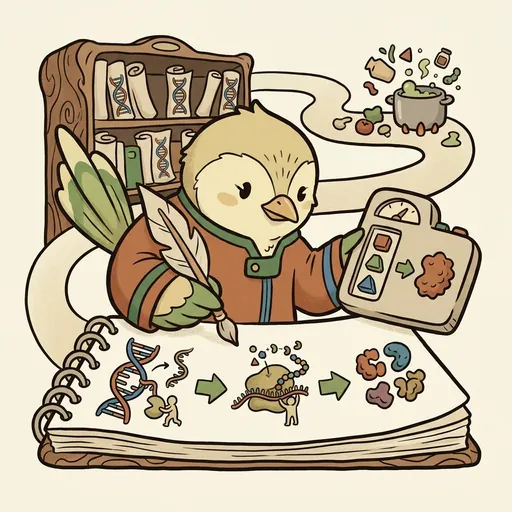
Script was easy to spot in the humming, whirring lab. She moved with the precise, deliberate steps of a tailorbird, always neat, always focused. Her lab tunic, a sturdy cream-colored fabric with soft green trim, seemed a little too big for her small frame. It made her look like a cartoon character, ready for some important, tiny work. She wore her dark hair pulled back in a tight bun, revealing a face that was often tilted in deep concentration.
Right now, Script was hunched over a workbench, her brow furrowed. Spread before her were her central dogma cards. They were small, laminated squares, each one representing a different piece of the genetic puzzle. Beside them, a sleek, handheld device blinked with numbers and letters: her codon-tracker. Script was deeply attentive to the molecular transcription happening on her screen, tracing invisible pathways with a careful finger.
“DNA,” she murmured, more to herself than anyone else. “RNA. Protein.”
She adjusted a card, then tapped a button on her tracker. The device immediately showed a sequence of three-letter combinations, like tiny secret codes. These were codons. Each codon, Script explained, was a specific instruction. It told the cell which of the twenty different amino acids to add next. Amino acids were the building blocks. They linked together to form long chains, which then folded into complex shapes. These folded chains were proteins. Proteins did nearly everything in a cell. They built structures, helped reactions happen, sent signals, and moved things around.
Script liked to explain it this way: “DNA → RNA → protein. The recipe travels from library to kitchen.” It was her favorite phrase, a simple way to describe a very complicated process.
She gestured to her central dogma cards. “Think of our cell’s nucleus as a grand library. Inside, the DNA holds all the master blueprints, the original recipes for every protein the cell might ever need.” She picked up a card labeled ‘DNA’. “But these master recipes can’t leave the library. They’re too precious, too big.”
So, when the cell needs a specific protein, it makes a temporary copy. This copying process is called transcription. Script pointed to another card, this one marked ‘mRNA’. “A special messenger molecule, mRNA, is created. It’s like a single recipe card, copied directly from the DNA blueprint.” The mRNA, a much smaller and more agile molecule, can then leave the nucleus, the library.
“Where does it go?” Script asked, looking up briefly, her eyes bright. “To the kitchen, of course!”
The cell’s kitchen, she explained, was the ribosome. Ribosomes were tiny factories floating in the cell. Script slid her mRNA card across the bench, as if sending it on a journey. Once the mRNA recipe reached a ribosome, the real work began. This next step was called translation.
The ribosome would “read” the mRNA recipe, codon by codon. For each three-letter codon, the ribosome would grab the correct amino acid. Script demonstrated this on her codon-tracker. As she scrolled, the device displayed a sequence of letters. Next to each three-letter codon, the name of an amino acid appeared. It was like watching a chef follow a recipe, adding one ingredient after another.
“These amino acids link up,” Script said, using her fingers to mimic a chain forming. “They make a long, flexible strand.” She paused, then slowly curved her hands together. “Then, that strand folds. It folds into a very specific, three-dimensional shape. That shape is the protein.”
The shape of a protein was incredibly important. It determined what job the protein could do. A protein shaped like a tiny key could unlock a cellular door. One shaped like a miniature crane could lift and move other molecules.
“This entire flow,” Script concluded, tapping her central dogma cards in order, “from DNA to RNA to protein, is the central dogma. It’s how genes make proteins. It’s the foundational way genetic information moves through every living thing.” She picked up her codon-tracker again, already lost in the intricate dance of letters and numbers. The recipe was always traveling, always being made, keeping the cell—and everything built from cells—alive.
The GeneForge ensemble
Script is part of GeneForge's distributed-narrative cast. Each character embodies a different curricular primitive; together they teach the full subject.