
Send and Ground
COMPLETE LOOP — *current only flows if it can get all the way back; a circuit is a round-trip, and ground is where it returns.* The electronics primitive of the closed loop and the return path — no complete loop, no flow, no matter how much pressure you have.
Press play to listen along. The line being read lights up as you go.
Show full transcript
Loading transcript…
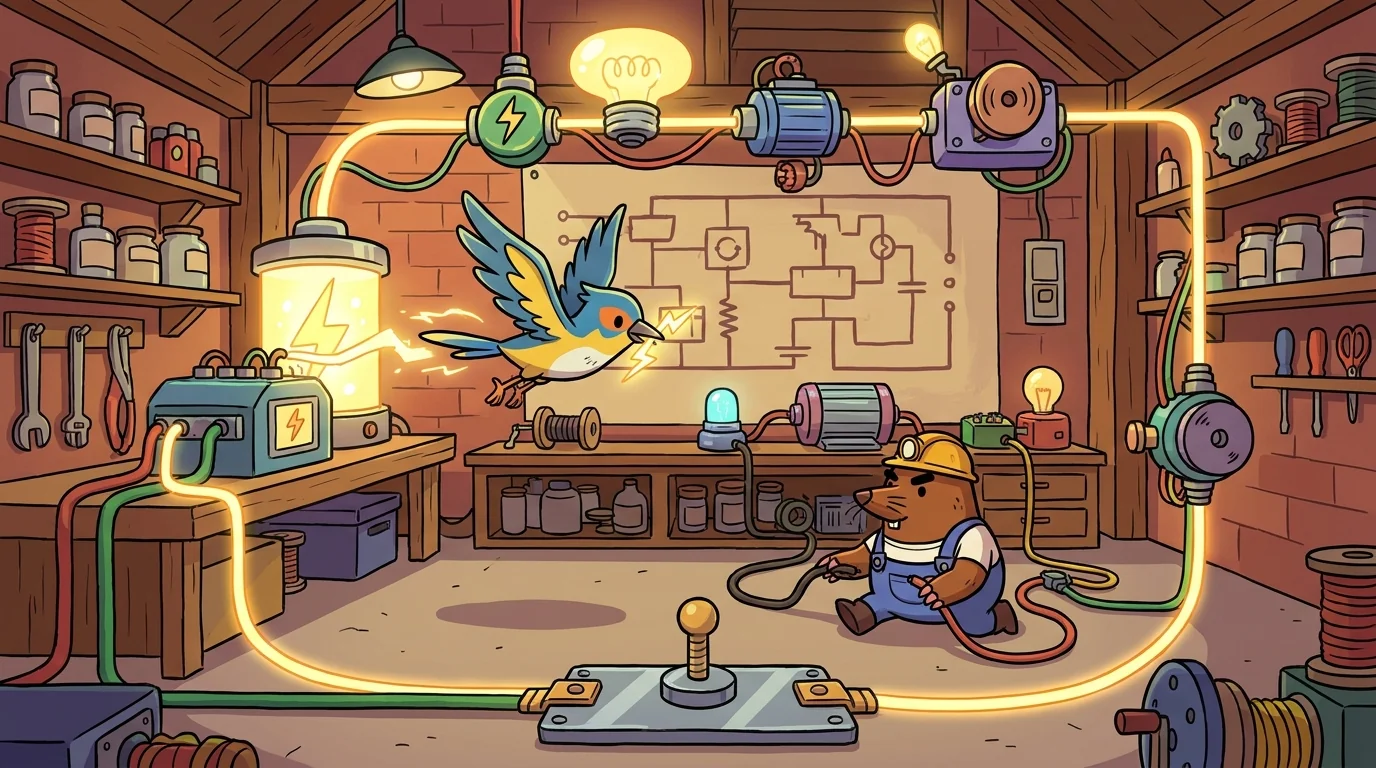
At the edge of the workshop, two friends worked as a pair, and no light in the whole place could turn on without both of them.
Send was a swift — quick, outbound, always carrying something away from the source and off into the circuit. Ground was a mole, low and settled, the steady place everything came back to. Send carried the charge out; Ground was the home it returned to. "A circuit isn't a one-way trip," they liked to say together. "It's a round-trip. Out through Send, through the light or the motor, and all the way back to Ground. Break the loop anywhere, and nothing flows — not one spark."
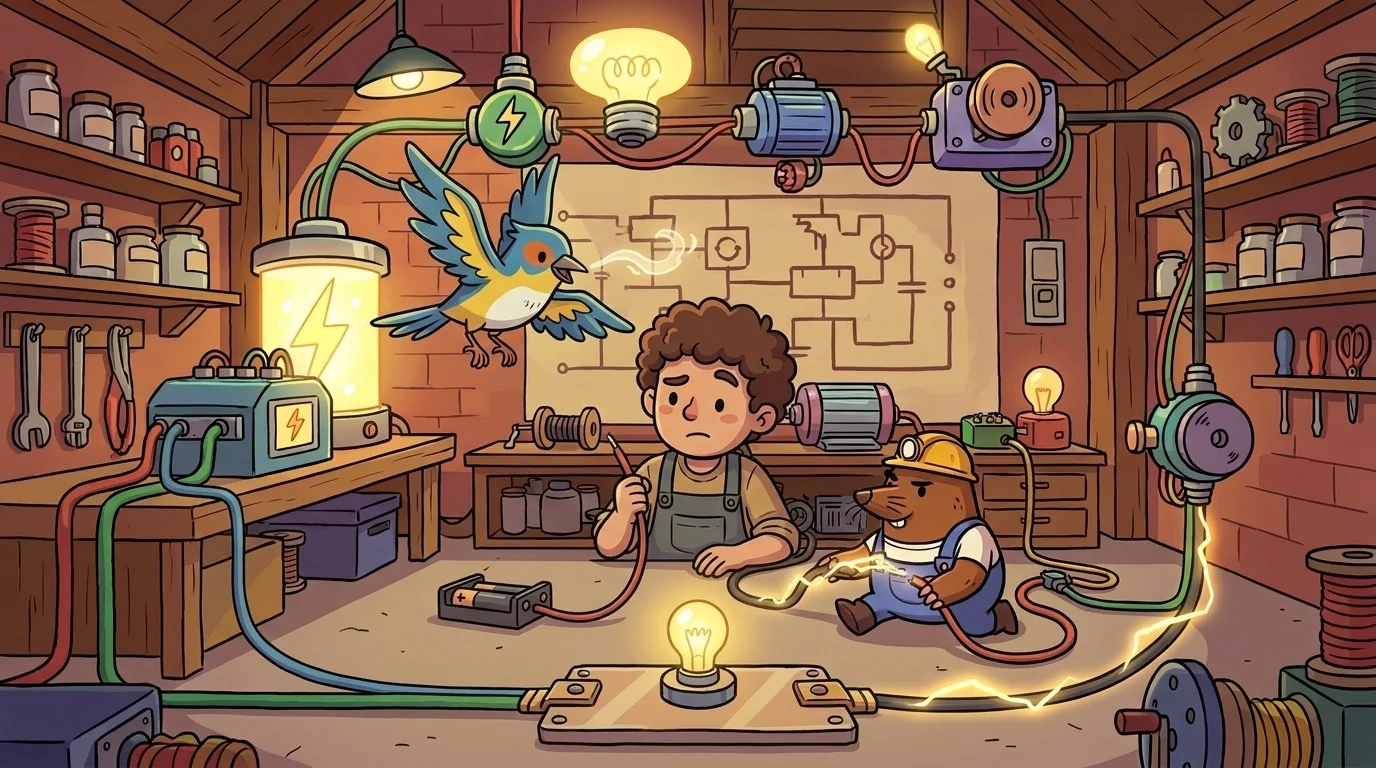
This was the idea beginners tripped over most, and the pair loved rescuing them from it. A student would wire a battery to a light with a single wire and be baffled that nothing happened. "You gave it pressure," Send would say kindly. "But I can only carry the charge out. There's no way home." Then Ground would connect the return wire, closing the loop — and the light came on. "There," Ground said. "Now it can come back to me. A circuit needs a there and a back."
They built on the workshop's water-analogy, but added the piece the others left implicit. "Push is the pressure and Flow is the current," Send said, "but pressure alone does nothing if the water has nowhere to return. Think of a loop of pipe: the pump pushes water out, it does its work turning a wheel, and it flows back to the pump to be pushed again. Cut the pipe anywhere and the whole flow stops — even with the pump roaring." Ground nodded slowly. "I'm the low place the water comes home to. Everything measures from me. I'm zero — and zero is where the loop closes."
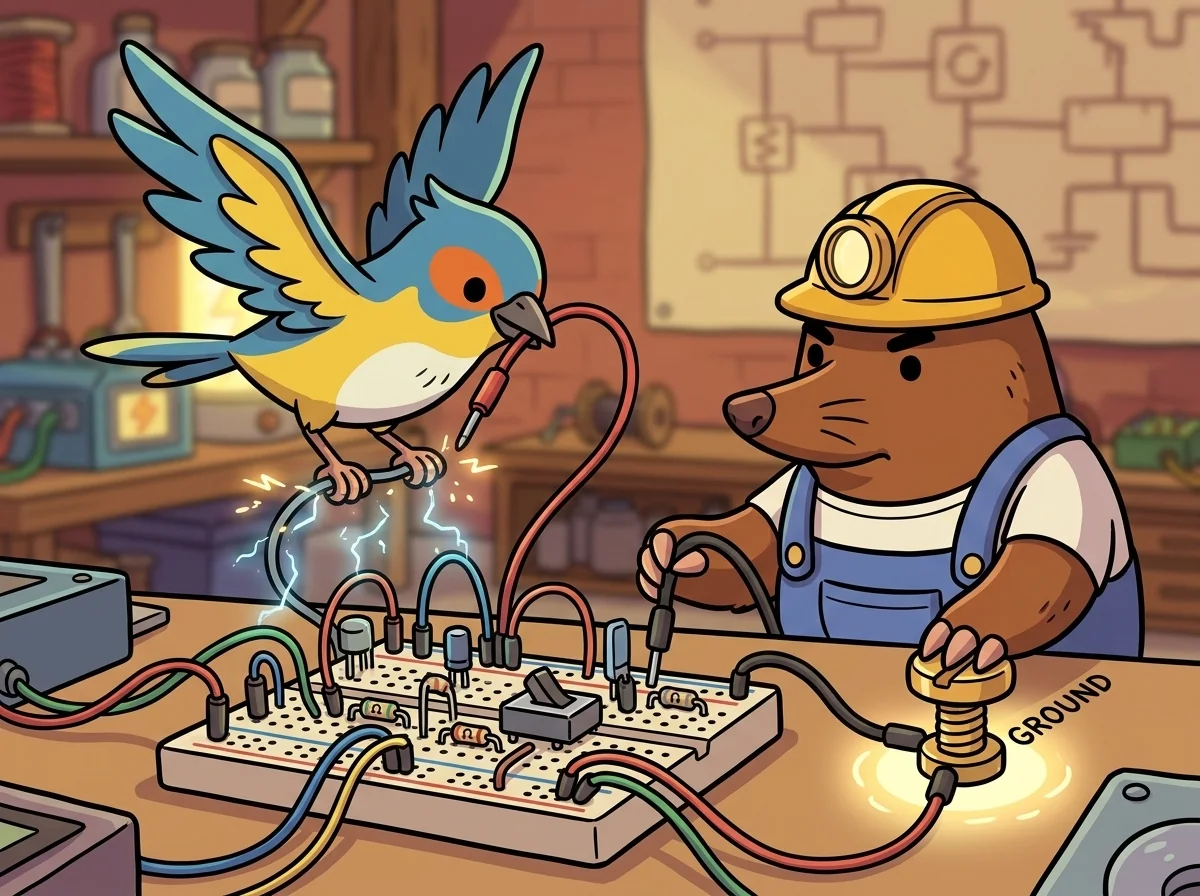
Neither made it mysterious. "It's a loop," Send said. "You can trace it with your finger on the breadboard — out from the source, through the component, back to Ground. If your finger can't complete the circle, neither can the current." SEE-and-BUILD: the most important thing you could see was whether the loop actually closed.
The pair came from a courier-and-burrow village. Send's family carried messages out across the valley; Ground's family kept the home-burrow where every courier returned to rest and be sent again. One storm, a landslide cut the return road, and the couriers could go out but never come back — and soon nothing moved at all, because a courier who can't return can't be sent again. Clearing that return road, the two young friends understood their shared craft: sending only works if there's a way back; the loop has to close.
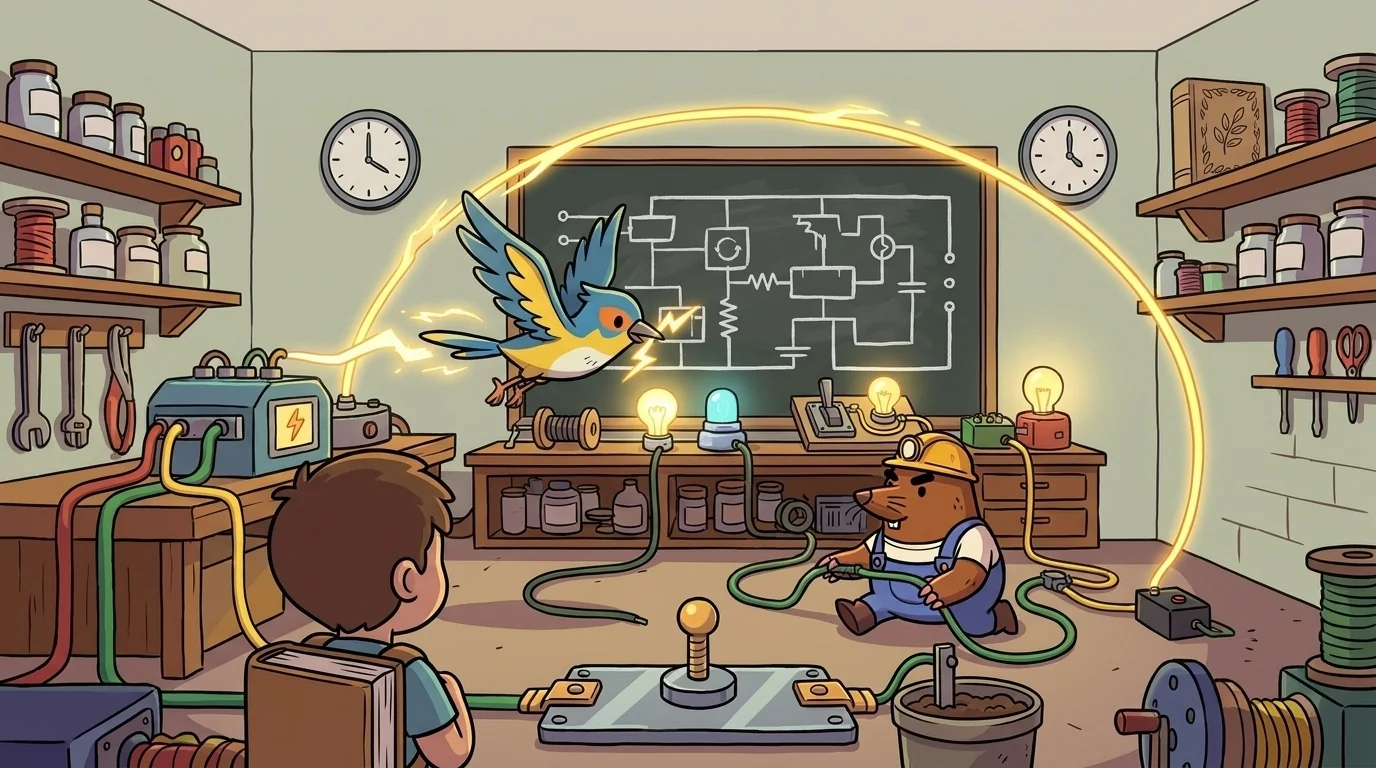
One day Watt, the workshop mentor, came to the village.
"What makes a complete circuit?" Watt asked them together.
Send zipped out along an imaginary wire. "Carrying the charge out from the source." Ground settled at the low end. "And giving it a path all the way back — to ground, to zero, to home. Out and back. Break the loop anywhere and nothing flows, no matter the pressure." Watt nodded. "You are two halves of one loop," he said. "You are appointed. Together."
In their shared classroom, Send and Ground start with the baffling one-wire light that won't turn on, let the students puzzle, then close the loop and watch it glow. Then the students trace the whole round-trip with a finger.
They teach the students a few habits about the complete loop: A circuit is a round-trip. Out from the source, through the component, back to ground. Not a one-way street. *No complete loop, no flow. Break the circle anywhere and everything stops — even with plenty of pressure. *Ground is home and zero. It's the return path and the reference everything is measured from. Zero is where the loop closes. *Trace it with your finger. If you can't draw an unbroken circle from source, through the part, back to ground, the current can't either. Find the break. *A "dead" circuit is usually an open loop.* Before blaming the battery, check whether the path actually comes all the way home.
Send tells the students, "I've carried charge out into circuits that had no way home, and nothing happened — all that pressure, wasted." Ground adds, "And I've watched a light sit dark until someone closed the loop back to me. Neither is a failure. It's just the loop reminding you it has to close."
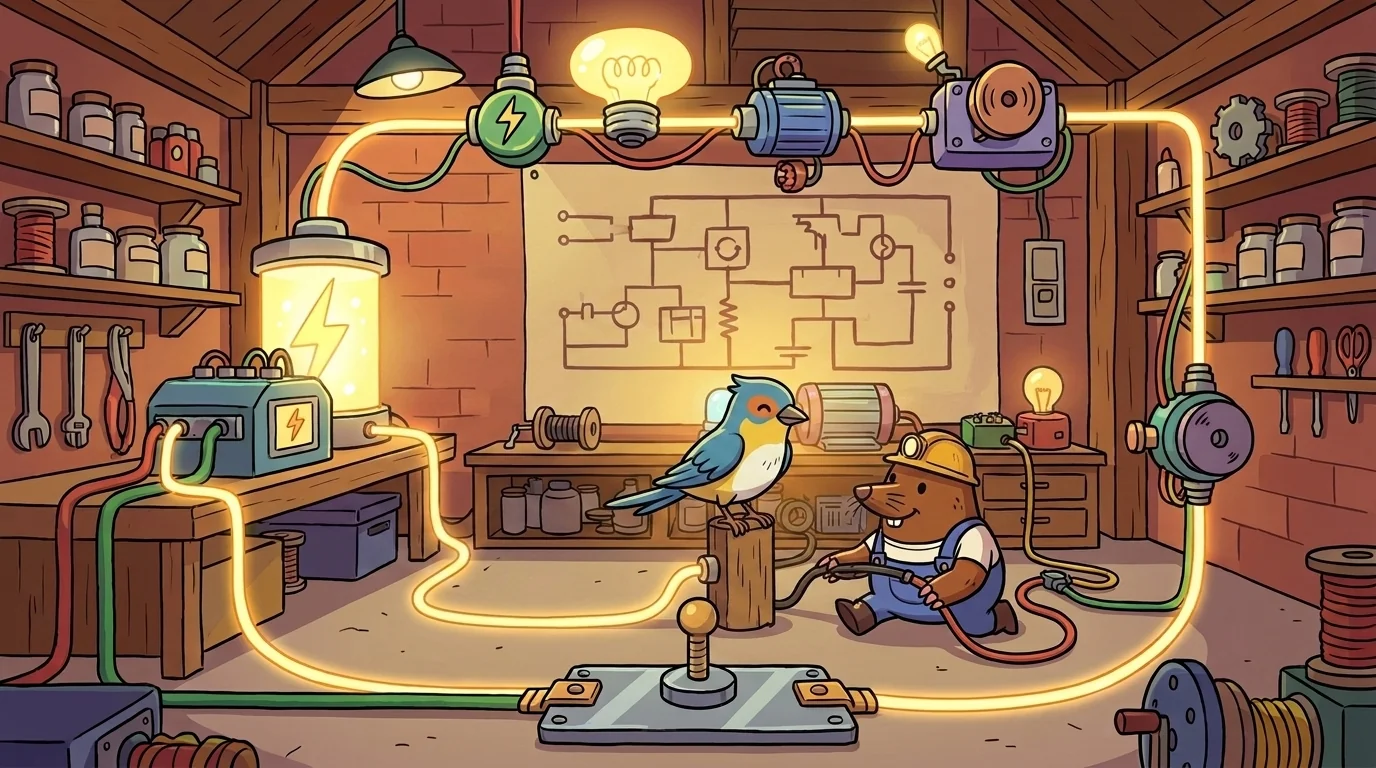
When a student asks why a battery with plenty of power still won't light a bulb, Send and Ground answer together, one after the other:
"Because power isn't enough," says Send. "It has to be able to get all the way out…" "…and all the way back," says Ground. "Close the loop, and it comes home, and everything moves."
Send settles beside Ground as the freshly-closed circuit lights steady and warm, the charge flowing out and home in an unbroken round-trip, and the no-way-back stuckness Send once felt on a cut courier-road has become something the pair now shares — a completed, it-came-full-circle relief, the quiet gladness of a loop that finally closes and lets everything move.
The CircuitForge ensemble
Send and Ground is part of CircuitForge's distributed-narrative cast. Each character embodies a different curricular primitive; together they teach the full subject.
-

Push
Voltage — the pressure difference that drives current; measured in volts
-

Flow
Current — electrons moving through wires; measured in amperes
-

Damp
Resistance — the slowdown; measured in ohms; Ohm's Law (V = I × R) emerges from Push + Flow + Damp together
-

Branch
Series vs parallel topology — one path or many; the topology decides the behavior
-

Build
Component-wiring craft — every component has a job; wire them together and the circuit comes alive
-

Store
Capacitance — a tank that fills with charge and hands it back; smooths bumps
-

Coil
Inductance / electromagnetism — a wound wire turns current into a magnetic reach
-

Relay
Switching / control — a gate the circuit can flip itself; small flips big