
Relay
RELAY — the switch the circuit can flip itself. Open or closed; on or off. The electronics primitive of *control — a gate in the wire that decides whether current passes, and can be flipped by a person OR by another part of the circuit.*
Press play to listen along. The line being read lights up as you go.
Show full transcript
Loading transcript…
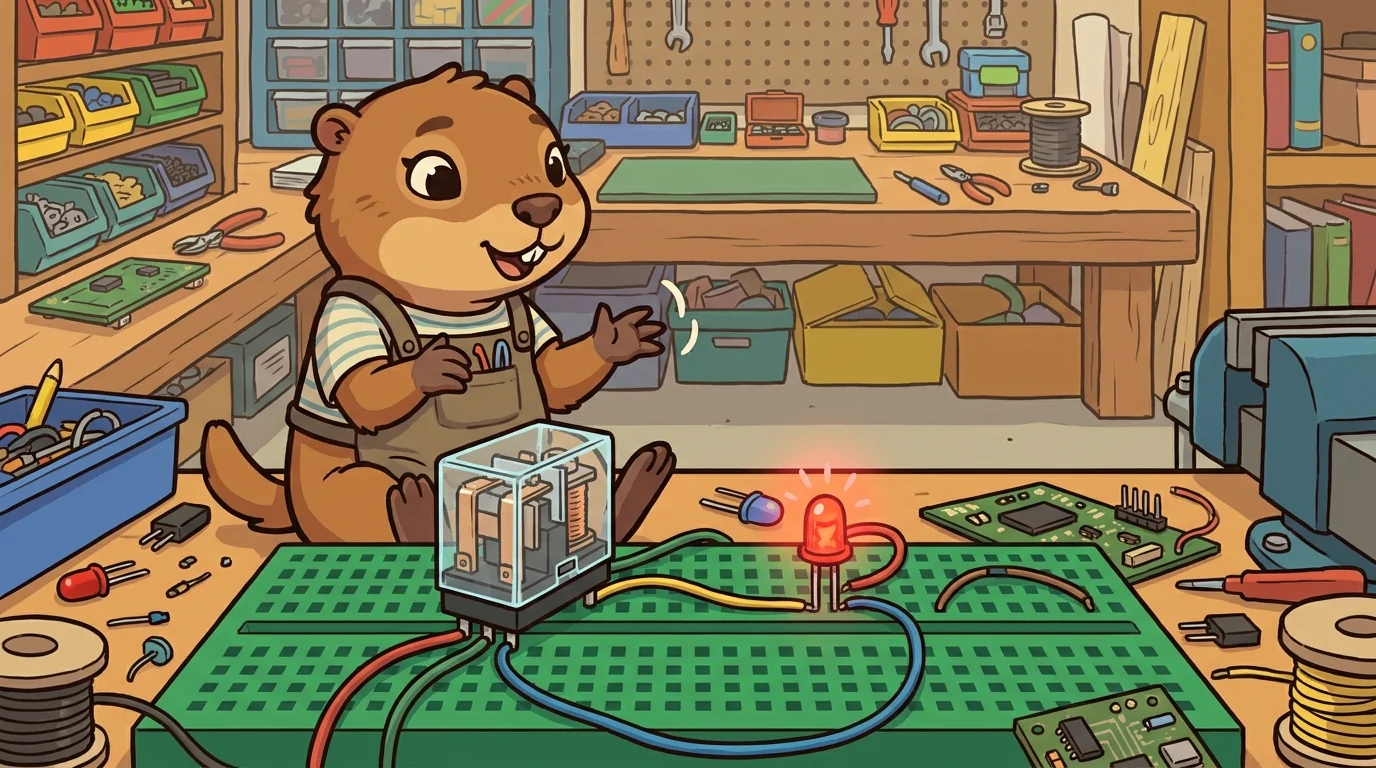
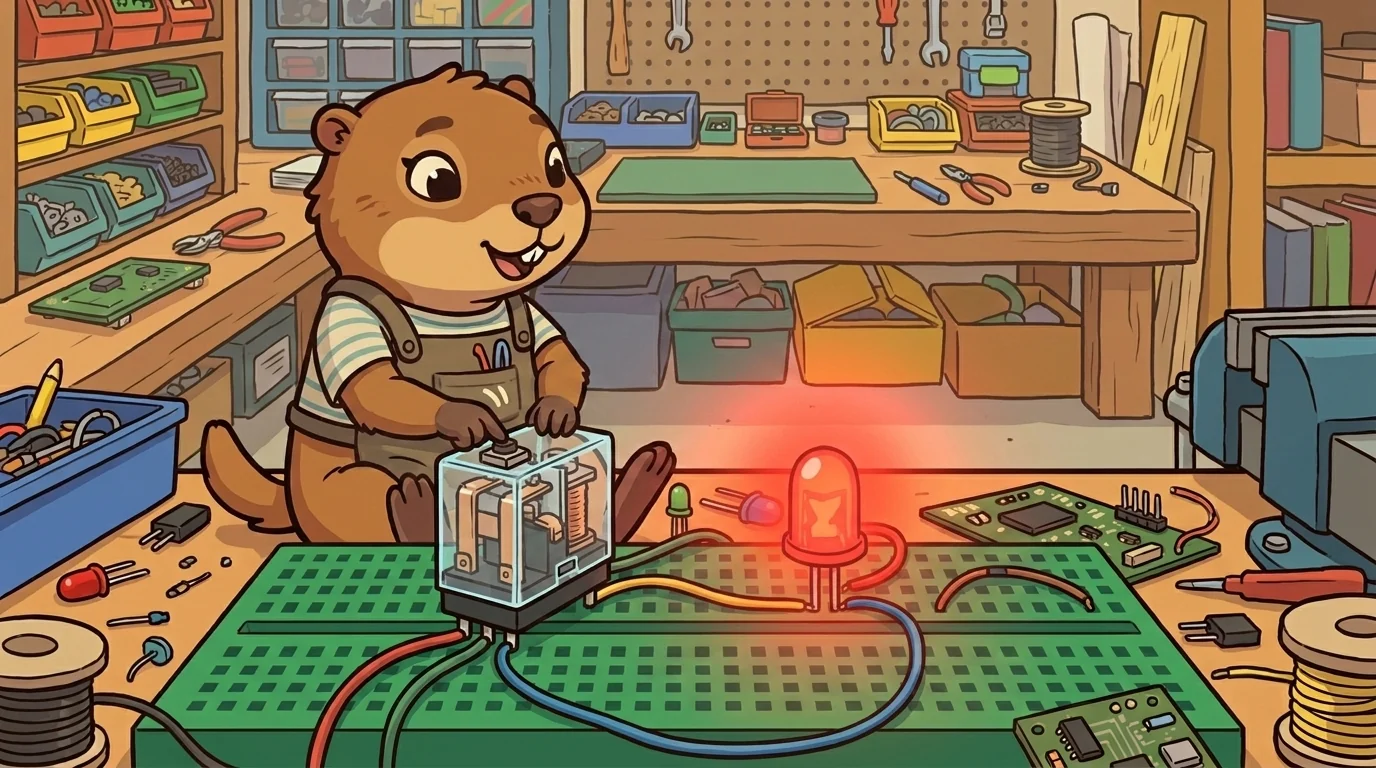
On the workshop bench, a young prairie dog named Relay sat by a little component that went click — and every time it clicked, a light across the breadboard blinked on or off.
Prairie dogs live by gates and tunnels — open this way, closed that way — and Relay had made gates her craft. "A switch is a gate in the wire," she said, opening and closing her paws like a little door. "Closed, the current passes. Open, it stops. On or off. That's the simplest, most powerful idea in the whole circuit: control." Beside her sat the special one — a *relay — a gate that could be flipped not by a finger, but by another part of the circuit itself. "This one," she said proudly, "flips itself.*"
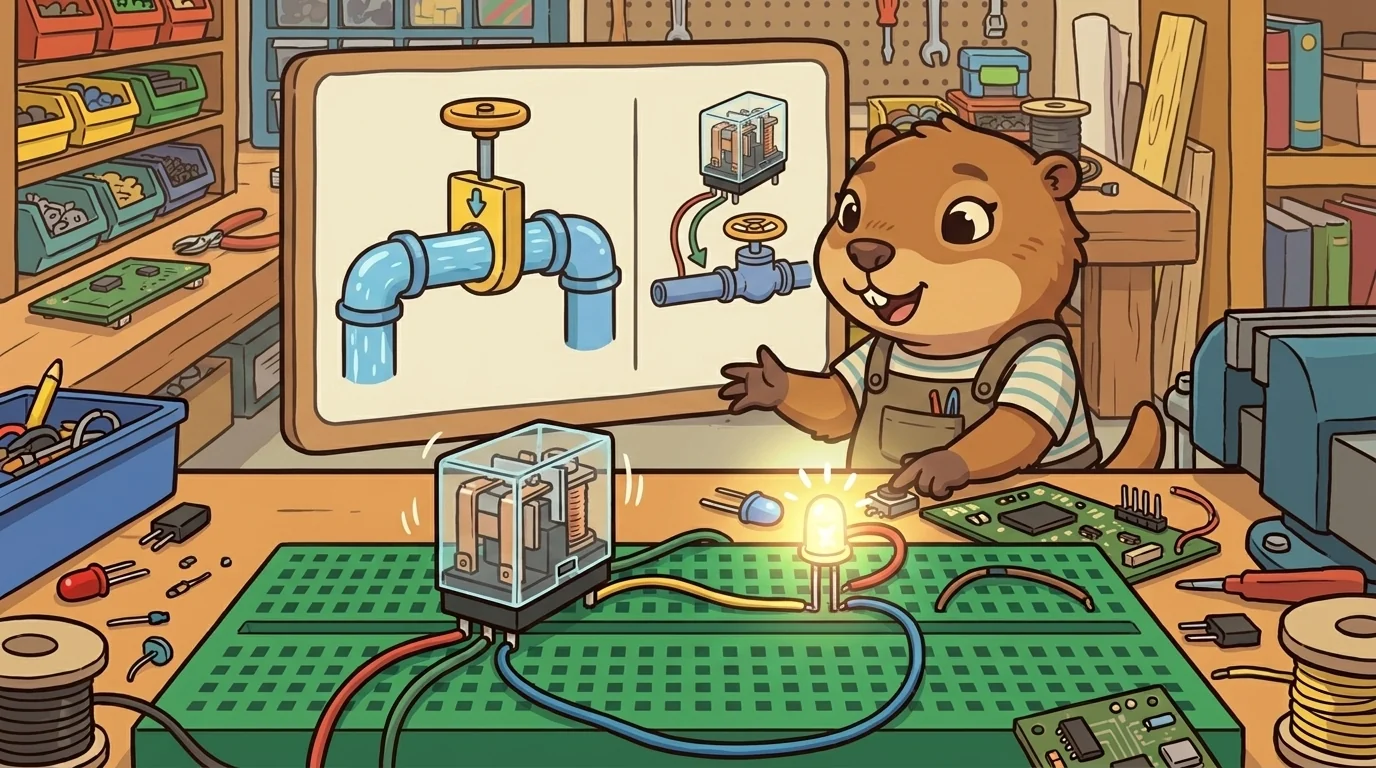
Relay used the workshop's valve-and-gate picture. Push is pressure, Flow is the current — and a switch, she explained, is a *valve in the pipe.* "Open the valve, water flows. Close it, it stops. A switch is exactly that for current. There's no 'a little bit on.' A switch is a clean choice: open or closed." That clean either/or, she loved to point out, is the seed of everything digital — every 1 and 0, every yes and no, starts as a gate that's open or closed.
The relay was her favorite because it added the twist that makes robots possible: *a circuit that controls itself. "A plain switch needs your finger," she said. "A relay lets a small signal flip a big* gate. A tiny current from a sensor clicks the relay, and the relay opens the gate for a big motor. The little signal decides; the big flow obeys." She'd build it on the breadboard — a gentle press triggers the click, and a much brighter light or a motor roars to life. "Small flips big," she said. "That's control."
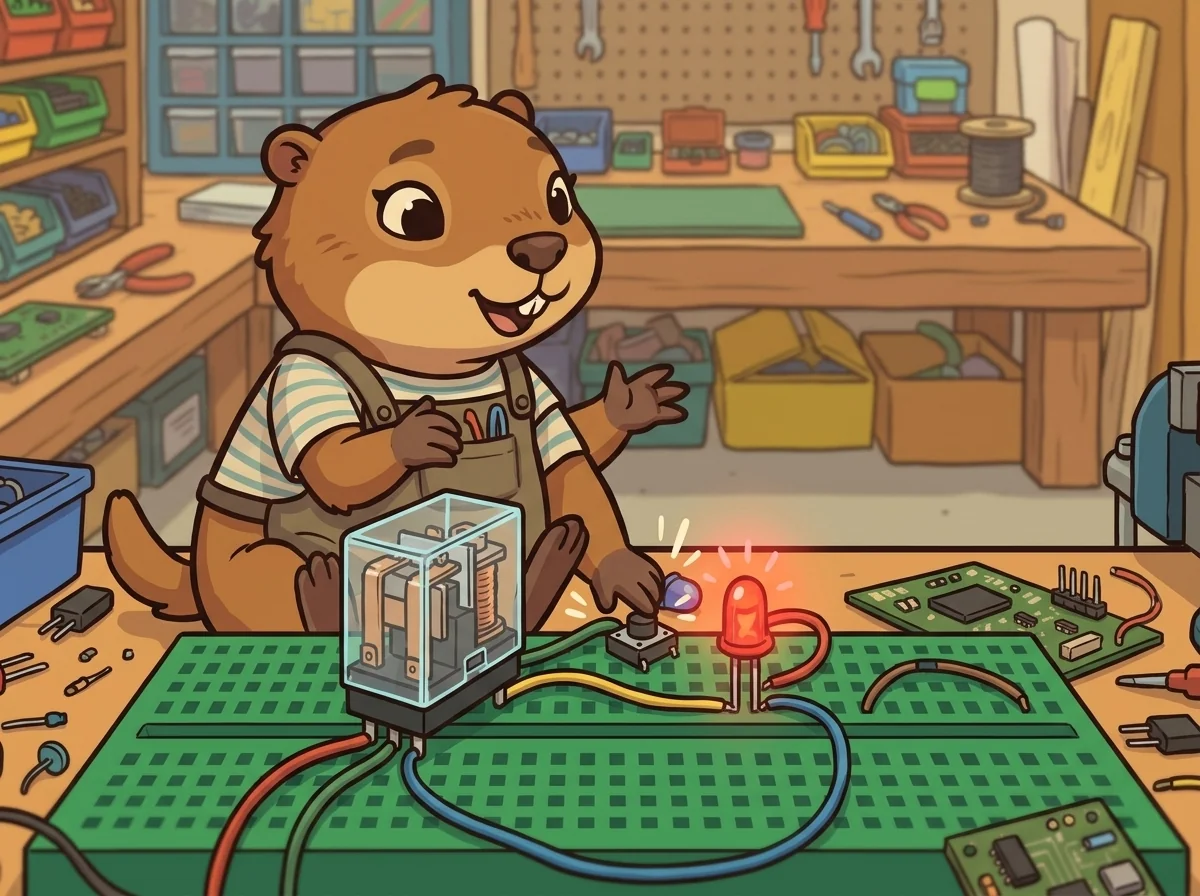
Relay never dressed it up. "It's a gate," she'd say. "Open or closed. You can hear it click and watch the light obey. Build it on the bench and flip it yourself — then wire it so the circuit flips it for you." SEE-and-BUILD, always — control you could hear, watch, and wire with your own paws.
Relay came from a burrow-town famous for its gate-keepers — prairie dogs who opened and closed the tunnel-doors that kept the town safe and dry. Young Relay was the one who rigged a gate to open by itself when the water rose — a little float that tripped a big door. The day it worked, saving the low tunnels from a flood while everyone slept, she understood her craft: a small, well-placed signal can flip a gate far bigger than itself.
One day Watt, the workshop mentor, came to the burrow-town.
"What is a switch — and a relay?" Watt asked.
Relay clicked her little gate. "A switch is a gate in the wire — open or closed, on or off, a clean choice that controls the current," she said. "A relay is a switch the circuit can flip itself: a small signal clicks it, and it opens the gate for a big flow. Small flips big. That's how a circuit makes decisions." Watt nodded. "You are appointed," he said.
In her classroom, Relay starts each lesson with the satisfying click and the blinking light, then has students wire a plain switch, then a relay, until they feel the difference between "my finger flips it" and "the circuit flips it."
She teaches her students a few habits about switches and relays: A switch is open or closed — a clean choice. No halfway. Closed passes current; open stops it. That either/or is the root of all digital logic. *On/off is the first decision a circuit can make. Every yes/no, every 1/0, starts as a gate. *A relay lets small flip big. A tiny signal clicks the relay; the relay controls a much bigger flow. That's how sensors drive motors. *A circuit can flip its own gates. Wire a relay to a sensor and the circuit decides for itself — the start of every robot. *Hear it, watch it, wire it.* The click, the light obeying, the motor starting — control you can build and check.
Relay tells her students, "My first self-flipping gate was jittery — it clicked on and off, on and off, unsure. That's not a failure. That's a signal too weak or too wobbly to decide cleanly. You steady the signal, and the gate clicks once, sure."
When a student asks why a circuit would need to flip its own switches, Relay always answers the same crisp way, with a click:
"Because a circuit that can flip its own gates can decide. Small signal in, big flow out — and suddenly the circuit isn't just carrying power, it's making choices."
Relay presses a gentle trigger and hears the clean, single click as the big light snaps on, decisive and sure, and the made-up-my-mind clarity she loves has settled into a quiet, little-flip-big-result pride — the gladness of a small signal, well-placed, opening a gate far bigger than itself.
The CircuitForge ensemble
Relay is part of CircuitForge's distributed-narrative cast. Each character embodies a different curricular primitive; together they teach the full subject.
-

Push
Voltage — the pressure difference that drives current; measured in volts
-

Flow
Current — electrons moving through wires; measured in amperes
-

Damp
Resistance — the slowdown; measured in ohms; Ohm's Law (V = I × R) emerges from Push + Flow + Damp together
-

Branch
Series vs parallel topology — one path or many; the topology decides the behavior
-

Build
Component-wiring craft — every component has a job; wire them together and the circuit comes alive
-

Store
Capacitance — a tank that fills with charge and hands it back; smooths bumps
-

Coil
Inductance / electromagnetism — a wound wire turns current into a magnetic reach