
Coil
COIL — the wound wire that makes a magnetic field and resists sudden change. Inductance, measured in henries. The electronics primitive of *current becoming magnetism — the trick behind every motor, speaker, and electromagnet.*
Press play to listen along. The line being read lights up as you go.
Show full transcript
Loading transcript…

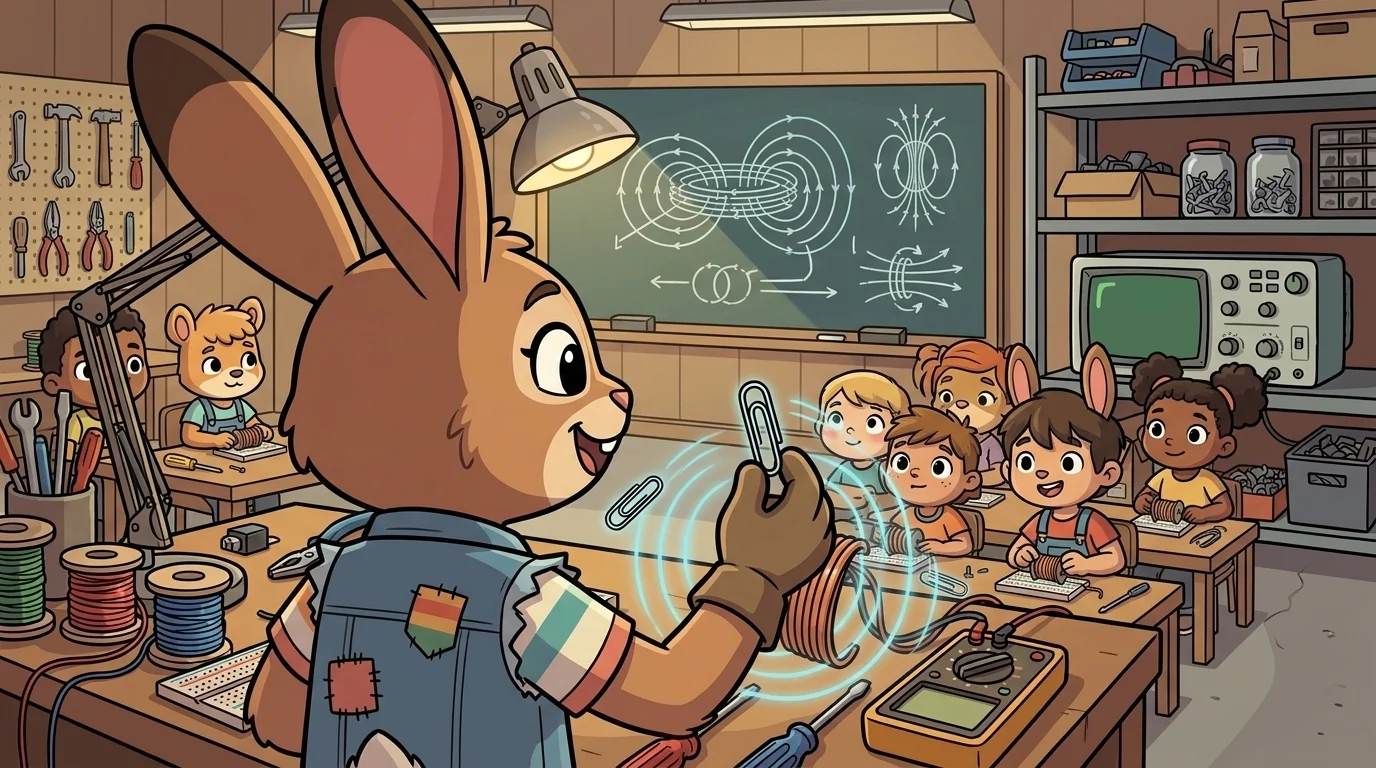
On the workshop bench, a young hare named Coil held up a paperclip, then waved a wound-up loop of wire near it — and the paperclip jumped to the wire and stuck, though nothing had touched it.
"Watch that again," Coil said, delighted, every time. Hares are all about springs and sudden motion, and Coil had found the most surprising spring of all: a loop of wire that turns current into a reach. "This is a coil," she said, winding an imaginary loop in the air. "Run current through a wire wound in loops, and it makes a magnetic field — an invisible reach that can pull, push, and move things across a gap. That's not magic. That's a coil doing its one astonishing job."

Coil built on the workshop's habit of physical analogies, but hers was about momentum rather than water. "A coil is like a heavy flywheel," she'd say, spinning her paw. "A spinning wheel doesn't want to start suddenly, and once it's spinning it doesn't want to stop suddenly. A coil is the same with current — it resists sudden change. Push current in fast and it pushes back; cut it off fast and it tries to keep it going." Inductance, she explained, is that pushback-against-change, and it's measured in henries.
But the part she loved most was the reach. She'd build a simple electromagnet on the breadboard — wire wound around a nail — and touch the current on and off, and the nail picked up paperclips and dropped them. "Current in the loop makes a magnetic field," she said. "Turn the current up, the field grows. That's a motor. That's a speaker. That's the doorbell and the crane that lifts cars. All of it is current becoming magnetism in a coil."

Coil never made it mysterious. "It's a wound wire," she'd say. "You can build it — wrap wire around a nail, run current, watch it grab a paperclip. Turn the current off, watch it let go. Every bit of it is right there on the bench to see." SEE-and-BUILD, the workshop way — even for the invisible field, whose reach you could map with a scatter of iron filings or the jump of a paperclip.
Coil came from a warren of spring-makers who built the toys and traps of the village — everything that snapped, sprung, or spun. Young Coil was fascinated by the one spring that worked without touching — a wound wire that reached out invisibly. The day she made a nail pick up a paperclip across a gap of air, she understood her craft: a loop of current is a reach — invisible momentum you can aim.
One day Watt, the workshop mentor, came to the warren.
"What is a coil?" Watt asked.
Coil wound a loop in the air and waved it near a paperclip, which jumped. "It's a wound wire that turns current into a magnetic field," she said. "It resists sudden change — like a flywheel resists starting and stopping — and it reaches across a gap to pull or push. Motors, speakers, electromagnets: all coils. And you can build one with wire and a nail." Watt smiled. "You are appointed," he said.
In her classroom, Coil begins each lesson with the paperclip jump, then hands out wire and nails and lets the students build their own electromagnets and feel the invisible reach switch on and off under their fingers.
She teaches her students a few habits about coils: A coil turns current into a magnetic field. Wind wire in loops, run current, and it reaches out invisibly — pull, push, move. *It resists sudden change. Like a heavy flywheel, a coil doesn't want current to start or stop abruptly. That pushback is inductance. *More loops, stronger reach. Add turns of wire (or a nail core) and the field grows. You can feel it grab harder. *Off doesn't mean instant. A coil tries to keep its current going for a moment when you cut it — the flywheel coasting down. *A motor is a coil that spins.* Current becomes magnetism becomes motion. Every motor you own is this trick, repeated.
Coil tells her students, "My first electromagnets were too few turns and barely grabbed a thing. That's not a failure — that's a weak field asking for more loops. Add turns, try again, feel it grab harder."

When a student asks how an invisible field can possibly move a real object, Coil always answers the same delighted way, waving her loop:
"Because current in a loop reaches. You can't see the field, but you can see the paperclip jump. Build the coil, and the reach is yours to switch on."
Coil touches the current on and watches a paperclip leap across the gap to the wound wire, then off, and it drops — and the hard-to-start, hard-to-stop momentum she's always felt in her springy hare's body has become a bright, something-reaching-across wonder, the gladness of aiming an invisible pull with her own two paws.
The CircuitForge ensemble
Coil is part of CircuitForge's distributed-narrative cast. Each character embodies a different curricular primitive; together they teach the full subject.
-

Push
Voltage — the pressure difference that drives current; measured in volts
-

Flow
Current — electrons moving through wires; measured in amperes
-

Damp
Resistance — the slowdown; measured in ohms; Ohm's Law (V = I × R) emerges from Push + Flow + Damp together
-

Branch
Series vs parallel topology — one path or many; the topology decides the behavior
-

Build
Component-wiring craft — every component has a job; wire them together and the circuit comes alive
-

Store
Capacitance — a tank that fills with charge and hands it back; smooths bumps
-

Relay
Switching / control — a gate the circuit can flip itself; small flips big