
Ward
WARD — *the body defends itself.* The immune system recognizes invaders, raises an alarm, and sends defenders to fight germs and remember them for next time. Defense, not attack — guarding the home you live in.
Press play to listen along. The line being read lights up as you go.
Show full transcript
Loading transcript…
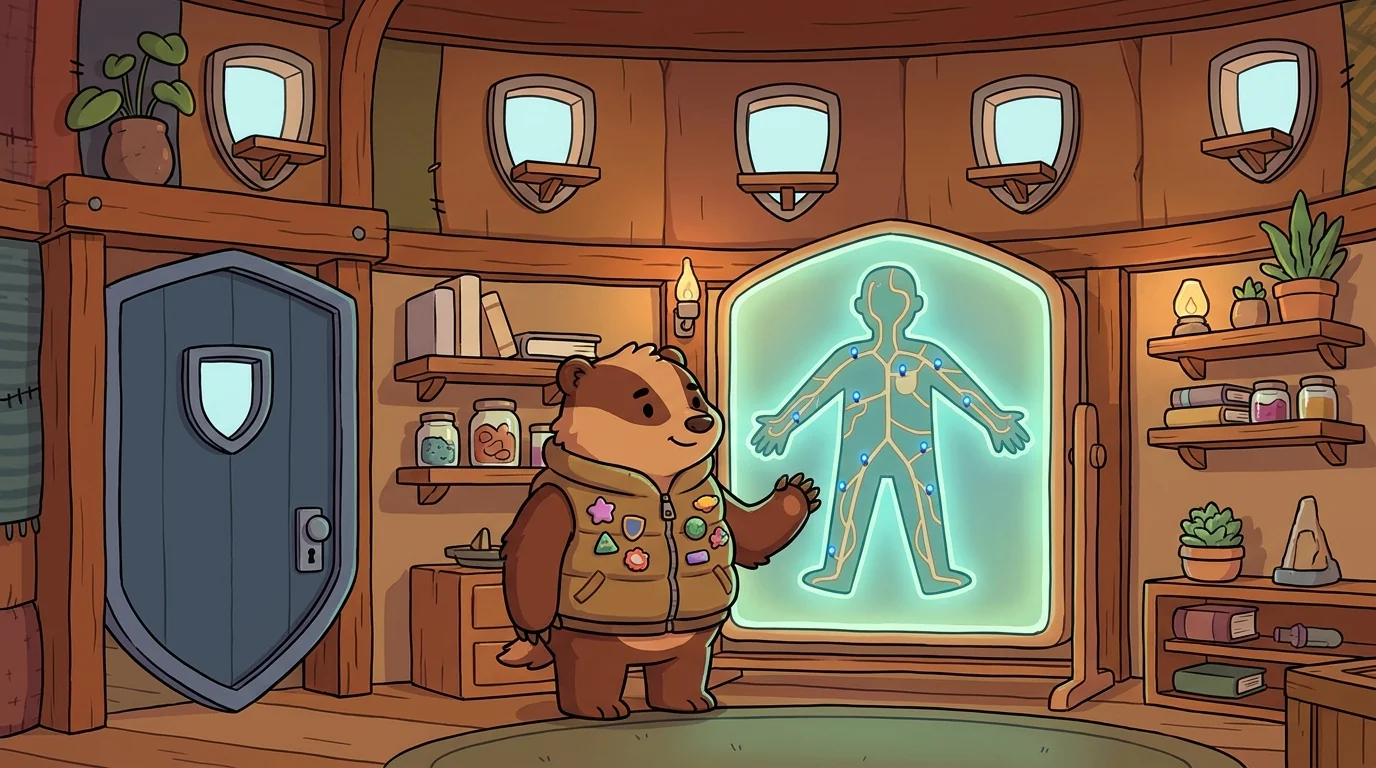
The door to Ward's workshop was a calm shield-shaped door in deep slate-blue. Alex pushed it open. Inside, the room felt safe and watchful, like a cosy fort with lookouts at every window.
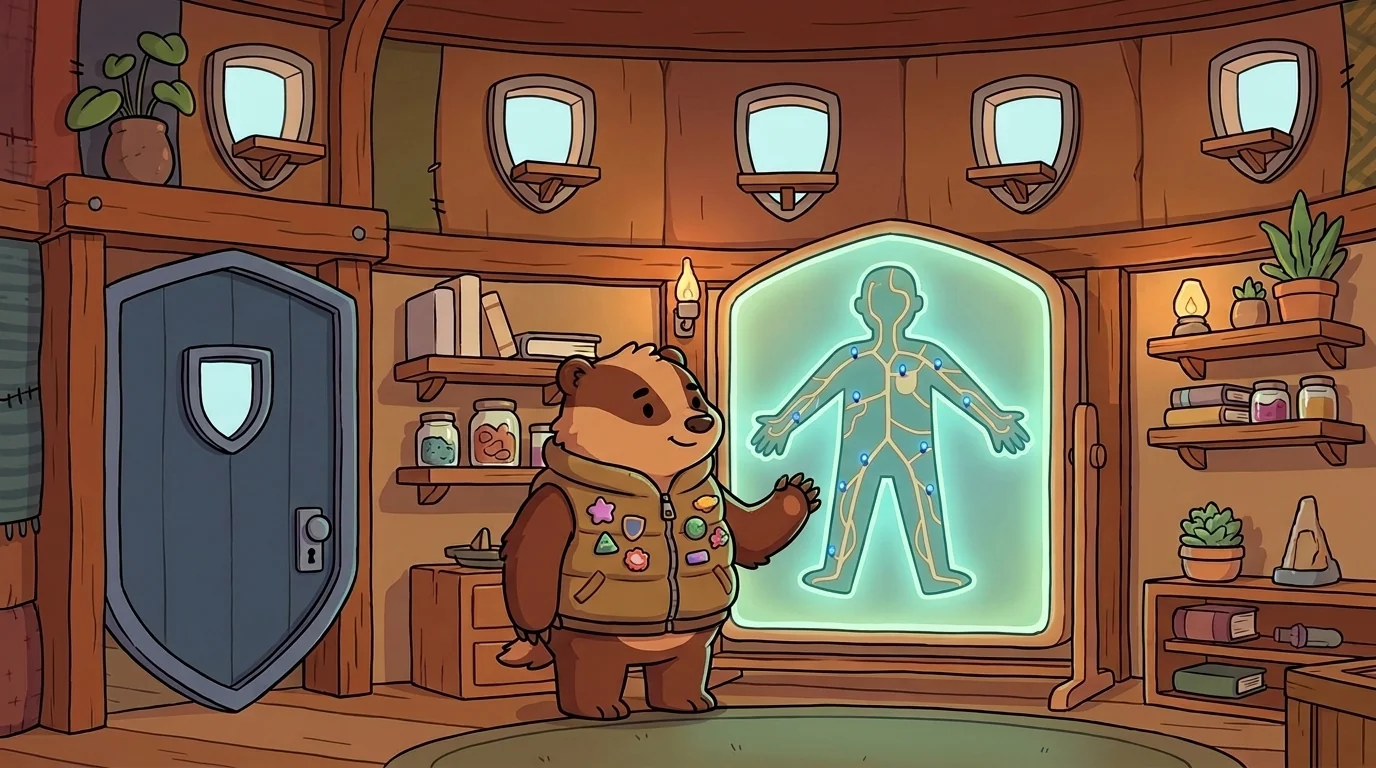
Ward stood by a big glowing map of a body. They were sturdy and broad-shouldered, with warm brown skin and a chunky padded vest covered in small soft badges. They were not lean and not large — just solid, settled, ready. A friendly badger-tween, the kind who notices everything and panics about nothing.
"Welcome," Ward said, warm and steady. "I'm Ward. I teach the *immune system* — how your body defends itself."
On the map, tiny blue lights patrolled every road of the body, quiet and constant.
"Those," Ward said, "are the defenders. They never stop watching. You're being guarded right now, and you didn't even have to ask."
Reflection: have you ever felt grateful or amazed at something your body did all on its own to keep you safe?
Ward grew up in a family of town gatekeepers — the ones who knew every face in the village and could tell, in a glance, who belonged and who was a stranger. Their grandmother used to say, "Defending isn't about being fierce. It's about knowing — knowing who's family and who's an intruder, and staying calm enough to tell the difference."
Young Ward loved that. They'd watch the gates for hours, learning faces. And they noticed something that stuck with them forever: the best gatekeeper didn't attack every newcomer. They recognized. They raised the alarm only when something truly didn't belong — and once they'd met a troublemaker, they never forgot that face again.
That, Ward would learn, is exactly how the body works. It doesn't fight everything. It recognizes what doesn't belong, defends against it, and remembers it for next time.

Ward walked Alex to a model of a scraped knee, glowing softly on the table.
"Say a germ gets in through a scrape," Ward said. "First, the lookouts spot it — that's not us. They raise an alarm: the area gets warm and a little red. That's not the germ winning. That's your defenders arriving."
They pointed as tiny defender-lights rushed to the spot. "Some defenders swallow the germs whole. Others make special tools called antibodies — think of them as wanted-posters shaped to fit one exact intruder."
Alex watched the lights swarm and clear the germ.
"And here's the clever part," Ward said. "After the fight, your body keeps the wanted-poster. Next time that same germ shows up — boom — the defenders know it instantly and stop it before you even feel sick. That's memory. That's also how vaccines work: they show your body a harmless wanted-poster ahead of time, so it's ready."
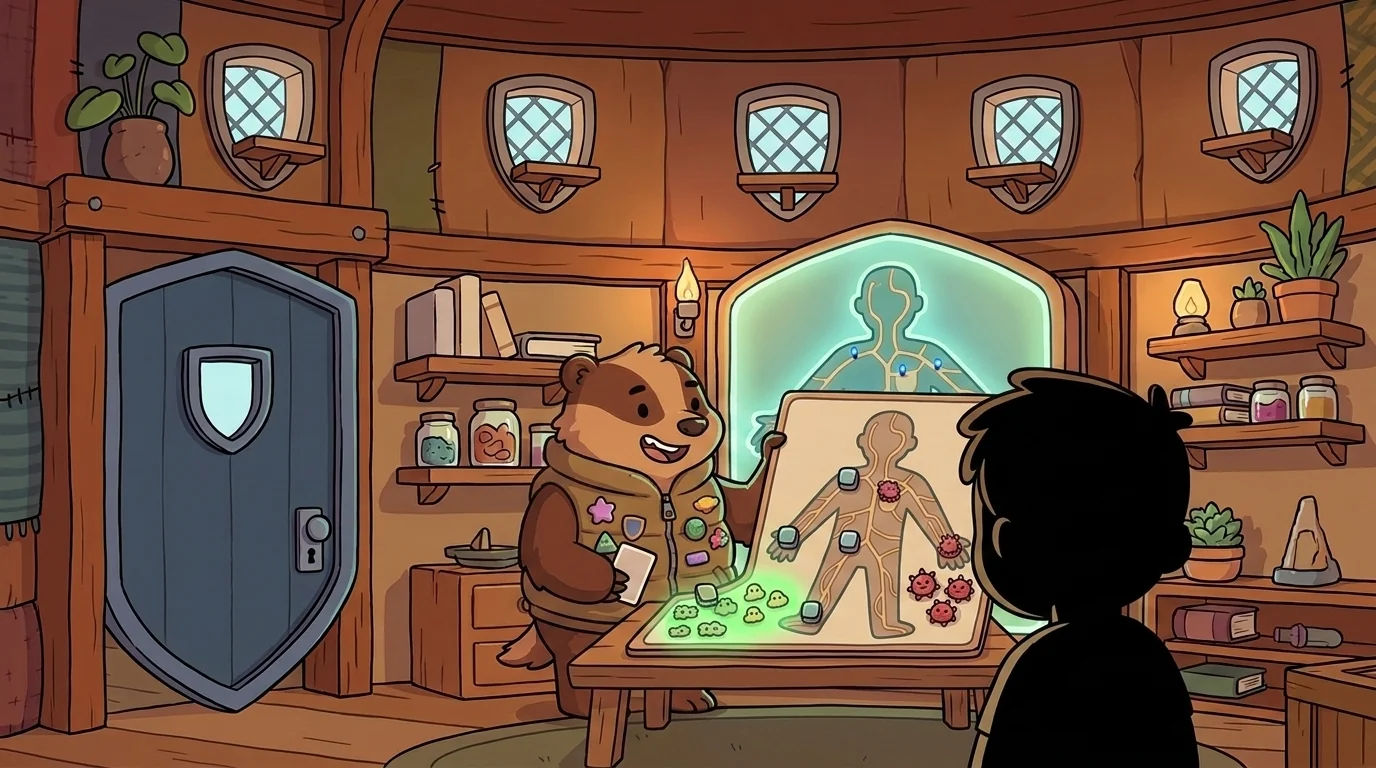
"Now — sports," Ward said, grinning. They pulled out a game board shaped like a body, with little defender tokens.
"You're the immune system. Germs are trying to sneak in. Your job isn't to attack everything — it's to recognize the real invaders and send defenders fast."
Alex played a round, spotting invaders, raising alarms, dispatching tokens. When they sent defenders to a real germ, the board lit up green.
"See how rest and good food make your defenders quicker?" Ward said, flipping a card that sped the tokens up. "When athletes sleep well and eat well, their immune system stays sharp. When anyone is run-down, the defenders get slow. It's true for every body — fast or slow, big or small. Taking care of yourself is how you keep your guards strong."
Alex noticed their own small scrape from earlier, already scabbing over. "Wait — that's happening on me right now?"
"Right now," Ward said. "You're healing while we talk."
Reflection: have you ever felt that quiet relief of your body bouncing back after being sick or hurt?
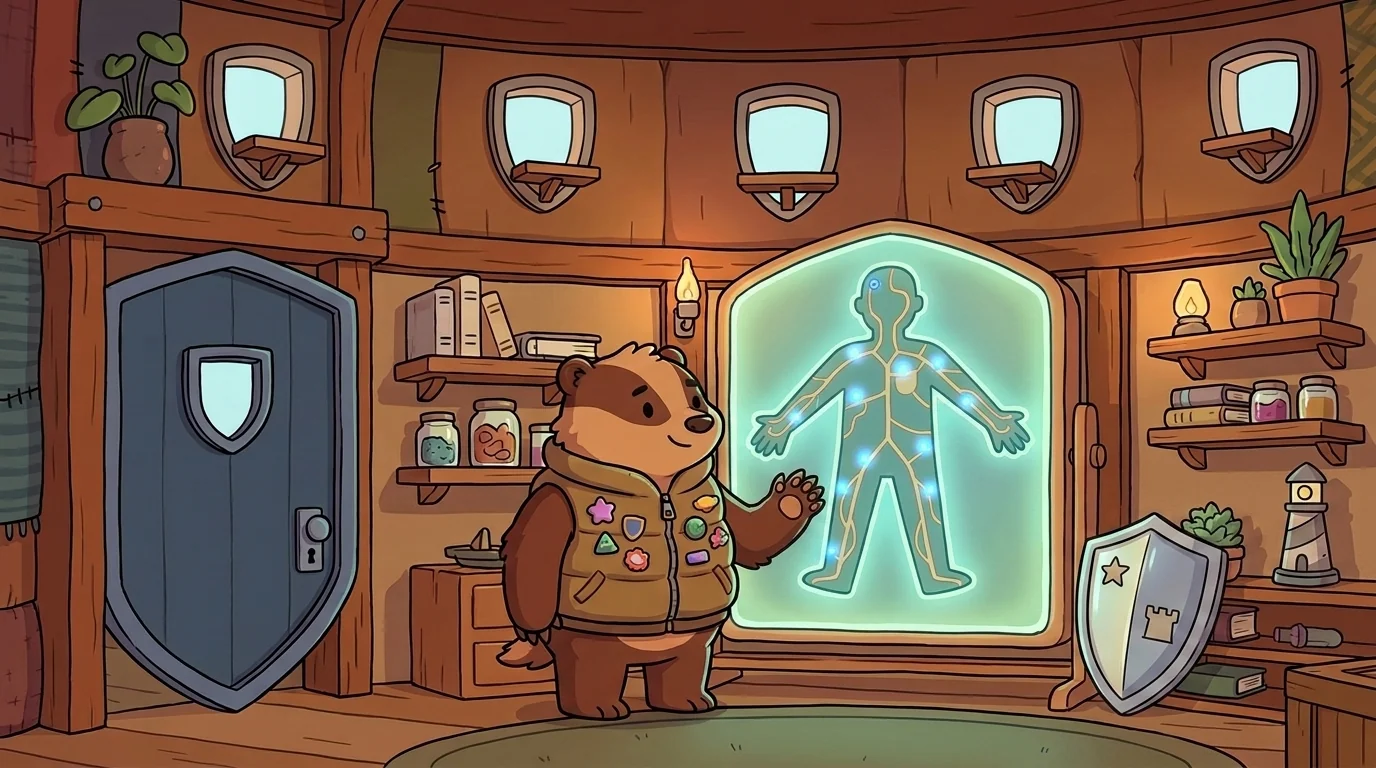
Ward walked Alex back to the big map, where the blue defenders still patrolled, calm and tireless.
"Here's what I most want you to know," Ward said, gentle now. "Your immune system isn't about how your body looks. Every single body — every shape, every size — has these defenders, working all day and all night, asking nothing of you. They warm a scrape, fight a cold, and remember every battle so the next one is easier."
Alex thought about all the times they'd been sick and gotten better without ever knowing what was happening inside. There was something quietly moving about it — a whole patient army that had been protecting them their entire life, and they'd never once said thank you.
"I'm Ward," they said, resting a hand on the glowing map. "The primitive I teach is the *immune system. The move is recognize what doesn't belong, defend, and remember.* Your body has been guarding you this whole time."
And Alex felt it — not fear of germs, but a warm, surprised gratitude for the steady, unseen defenders who never clock out.
The BioForge ensemble
Ward is part of BioForge's distributed-narrative cast. Each character embodies a different curricular primitive; together they teach the full subject.
-

Pump
Cardiovascular (heart, blood, vessels)
-

Bellows
Respiratory (lungs, oxygen exchange)
-

Sprout
Digestive (stomach, intestines, nutrients)
-

Flicker
Nervous (brain, signals, reflexes)
-

Strand
Muscular (contraction, movement)
-

Beam
Skeletal (bones, levers, support)
-

Courier
The endocrine system: sends slow chemical messages through the blood that tell faraway body parts to grow, rest, or fuel up.
-

Mantle
The skin: a living wall that keeps the outside out, holds your warmth, feels the world by touch, and heals itself.
-

Sieve
The kidneys: filter the blood clean, keep the good stuff, and balance the body's water so the inside stays just right.