
Pump
PUMP — *the heart moves blood to every cell. circulation is delivery.*
Press play to listen along. The line being read lights up as you go.
Show full transcript
Loading transcript…
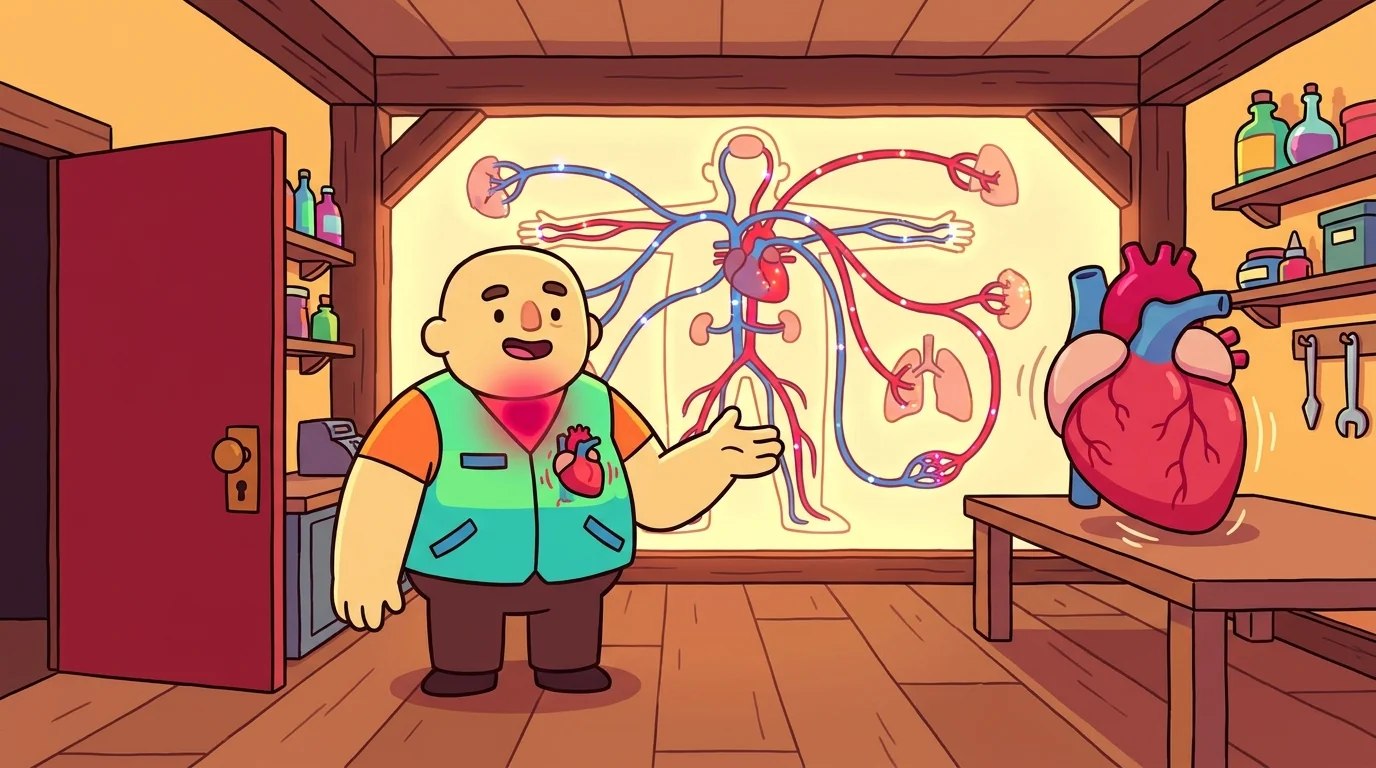
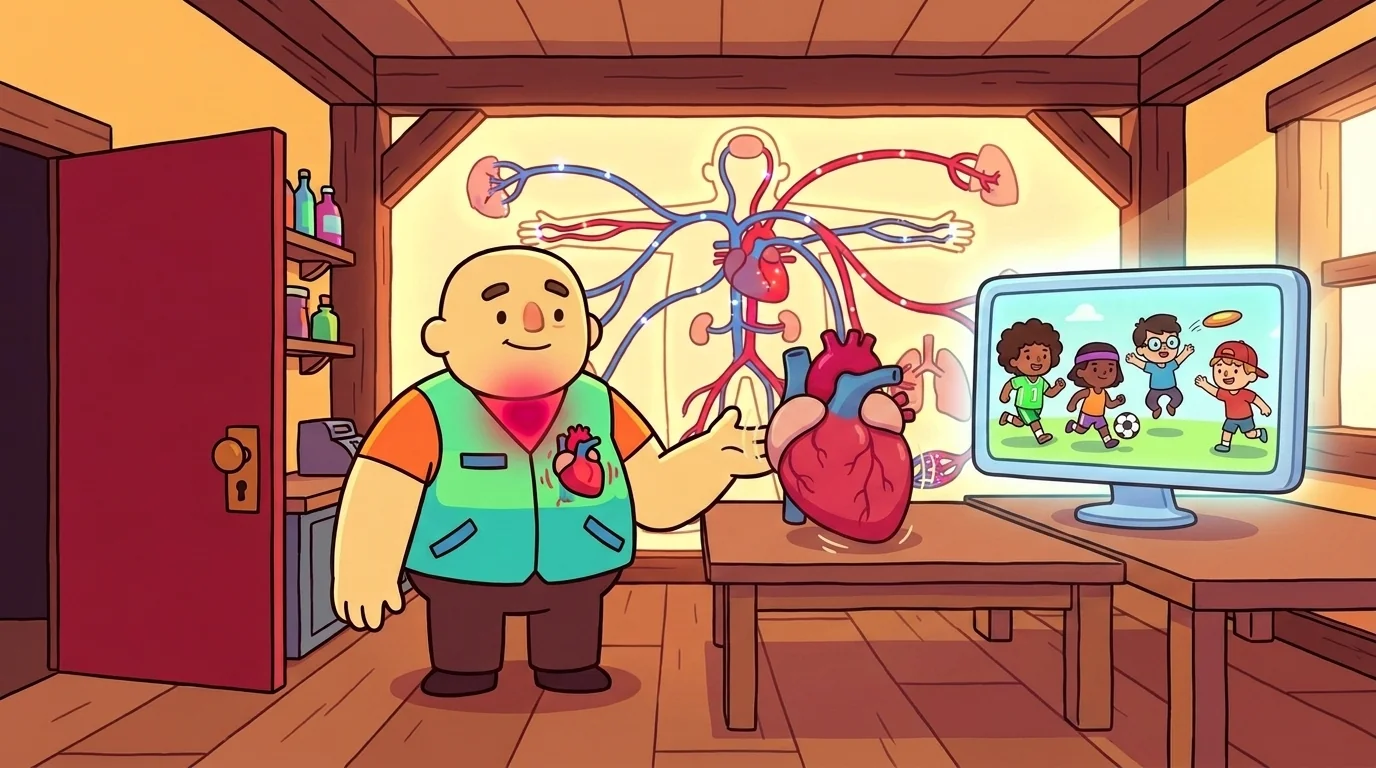
Pump stood in the center of her workshop, a steady, humming presence. She was a tween, round and soft and strong, with warm cream skin and a soft ruby throat. Her chunky-cartoon lab vest, a cheerful shade of teal, held a small, perfectly detailed heart model and a complex circulation map. The map glowed faintly on the wall behind her, a network of blue and red lines tracing paths across a simplified human body.
Pump was small, but her energy felt enormous. She moved with a quiet focus, her eyes always drawn to the flow of things. "The heart moves blood to every cell," she liked to say, her voice calm and clear. "Circulation is delivery."
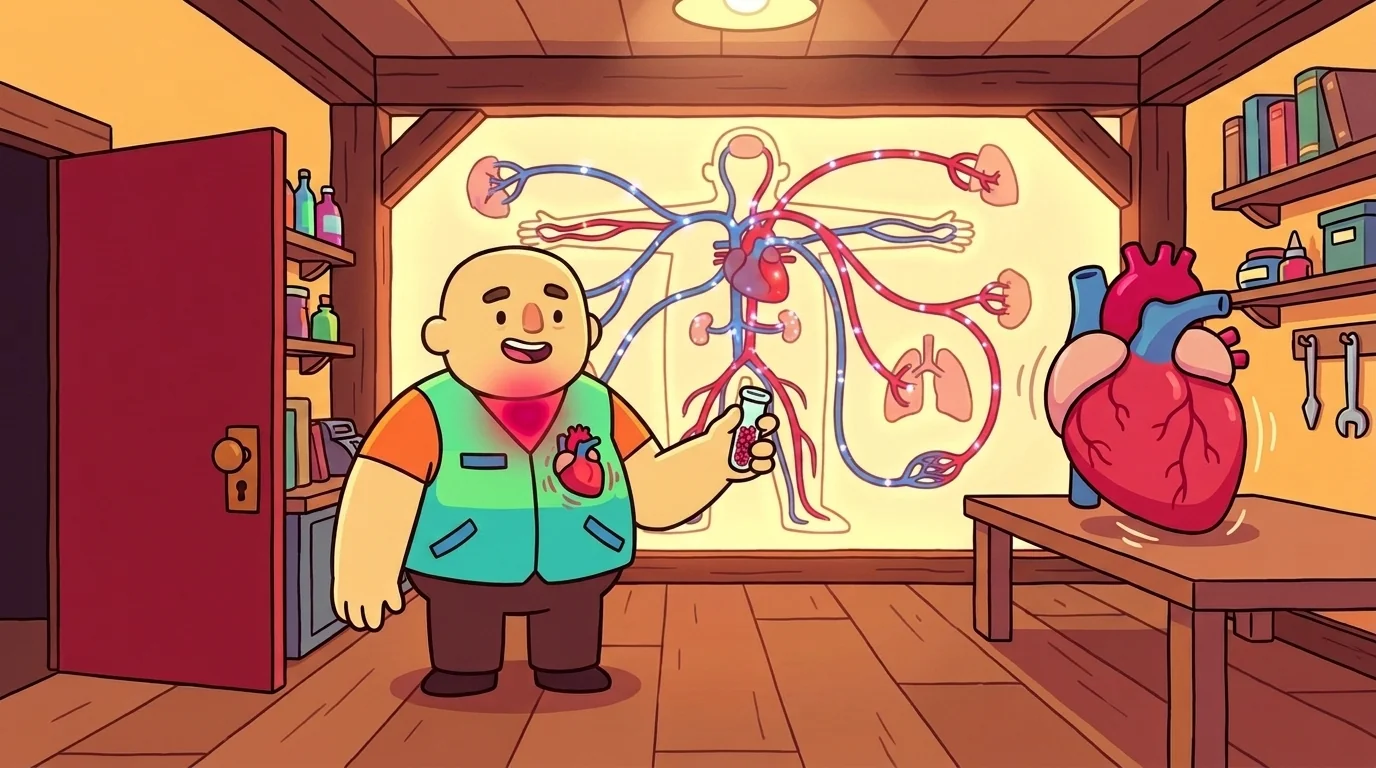
Her signature heart model, perched on a stand beside her, pulsed with a soft, rhythmic thump-thump. On the wall, the circulation map lit up, showing a closed loop: bright red arteries branching out, fading into a shimmering haze of capillaries, then gathering into deep blue veins, all flowing back to the heart. It was a constant, tireless journey.
This was Pump's world, the world of the *cardiovascular system. She taught the anatomy craft of the heart-as-delivery-system*. The heart, she explained, was a muscle. It pumped without stopping, about one hundred thousand times every single day. That's enough to move roughly two thousand gallons of blood. All this blood traveled through sixty thousand miles of vessels, a network longer than the Earth's equator. Its job was simple but vital: deliver oxygen, nutrients, hormones, and immune cells, and then carry away waste.
"Think of it like a river," Pump told her class, gesturing to the glowing map. "A river that reaches every single house in a huge city, bringing supplies and taking away trash."
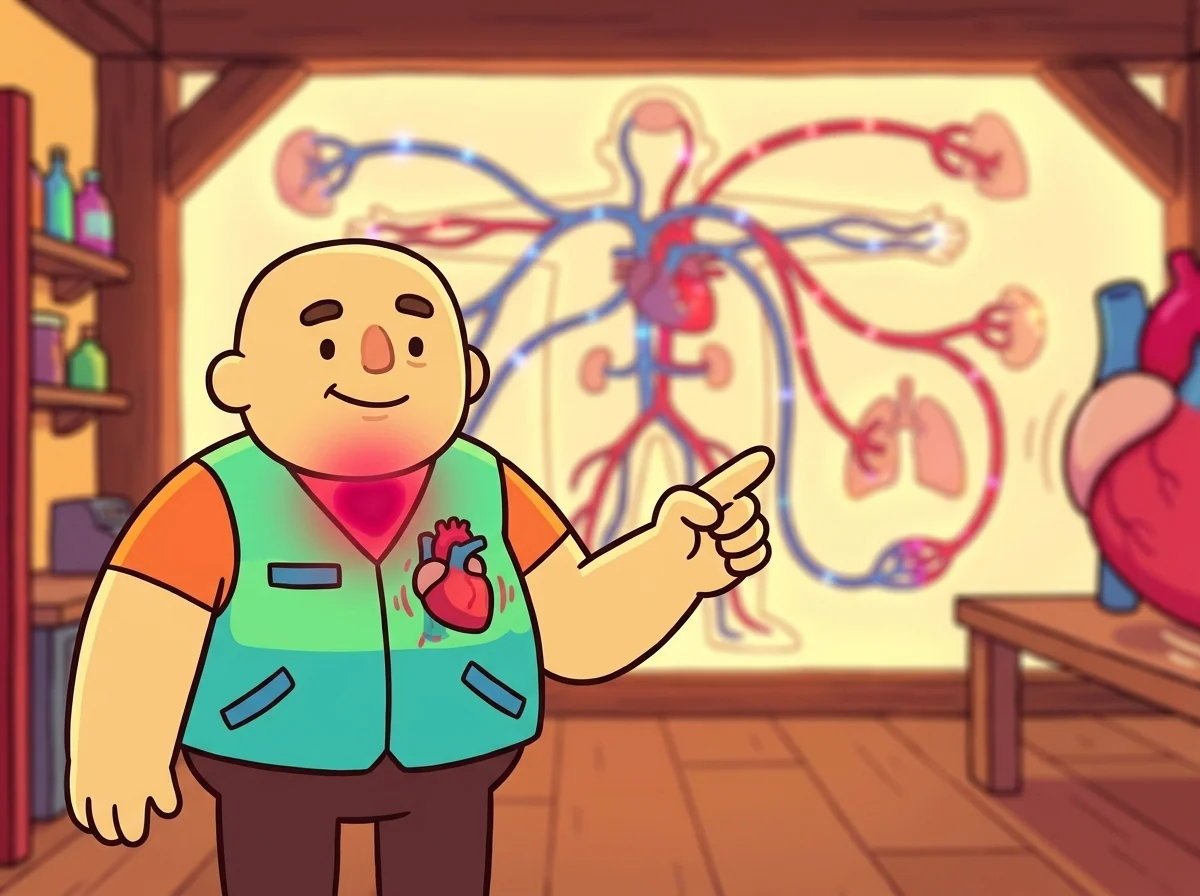
The system had two main circuits. One, the pulmonary circuit, was a quick trip from the heart to the lungs and back. "That's where the blood picks up fresh oxygen," Pump explained, pointing to a section of the map where red lines brightened. The other, the systemic circuit, was the grand tour. It took blood from the heart to every other part of the body, then brought it back. "Everywhere else," Pump emphasized, "from your brain to your toes." It was a closed loop, a perfect circle with no breaks, running your whole life long.
Pump believed in teaching through movement, through sports. "When you run," she said, "your heart speeds up. It has to. Your muscles need more oxygen, fast." She showed a graph on a screen, a jagged line spiking upward. "More blood flows, more oxygen reaches those hard-working muscles."
A student named Leo, who always seemed to have a question, raised his hand. "So, like, if you train for a marathon, does your heart get bigger?"
Pump nodded. "Exactly, Leo. When you train consistently, your heart muscle strengthens. It becomes more efficient. It can pump more blood with each beat. That's what cardiovascular fitness means." She paused, looking at each face in the room. "And this is important: fitness lives in cardio-capacity, not body shape. Every body has a heart that does this work. A strong heart can look different in everyone."
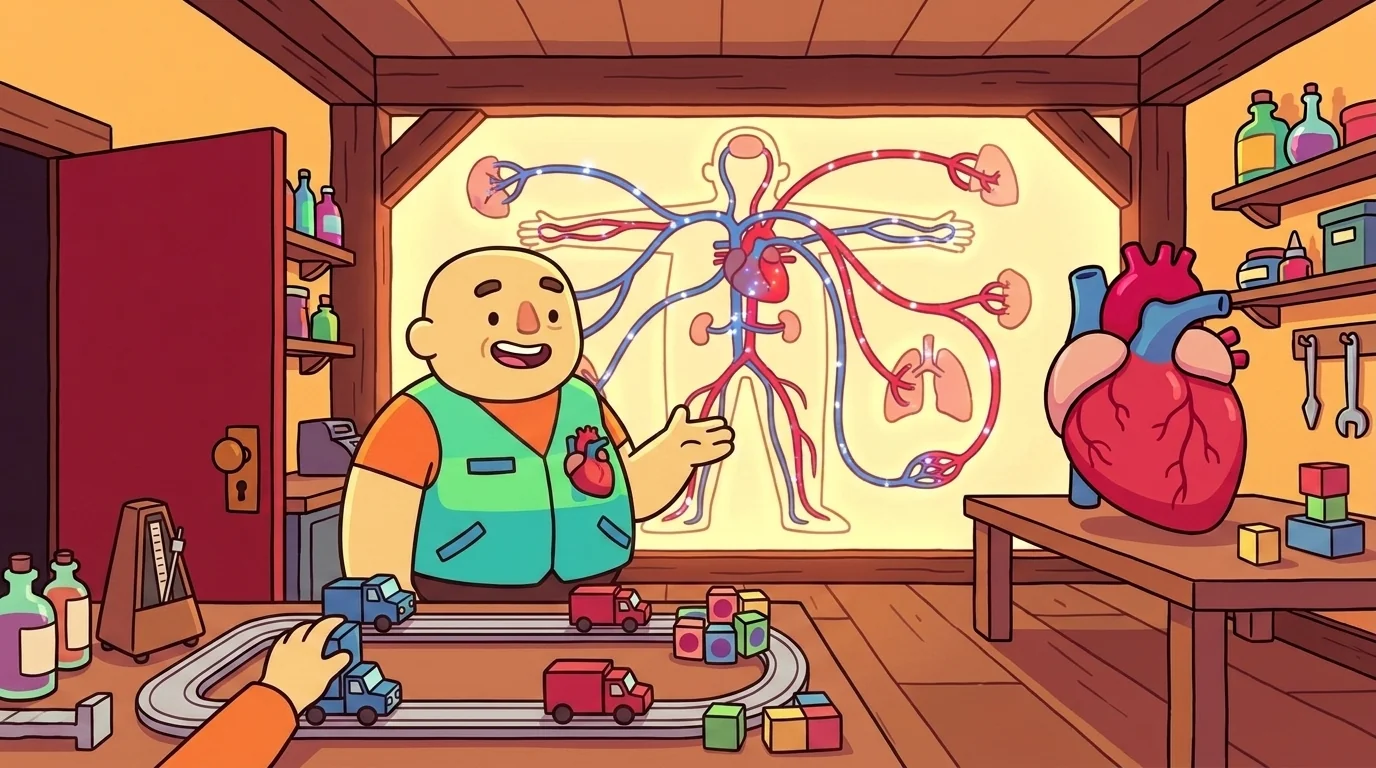
She clicked a button, and the heart model on the stand began to beat faster, a quickened thump-thump-thump. On the map, the red and blue lines pulsed with a more urgent glow. "Your heart is a tireless worker," Pump said. "It's always adapting, always delivering."
Her workshop was a place of constant motion. The heart model beat steadily, a quiet rhythm against the hum of the room. The circulation map traced blood from the heart, through the lungs, and then out to the entire body. "Continuous delivery," Pump murmured, almost to herself. "Every cell, every minute."
Pump was clear, steady, and unwavering in her message: "The heart moves blood to every cell. Circulation is delivery. When you sprint: your heart speeds up, blood flow rises, more oxygen reaches your muscles. When you train consistently: your heart muscle strengthens; cardiovascular fitness improves. Fitness lives in cardio-capacity, not body shape. Every body has a heart that does this work."
She taught the basic scaffolds of the cardiovascular system. Students learned about the heart's structure: its four chambers, the valves that kept blood flowing in one direction, and how it worked as a double-pump. They understood the two circuits, pulmonary and systemic. They traced the vessels: arteries carrying blood away, capillaries where the real exchange happened, and veins bringing it back. They even learned about the components of blood itself—red cells for oxygen, white cells for defense, platelets for clotting, and plasma carrying everything else.
Pump also taught them about heart rate and how it related to cardiovascular fitness. Most importantly, she drilled home the anti-pattern: never equating cardiovascular fitness with body-shape. "Your body is an amazing machine," she'd say. "Focus on what it does, not just what it looks like."
This knowledge wasn't just for her workshop. It linked to other areas. "Think about FitQuest," Pump explained, "and how functional fitness makes your body stronger. Or HeatForge, and how convection moves heat around. Even WellnessForge, about keeping your whole self healthy. It's all connected."
Pump stood, a small, steady figure. "I am Pump. The primitive I teach is the cardiovascular system. The move is heart-as-delivery; circulation reaches every cell; cardiovascular fitness ≠ body-shape."
"The heart moves blood to every cell. Circulation is delivery."
The BioForge ensemble
Pump is part of BioForge's distributed-narrative cast. Each character embodies a different curricular primitive; together they teach the full subject.
-

Bellows
Respiratory (lungs, oxygen exchange)
-

Sprout
Digestive (stomach, intestines, nutrients)
-

Flicker
Nervous (brain, signals, reflexes)
-

Strand
Muscular (contraction, movement)
-

Beam
Skeletal (bones, levers, support)
-

Ward
The immune system: recognizes what does not belong, sends defenders to fight germs, and remembers each one for next time.
-

Courier
The endocrine system: sends slow chemical messages through the blood that tell faraway body parts to grow, rest, or fuel up.
-

Mantle
The skin: a living wall that keeps the outside out, holds your warmth, feels the world by touch, and heals itself.
-

Sieve
The kidneys: filter the blood clean, keep the good stuff, and balance the body's water so the inside stays just right.