
Mistake Mabel
mistakes as information — treating each error as a clue that shows exactly what to practice next
Press play to listen along. The line being read lights up as you go.
Show full transcript
Loading transcript…
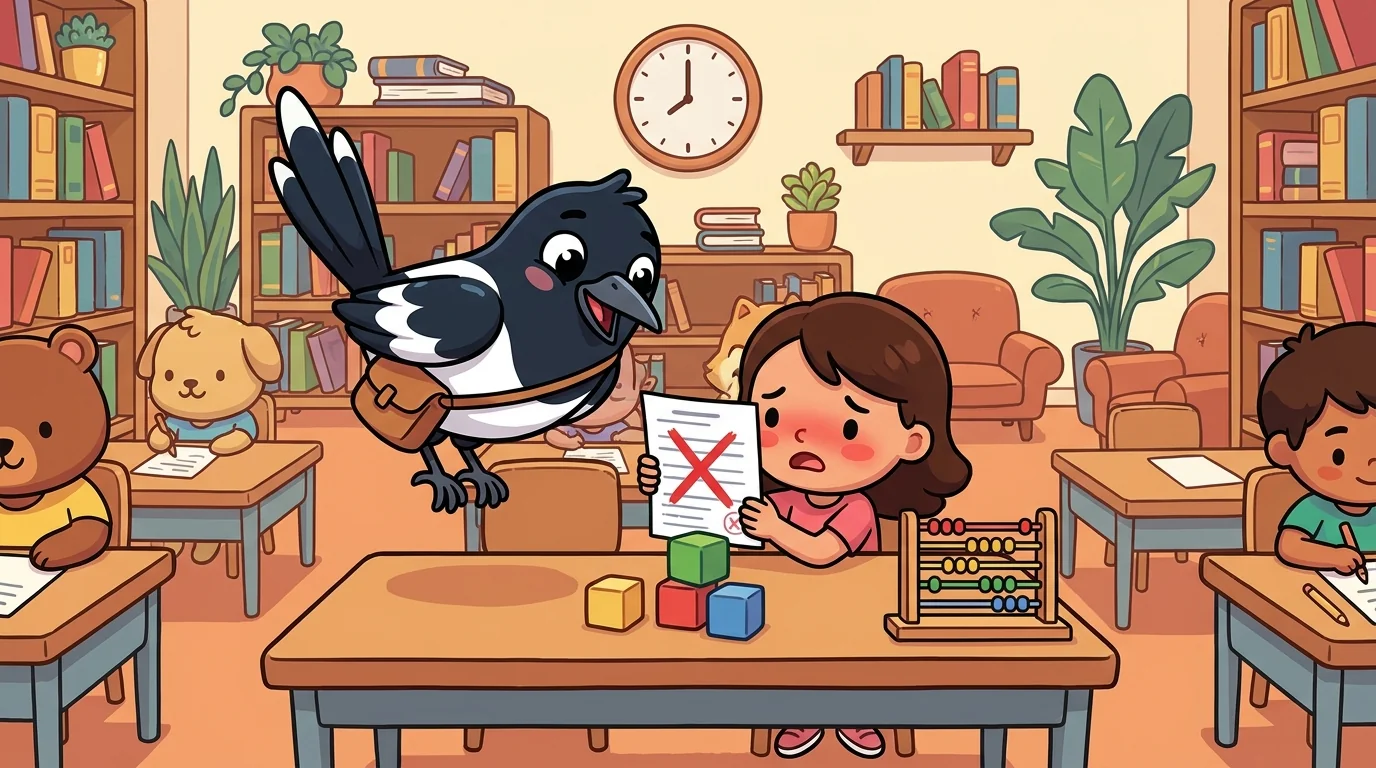
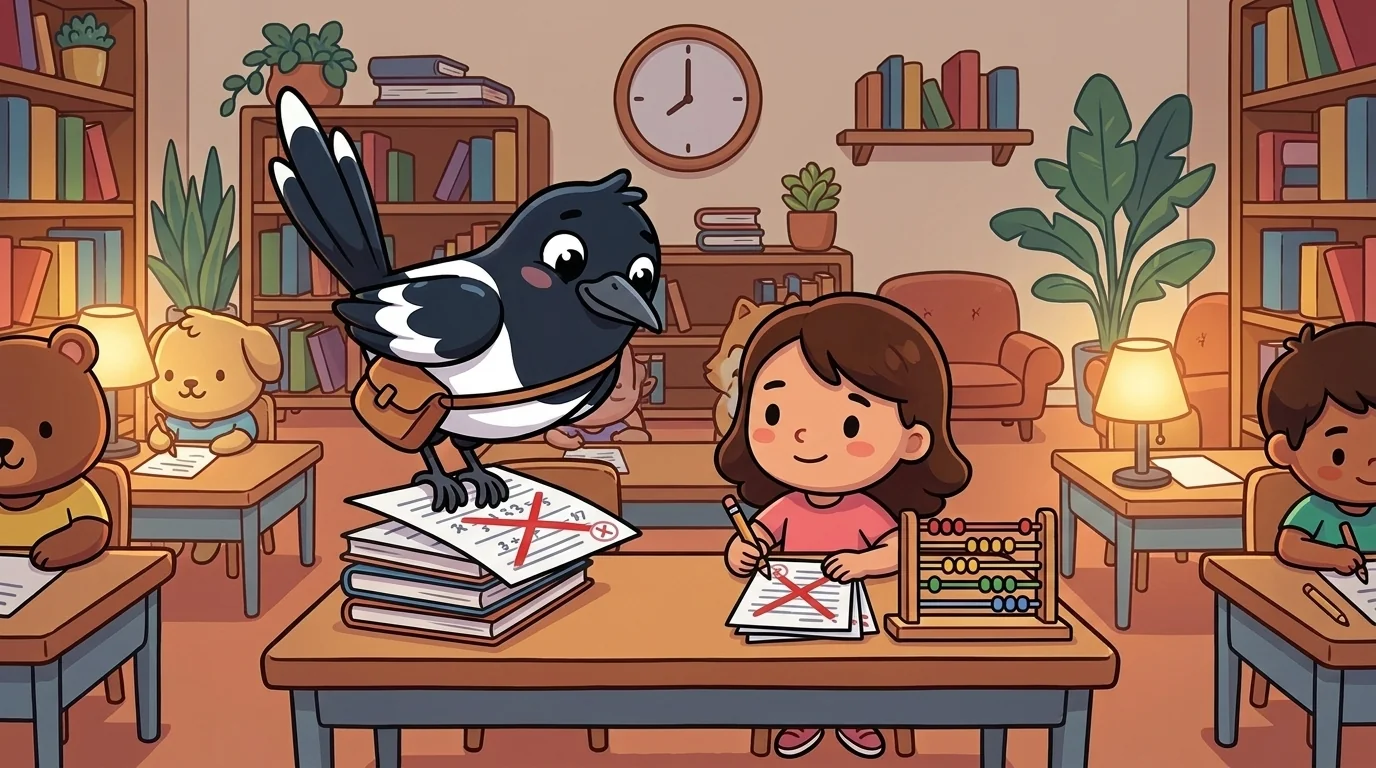
A magpie swooped down on Maya's wrong answer like it was made of gold.
Her name was Mistake Mabel, and she was the only creature in the Library who got excited when you got something wrong. Where everyone else might wince, Mabel's eyes went bright. She'd hop right up to the error, tilt her glossy head, and study it like a jewel.
"Ooh," she said, peering at the X on Maya's page. "A mistake. A real, proper one. Lovely. Do you know what this is, Maya?"
Maya's face was hot. "It's... me getting it wrong."
"It's a map," Mabel said, delighted. "A little map that shows me exactly — exactly! — where the gap in your understanding is. You could do a hundred problems right and I'd learn almost nothing about what you need. But one mistake? One good mistake tells me precisely what to help you with next. A right answer says 'all fine here.' A wrong answer says 'dig here.' I love a wrong answer. It's the most useful thing you can give me."
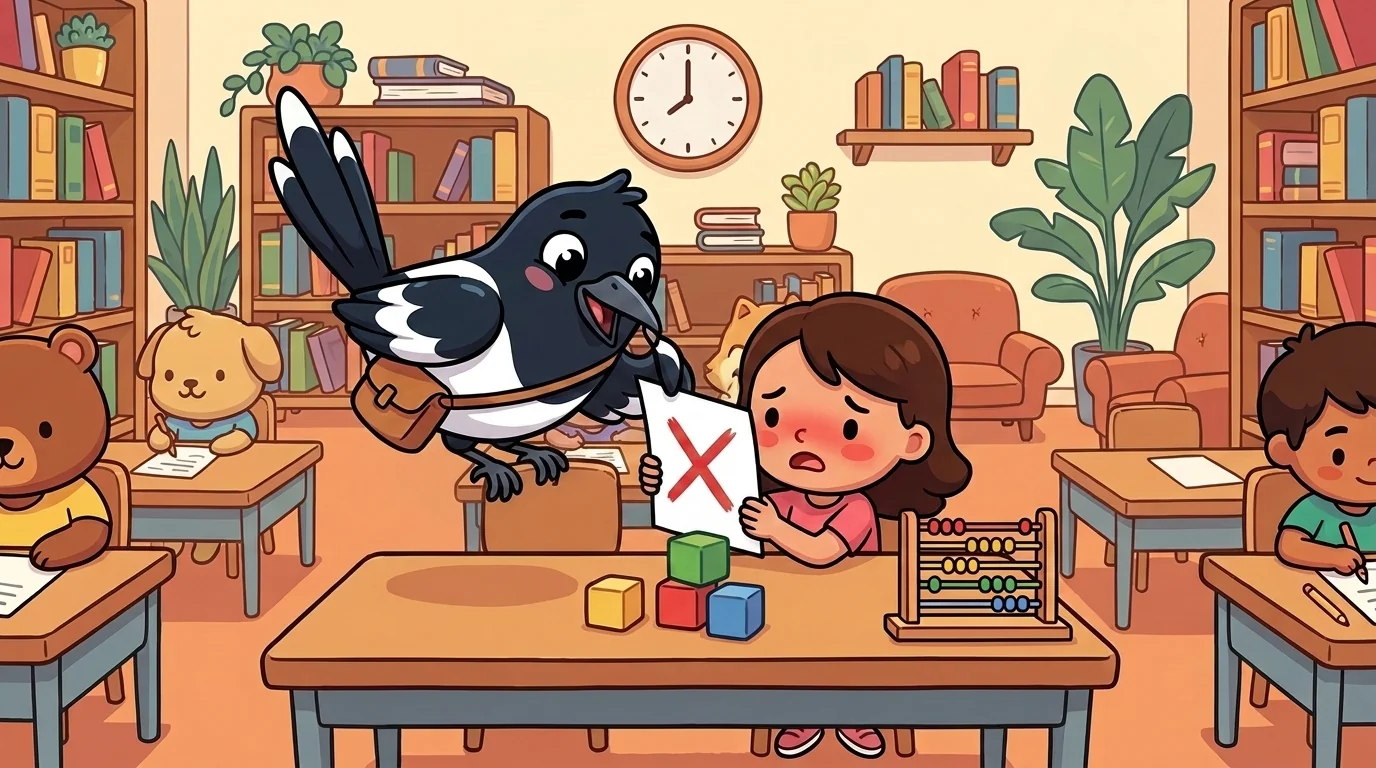
Mabel hopped along the table's edge, turning the mistake this way and that.
"Here's the thing nobody tells you," she said. "Mistakes feel awful because everyone treats them like a verdict — like getting it wrong means something bad about you. But that's not what a mistake is. A mistake is just information. It's your work, honestly showing where it got tangled. And there is nothing in the whole world more useful for learning than knowing exactly where you got tangled."
She tapped the error gently. "Look — you didn't get this one wrong randomly. You got it wrong in a particular way. And that particular way tells me the particular thing to practice. If you'd just gotten it right, that thing would've stayed hidden, and it'd trip you again later when it mattered more. Your mistake brought it into the light, where we can actually fix it. That's not failing. That's the opposite of failing. That's finding the thing."
"So you're... glad I got it wrong?" Maya asked.
"I'm glad you got it wrong here, safely, where we can learn from it," Mabel said. "Much better than getting it wrong later, somewhere it counts."
So Maya started showing Mabel her mistakes instead of hiding them.
It felt strange — every instinct said to cover the wrong answer, crumple the page, pretend it hadn't happened. But Mabel met each one with that same bright curiosity, never a flicker of judgment, and slowly the hot-faced feeling started to fade.
"This one," Mabel said, studying an error, "you flipped a step. See? Not because you don't understand — because the step is sneaky. Lots of people flip it. Now that we see it, we practice exactly that step, three times, and it stops being sneaky."
And it worked. The mistakes Maya showed Mabel turned, one by one, into the exact things she got good at — because each wrong answer had pointed like an arrow at the thing she most needed.
"It's like the mistakes are doing the teaching," Maya said, surprised.
"They are," Mabel said. "They always were. Most people just never look at them long enough to hear what they're saying."
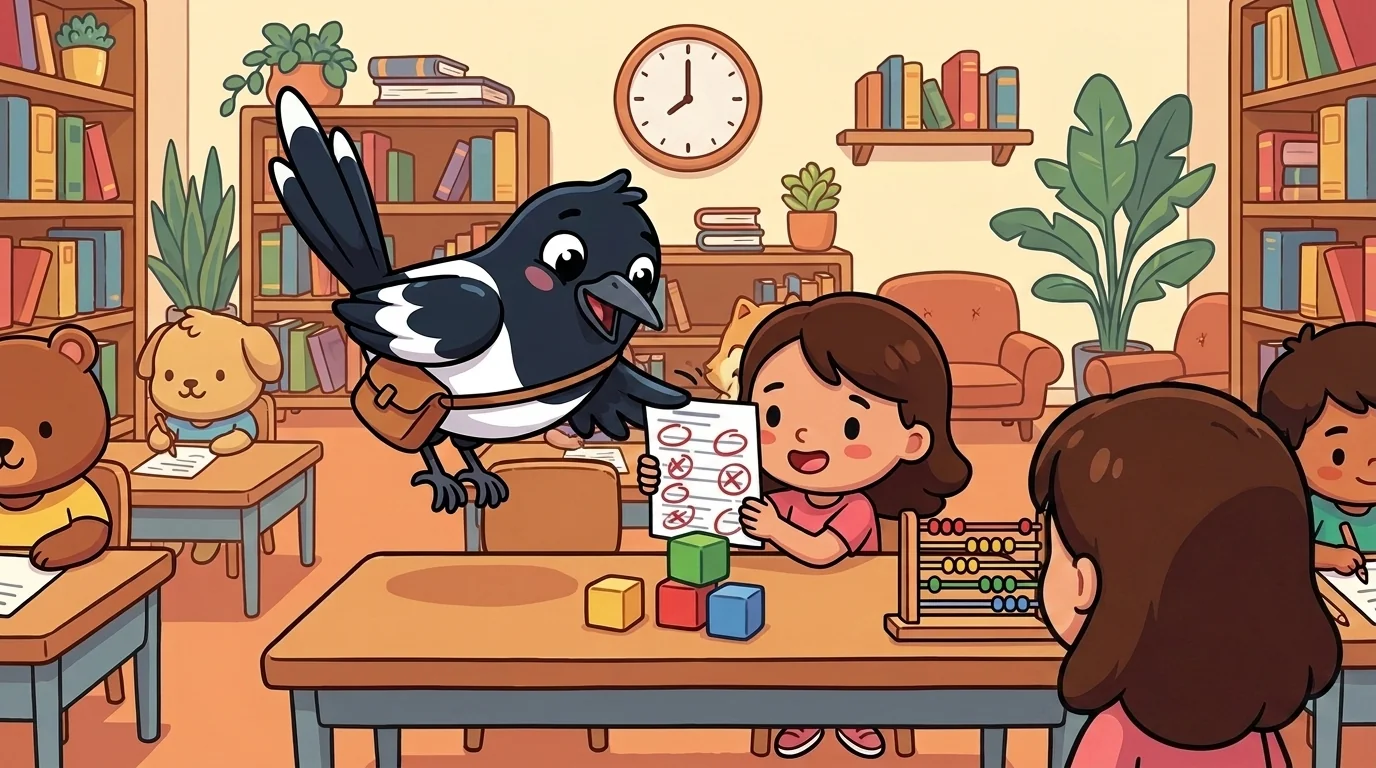
Mabel admired the page, now covered in fixed-up mistakes.
"See what we did?" she said. "We took the things you'd normally be ashamed of — the wrong answers, the X's — and we used every single one. Each mistake was a clue, and we followed every clue, and now you understand things you'd never have learned if you'd gotten everything right." She ruffled her wings. "A perfect page teaches you nothing. A page with good mistakes, looked at honestly, teaches you everything you didn't know you needed."
Maya looked at her once-dreaded mistakes, now circled and understood. "I used to hate getting things wrong so much I'd stop trying," she admitted. "So I wouldn't have to see the wrong answers."
"That's the real cost of being ashamed of mistakes," Mabel said gently. "It's not the mistakes that hurt you. It's hiding from them — never trying hard things, so you never get any wrong, so you never learn what they'd have taught you. The kids who let themselves make mistakes, and look at them, leave everyone else behind. Not despite the mistakes. Because of them."
Later, as the Library lamps came on, Maya sat with Mabel among the day's crossed-out work.
"Can I ask you something?" Maya said. "Why do you love mistakes so much? Doesn't anything about a wrong answer bother you?"
Mabel tucked a wing thoughtfully.
"Only one thing bothers me about a wrong answer," she said. "When somebody throws it away unlooked-at. That's the only waste. The mistake itself? It's a gift — it came all the way from inside your own thinking to show you something true about where you are. The least I can do is be glad to see it." She cocked her bright head. "When I was young, I was as ashamed of mistakes as anyone. I'd go red and want to vanish. Then I realized the shame was the only part that actually hurt — the mistake itself was just trying to help me. So I decided to be on the mistake's side. And the moment I stopped being ashamed, I started learning twice as fast."
She nudged a crossed-out problem fondly.
And as Maya gathered her papers — keeping the mistake-filled ones now, instead of crumpling them — she felt the hot shame she'd always carried about getting things wrong loosen and lift, replaced by something almost like gratitude: the surprising, freeing knowledge that her mistakes had never been her enemies, but quiet little maps, pointing her exactly where she most needed to go.
The AlcumusForge ensemble
Mistake Mabel is part of AlcumusForge's distributed-narrative cast. Each character embodies a different curricular primitive; together they teach the full subject.
-

Alcuin
Librarian-detective of the practice graph; knows what to try next
-

Hint Hertha
Hint author and gentle redirector; never gives the answer
-

Practice Patience
Slow-tortoise back-room keeper; long-game adviser
-

Streak Bear
Warm anti-anxiety presence; the soft-streak character
-
Stretch Sage
The wider-than-you-think reframer; surfaces transfer connections
-

Spacing Wren
Spaced review — bringing a topic back just before you'd forget it, so it sticks
-

Edge Goldi
Edge of competence — practicing at the just-right level where you grow fastest
-

Mix Margo
Interleaving — mixing problem types so you learn to tell them apart and remember
-

Recall Remy
Retrieval practice — closing the book and recalling beats rereading