
Hint Hertha and Stretch Sage
smaller-then-wider — deep mastery happens when you SHRINK a hard problem to find the meaning AND widen a solved problem to find the structure. Two directions. One discipline.
A story read by Hint Hertha and Stretch Sage
Press play to listen along. The line being read lights up as you go.
Show full transcript
Loading transcript…
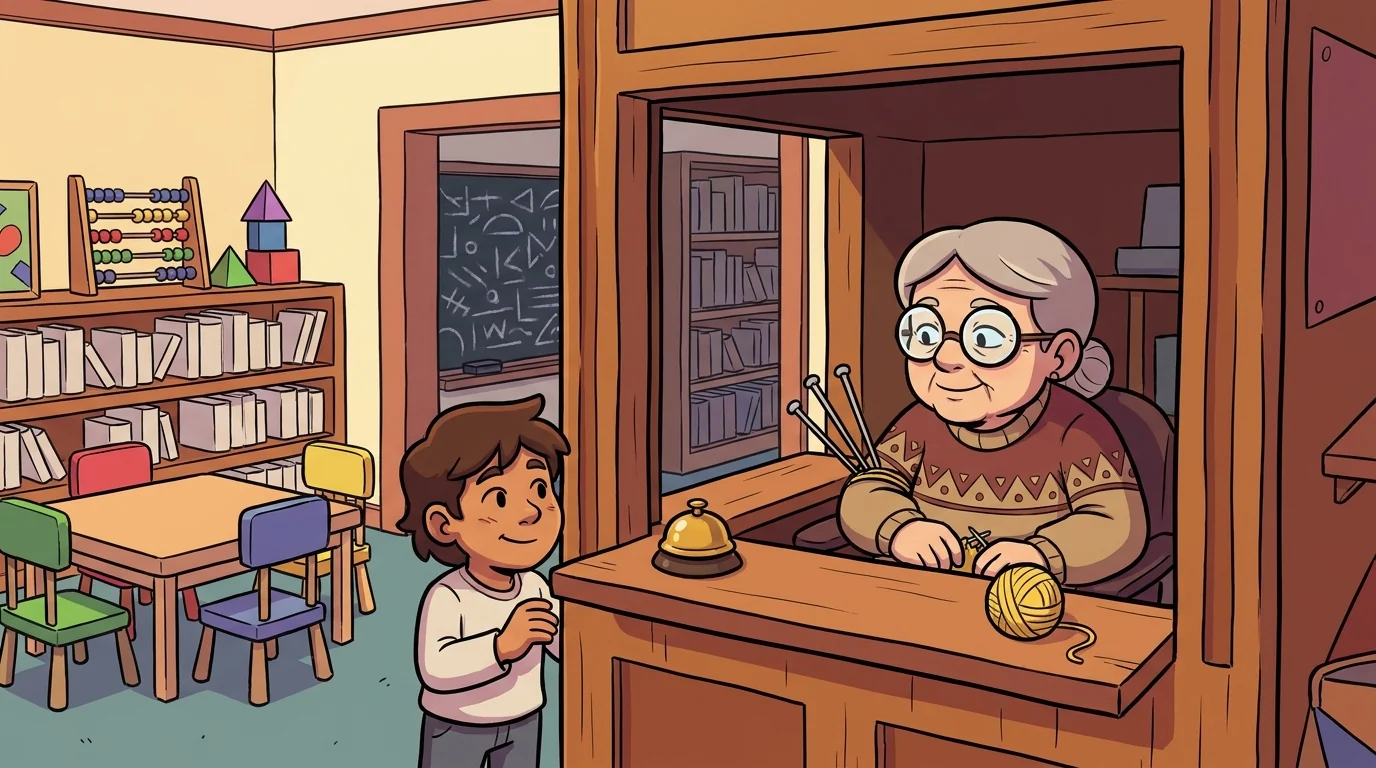
Maya was stuck.
She had been stuck for twenty minutes. The problem on her worksheet was not, by Library standards, especially monstrous. It said:
A baker has a recipe that calls for 3/4 cup of flour. She wants to make 2/3 of a batch. How much flour does she use?
Maya stared at it. She tried adding the fractions. That felt wrong. She tried subtracting them. That felt wrong too. She thought maybe she had to multiply them, but multiplying two fractions less than one would make the answer smaller than either, and she didn't know if that was even legal. She had been chewing on her pencil for so long the eraser had teeth marks.
Eventually she pushed back from the table. She walked over to the wooden booth between the children's section and the back room. She rang the bell.
Ding.
The brass shutter clanked open. Hint Hertha looked out over her round glasses. She had three knitting needles balanced on her wrist and a small ball of yellow yarn in her lap.
"Tell me what the problem is asking," she said.
Maya read it out loud. The whole thing. Twice. Hertha nodded each time. She set down her knitting.
She said, "What does it mean to take two-thirds of a batch?"
Maya frowned. "It means... you make less than a whole batch. You make a smaller batch."
"How much smaller?"
"Two-thirds of the size."
"So if a whole batch needed three cups of flour, how much would two-thirds of a batch need?"
Maya thought. "Two cups."
"Why?"
"Because two-thirds of three is two."
Hertha smiled. "Excellent. Now. The recipe doesn't call for three cups. It calls for three-quarters of a cup. So what does two-thirds of three-quarters mean?"
Maya stared at the page.
"Oh," she whispered.
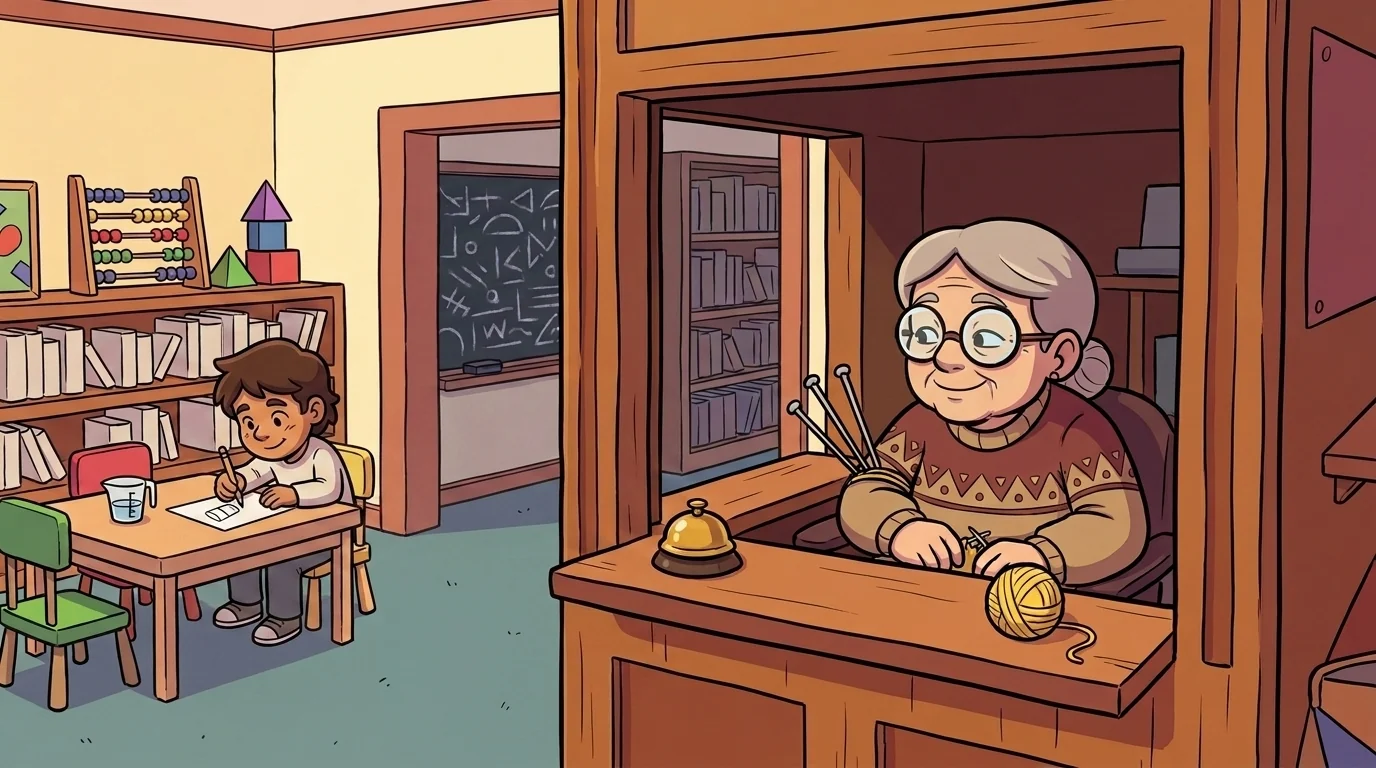
She walked back to her table. She wrote slowly:
I need 2/3 of 3/4 of a cup.
She turned that over in her head. Two-thirds of three-quarters. It wasn't an addition problem. It wasn't a subtraction problem. It was a taking-part-of-a-part problem.
She had done these before. With whole numbers. Two-thirds of fifteen. You divide by three, then multiply by two. Fifteen divided by three is five. Five times two is ten. So two-thirds of fifteen was ten.
The same recipe must work for fractions.
Three-quarters divided by three is one-quarter. One-quarter times two is two-quarters. Two-quarters is one-half.
The baker uses half a cup of flour.
Maya checked it. Half a cup is two-thirds of three-quarters of a cup. She drew a quick picture. A glass with three-quarters of a cup. Mark off two-thirds of that height. Yes. The mark landed exactly at one-half.
She laughed quietly. She wrote 1/2 cup in the answer box. She put down the pencil.
The pencil felt much lighter than it had ten minutes ago.
Maya was packing up to go home when she heard a low rumble of a voice behind her.
"What's that on the worksheet?"
She turned around. Stretch Sage was standing in the aisle, holding his sketchbook under one arm. He had come over from the alcove. He must have been watching.
"It's a fraction problem," Maya said. "I figured it out."
"May I see?"
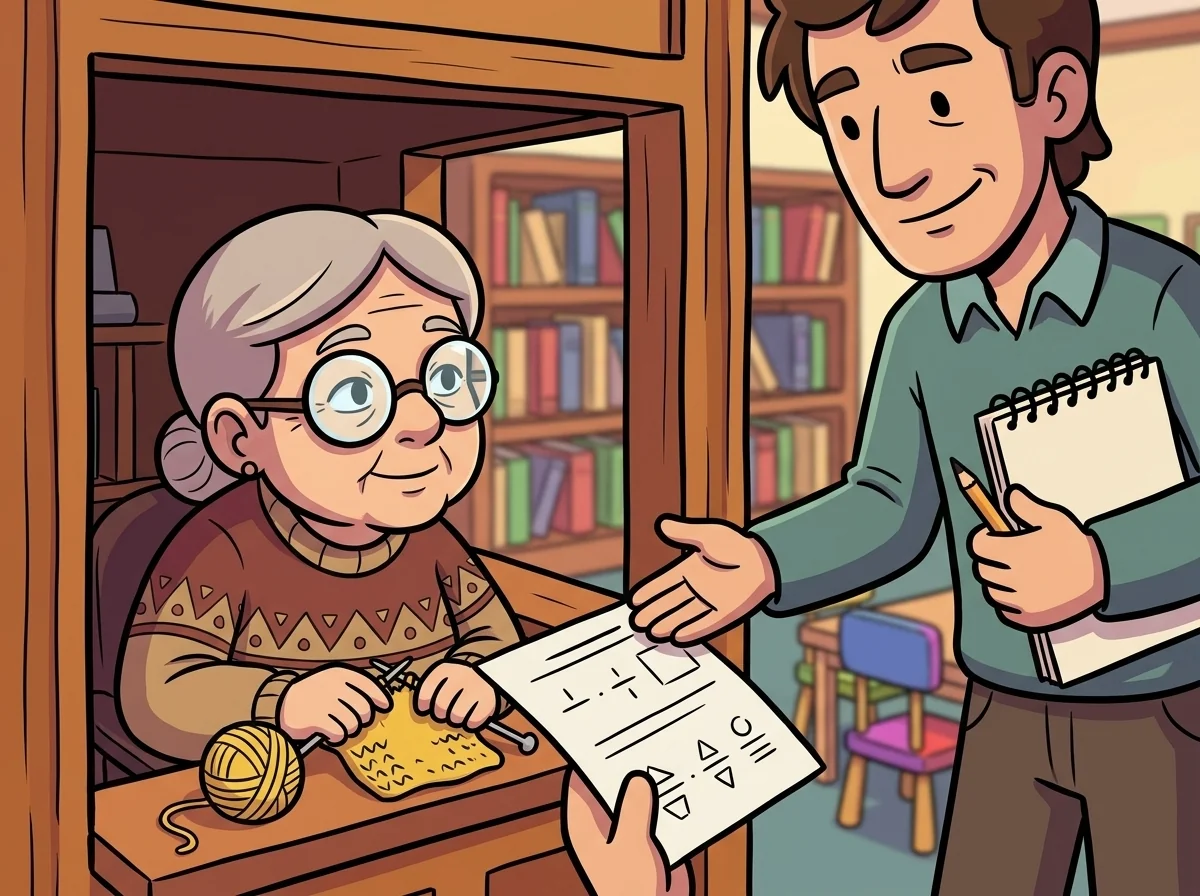
She handed him the worksheet.
Stretch read the problem. He read Maya's work. He nodded slowly. He turned his crooked smile on her.
"This is good," he said. "Hertha got you to see it as taking a part of a part. That's the real meaning. Most kids never get that meaning. They just memorize multiply across the top, multiply across the bottom. You actually saw it."
"Thank you."
"What would happen," Stretch said, tapping the page, "if the baker wanted to make seven-eighths of a batch instead of two-thirds?"
Maya thought.
"Then I'd need seven-eighths of three-quarters."
"And how would you do that?"
"Three-quarters divided by eight is three-thirty-seconds. Times seven is twenty-one thirty-seconds. I'd use twenty-one thirty-seconds of a cup."
"Whatever-thirty-seconds is small," Stretch said. "Is that right?"
"It's less than a cup. The original was three-quarters of a cup. Seven-eighths is almost a whole batch. So the flour should be almost three-quarters of a cup. Twenty-one thirty-seconds is..."
She did the math.
"Twenty-four thirty-seconds is three-quarters. Twenty-one is three less than twenty-four. So it's three thirty-seconds less than three-quarters. That's a little less than a teaspoon less than three-quarters. That sounds right."
"That sounds right to me too," Stretch said. He nodded approvingly.
He flipped the worksheet over.
"Now, what would happen," he said, "if the recipe called for 2/3 cup of flour instead of three-quarters, and the baker wanted 3/4 of a batch instead of two-thirds?"
Maya squinted. "That's... the same numbers. Just swapped."
"Is it the same answer?"
She paused. Three-quarters of two-thirds. Two-thirds of three-quarters. She had figured both of those.
Three-quarters of two-thirds. Two-thirds divided by four is two-twelfths. Times three is six-twelfths. Which is one-half.
The same answer.
Half a cup.
Maya's eyes went wide.
"It's the same?"
"It's the same."
"But that doesn't make sense. The recipe is different. The batch size is different."
"And yet," Stretch said.
Maya stared at her worksheet.
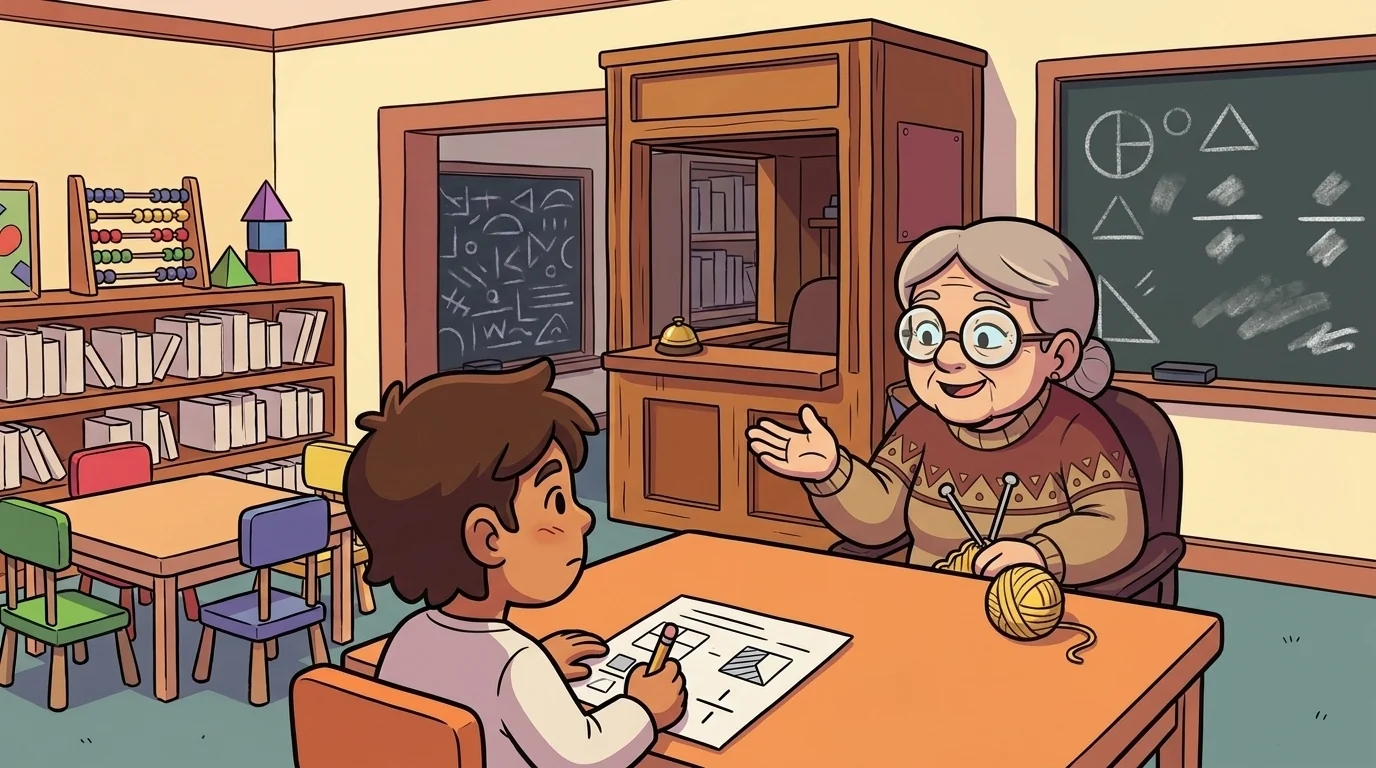
"The order doesn't matter," she said slowly. "Two-thirds of three-quarters is the same as three-quarters of two-thirds. The flour needed is the same."
"Why might that be?" Stretch asked.
Maya thought hard. The answer was hovering somewhere just out of reach.
"Because... we're taking the same total amount of stuff each time? Two-thirds and three-quarters multiplied together is the same as three-quarters and two-thirds multiplied together. Multiplication doesn't care about order. Two times three is the same as three times two. So when we multiply fractions to get a part of a part, it doesn't matter which is the part and which is the whole."
"That's a deep observation," Stretch said. "That's actually a property of multiplication. Mathematicians call it commutativity. It holds for whole numbers. It holds for fractions. It holds for almost every kind of number you'll meet. Multiplication doesn't care about order. Addition doesn't either. Subtraction does. Division does. You can tell a lot about an operation by asking whether it cares about order."
Maya looked at the worksheet again. The original problem felt very, very small now. It had grown into something much wider.
She had started the afternoon stuck on one fraction-baking problem.
She had ended it with a property of multiplication.
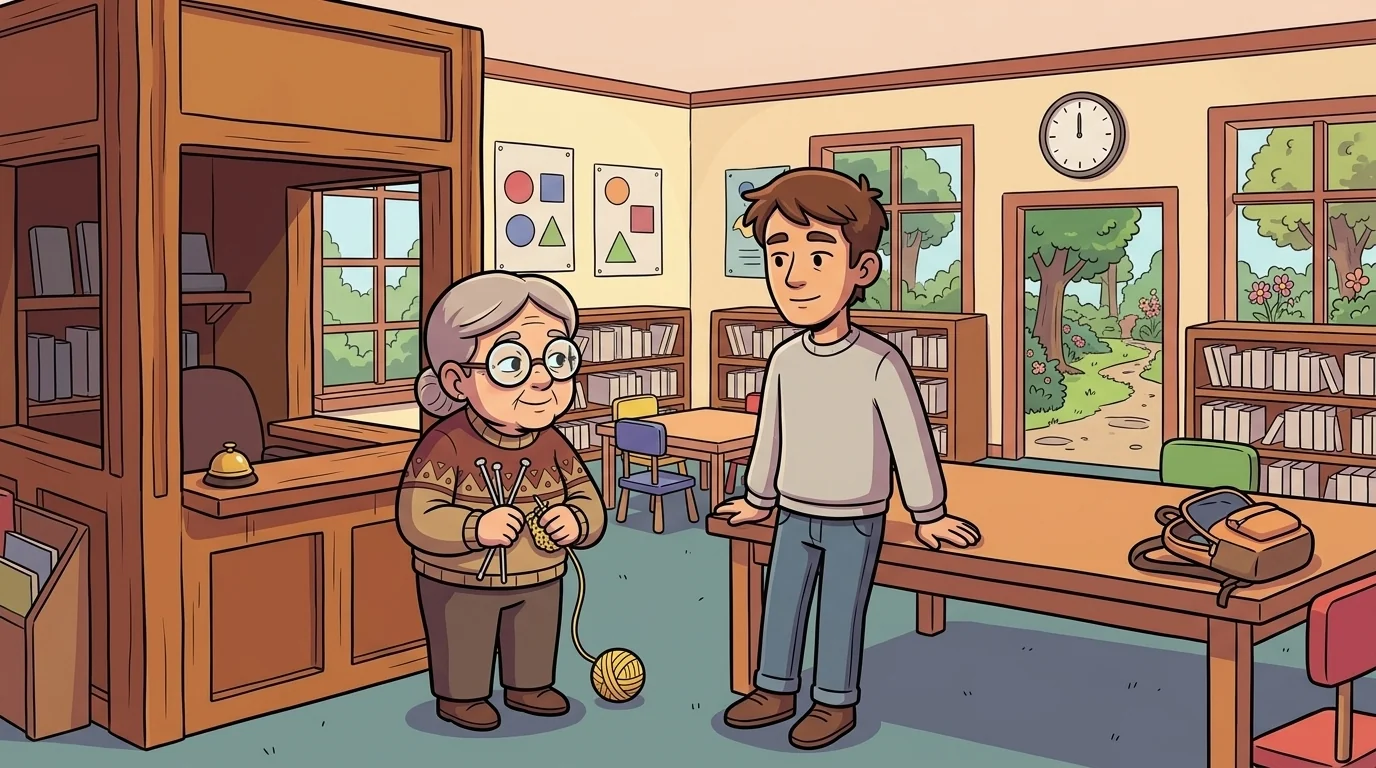
She was packing her bag for real this time. Hertha had come out of her booth to stretch her legs. Stretch was still leaning on the table.
"You two ganged up on me," Maya said, almost laughing.
"We didn't gang up," Hertha said. "I showed up first. Sage showed up second. He always does that."
"I show up after the problem has been defeated," Stretch said. "I cannot defeat problems. I can only widen them. Hertha defeats them by making them smaller. Then I take what is left and make it bigger again. In a different direction."
"It's the same problem," Hertha said.
"It is the same problem," Stretch said.
"It's just gone smaller and then wider," Hertha said.
"You make it sound easy," Maya said.
"I make it sound like a discipline," Hertha said. "Which is what it is. The problem on your page took twenty minutes. The lesson took one afternoon. The lesson is going to last a year. That is the trade."
Stretch nodded slowly.
"Smaller, then wider," he said. "That's the whole job."
"That's the whole job," Hertha agreed.
Maya walked home along the path through the gardens. She did not stop thinking about three-quarters and two-thirds the whole way. She did not stop thinking about commutativity either, even though she did not yet trust the word. She had never met a math word she trusted on first acquaintance.
But she had decided one thing.
She would ring the bell again tomorrow.
And then she would go find Stretch in his alcove.
She would do it in that order.
The AlcumusForge ensemble
Hint Hertha and Stretch Sage is part of AlcumusForge's distributed-narrative cast. Each character embodies a different curricular primitive; together they teach the full subject.
-

Alcuin
Librarian-detective of the practice graph; knows what to try next
-

Hint Hertha
Hint author and gentle redirector; never gives the answer
-

Practice Patience
Slow-tortoise back-room keeper; long-game adviser
-

Streak Bear
Warm anti-anxiety presence; the soft-streak character
-

Stretch Sage
The wider-than-you-think reframer; surfaces transfer connections
-

Spacing Wren
Spaced review — bringing a topic back just before you'd forget it, so it sticks
-

Edge Goldi
Edge of competence — practicing at the just-right level where you grow fastest
-

Mistake Mabel
Mistakes as information — every error is a map to what to practice next
-

Mix Margo
Interleaving — mixing problem types so you learn to tell them apart and remember
-

Recall Remy
Retrieval practice — closing the book and recalling beats rereading