
Sure
CONFIDENCE — *a model doesn't just answer; it reports how sure it is.* The AI-literacy primitive of *confidence* — reading a model's answer as a probability ("70% cat"), and treating a low-confidence answer as a signal to slow down and check rather than a verdict to trust.
Press play to listen along. The line being read lights up as you go.
Show full transcript
Loading transcript…

Sure was made of a paper dial with a swinging needle.
It wasn't an animal, and it wasn't a robot. Sure was a round card face with numbers around the edge, from zero in the corner up toward a hundred — and a light needle that swung to point somewhere along the way. The needle almost never slammed all the way to a hundred. It usually settled somewhere in the middle-high range, quivering a little. That was Sure's whole body: a face, some numbers, and an honest, trembling needle.
Sure had one job. Whenever a model gave an answer, Sure reported how sure the model was about it. Not just "cat." Sure said "seventy out of a hundred — cat." "The answer is only half the story," it would say. "The other half is how confident the model is. Never take one without the other."

This is a piece almost everyone forgets. Sure teaches *confidence. A model rarely "knows" an answer the way you might imagine. It produces a probability* — a number for how well the clues matched each option. "Seventy percent cat, thirty percent dog" is a very different message from "ninety-nine percent cat," even though both would just say "cat" if you only listened to the top answer. The confidence tells you whether to trust it or double-check.
Sure loved to point out the danger of ignoring the needle. "People hear the answer and treat it like a fact," it said. "But if my needle only reached sixty, that answer is barely more than a coin-flip dressed up in a confident voice. The model isn't lying. It reported sixty. Someone just didn't look at the needle."
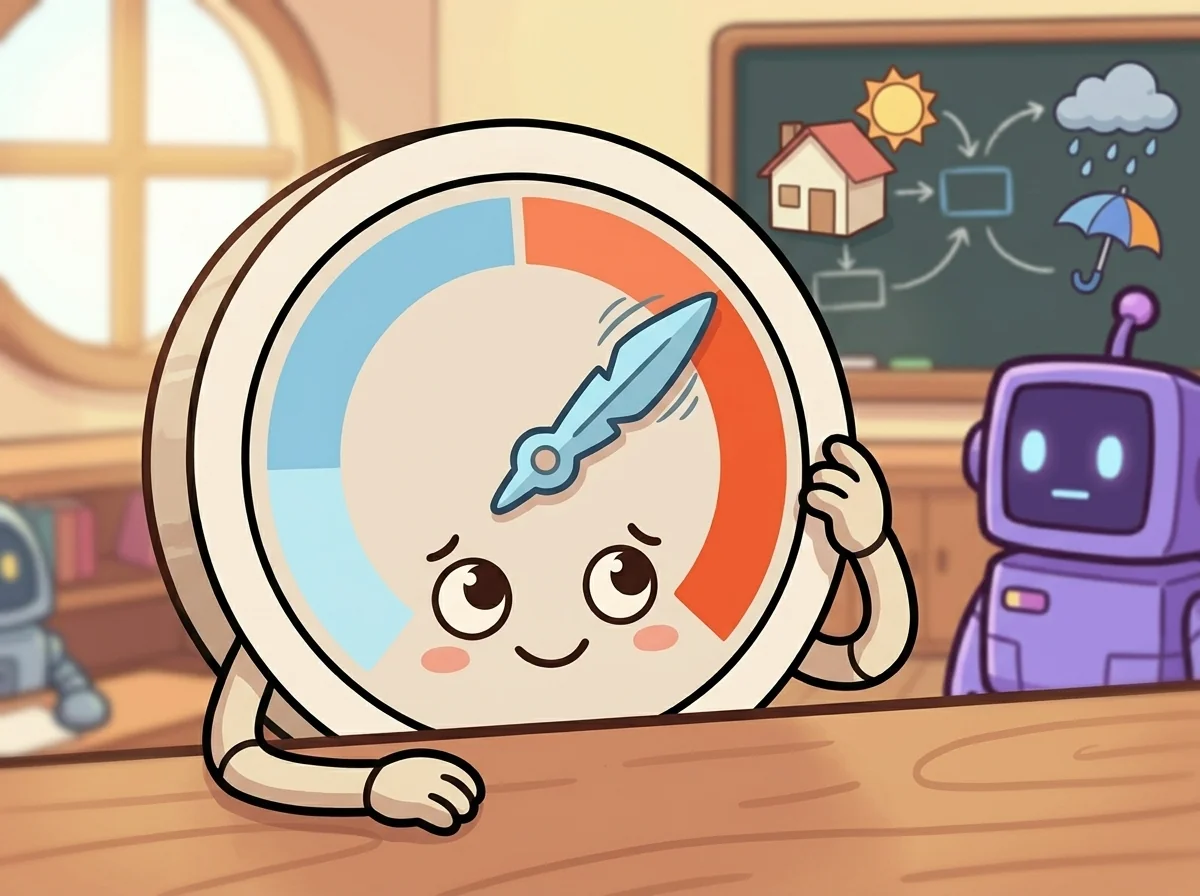
Sure never claimed to feel certain or doubtful — it had no feelings at all. "I do not worry," it said. "I am a dial. I show a number. But that number is the most honest thing the model can give you." Some people imagine AI as always right or always wrong, on or off. Sure showed the in-between truth: most answers come with a how-sure, and reading it is the difference between using a tool well and being fooled by it.
Sure came from the village, its dial-face painted in the paper-crafts workshop. Its first job was helping the weather corner of the local paper. The old forecast just said "rain" or "sun," flat and certain, and people planned whole days around it — and got soaked, and got furious. Then Sure was added, and the forecast changed to "seventy percent chance of rain." Now people carried an umbrella when the needle was high and risked it when the needle was low. Nobody was angry anymore, because nobody had been promised certainty. Sure understood its purpose then: an honest 'how sure' saves people from a confident wrong answer.
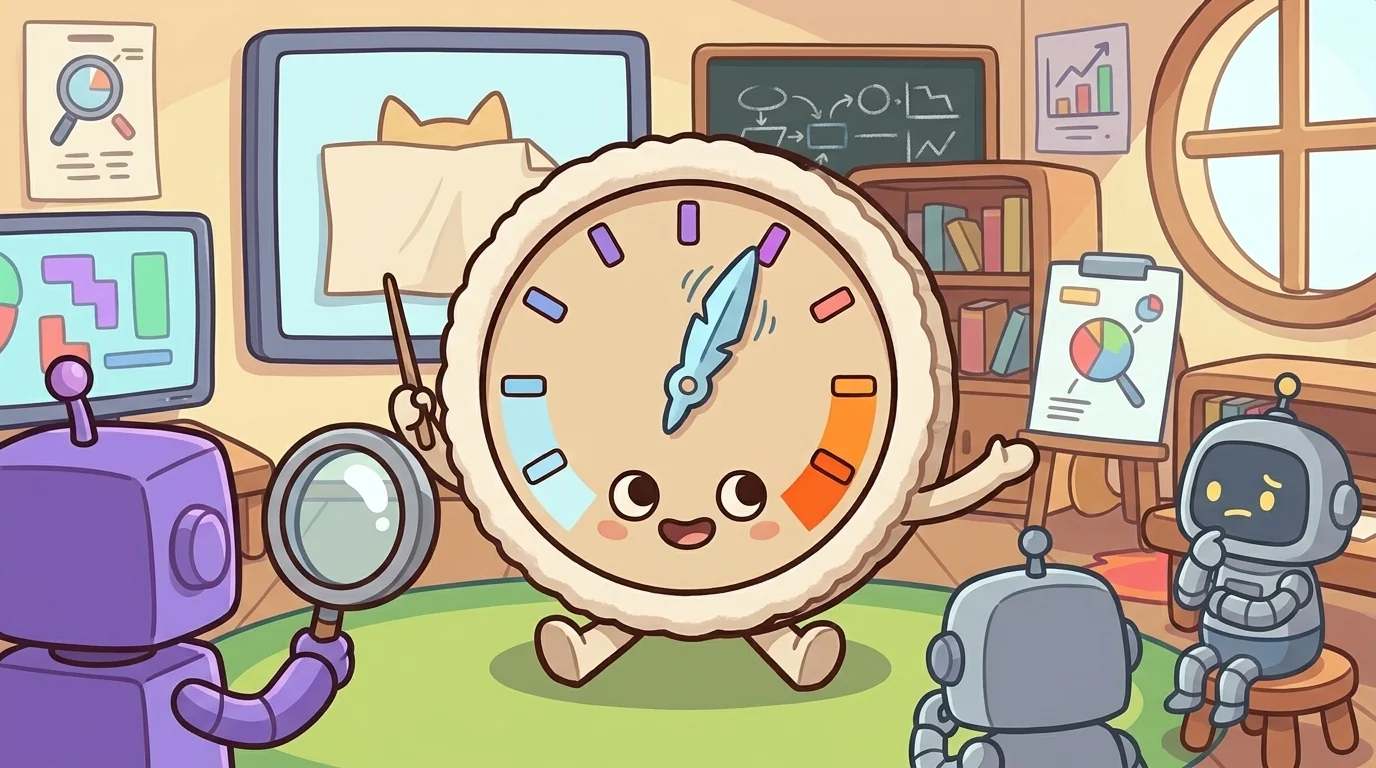
One day Bit came to the workshop, looking for teachers for the AIForge academy.
"What is confidence?" Bit asked.
Sure's needle swung and settled, quivering, at about seventy. "It is how sure the model is, reported as a number," it said. "The answer alone can fool you. The answer plus the confidence tells you whether to trust it or check it. A low needle is not a failure — it is the model being honest that this one is close." "You are hired," Bit said.
In its classroom, Sure begins each lesson by asking the model a question and then covering the answer. "Before we look at what it said," Sure tells the students, "let's look at how sure it was." Then they reveal the needle, and only after that the answer — so the students learn to read confidence first.
It teaches the students a few habits about confidence: Read the needle, not just the answer. "Cat at 95" and "cat at 55" are very different messages, even though both say cat. *A low confidence means check, not trust. When the needle is low, that's the model asking you to slow down — not a green light. *High confidence can still be wrong. A confident model that had bad clues (ask Cue) or biased data (ask Skew) can be sure and mistaken. Confidence isn't proof. *Never round the needle to certainty. Turning "70%" into a flat "yes" throws away the most useful part. *Two close numbers mean it's torn.* "51% cat, 49% dog" means the model basically shrugged. Treat it that way.
Sure tells its students, "The scariest thing isn't a model that's unsure. It's a model that's unsure but sounds certain because nobody showed the needle. Show the needle. Then people can decide wisely."

When a student asks whether a model can ever be totally sure, Sure always answers the same way, needle trembling honestly below the top:
"Almost never all the way. And that's fine. Knowing how sure is what keeps you safe. Read the needle first."
Sure lets its needle rest at an honest seventy, not pretending to reach the end, and the uneasy wait-it-wasn't-certain feeling it used to notice when people treated its numbers as facts has settled into a clear, honest calm — the steady gladness of telling the truth about how sure you really are.
The AiForge ensemble
Sure is part of AiForge's distributed-narrative cast. Each character embodies a different curricular primitive; together they teach the full subject.
-

Sort
Classifier — the simplest ML; putting things in categories
-

Feed
Training data — the examples a model learns from; garbage-in-garbage-out
-

Skew
Bias — where AI systems go wrong when training examples lean
-

Edge
Model limitations — what a model can't do; modeling 'I don't know' as a good answer
-

Stake
Ethics — what's at stake in deploying AI; people choosing, not rules-from-the-sky
-

Split
Train/test split — keep some examples hidden to tell learning from memorizing
-

Cue
Features — a model decides from the clues you give it; choose good clues