
Guess and Grade
SUPERVISED TRAINING — *guess, check the guess against the true answer, and let the gap fix the model.* The AI-literacy primitive of the training loop — a model makes a prediction, an answer key marks how far off it was, and that measured error is exactly what nudges the model to do better next time.
Press play to listen along. The line being read lights up as you go.
Show full transcript
Loading transcript…
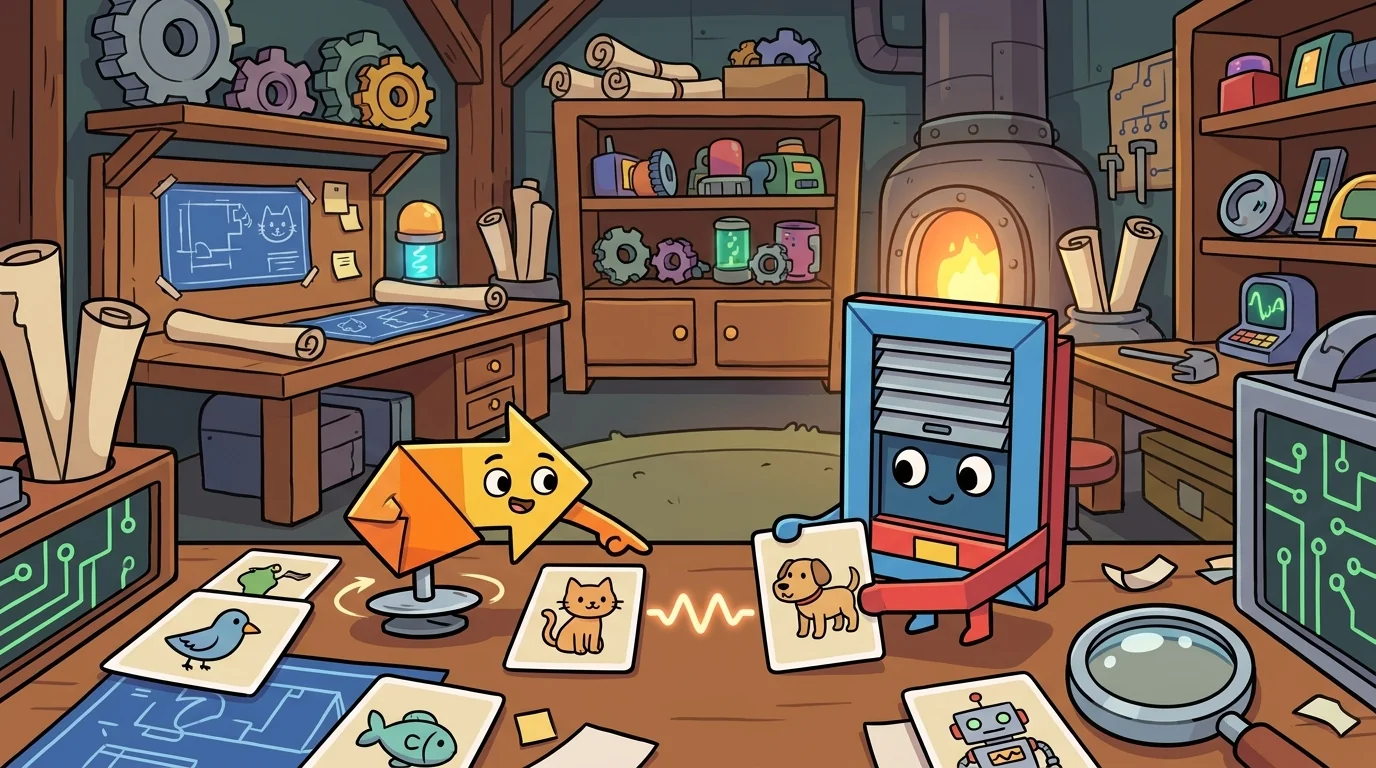
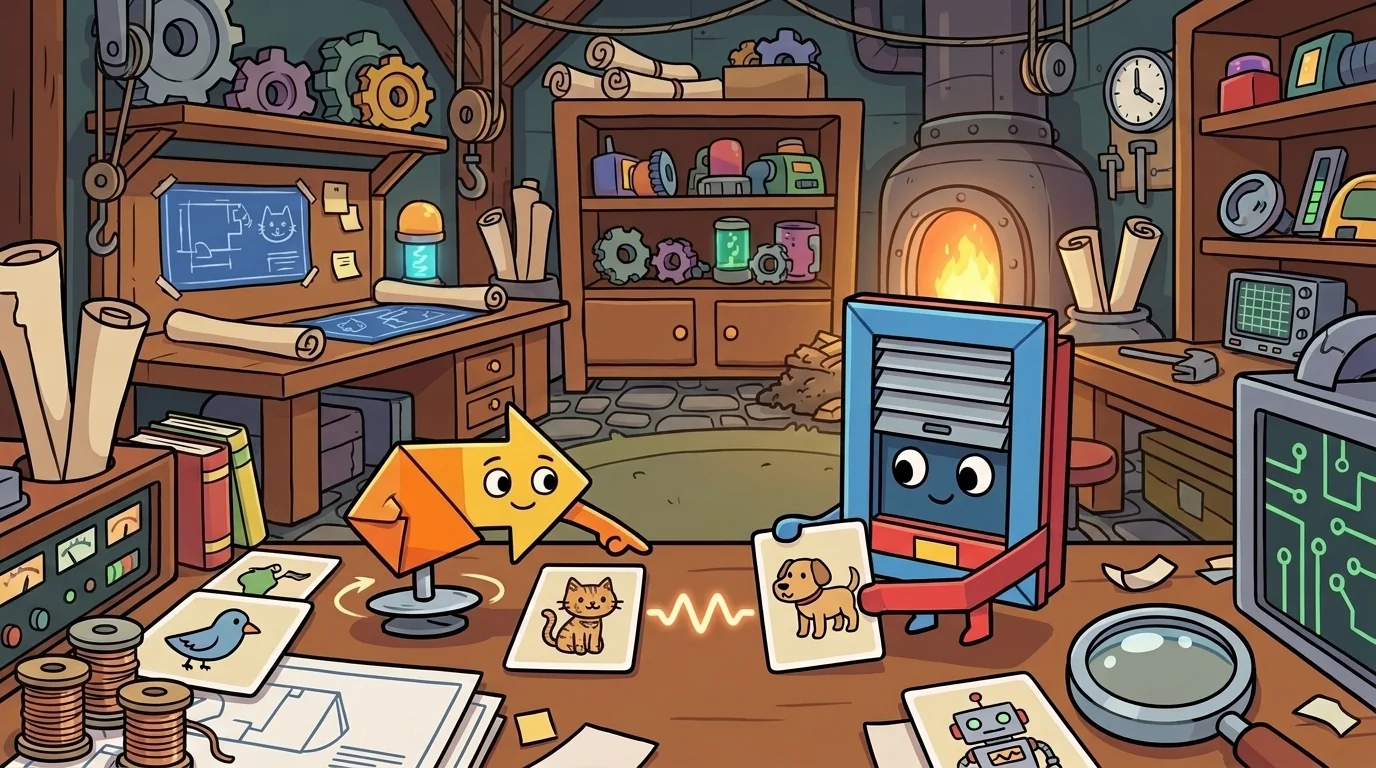
In the corner of the AIForge workshop, two paper figures worked as a pair, and neither made much sense without the other.
Guess was a folded arrow on a pivot. It swung to point at an answer — this card is a cat, that one is a dog — quickly, willingly, over and over. It was built to commit. Grade was a flat frame that held an answer key behind a little shutter. Grade never guessed anything. It only did one thing: it laid Guess's pointing arrow beside the true answer and marked exactly how far apart they were. Guess predicts. Grade measures the miss. Together they are how a model learns at all.
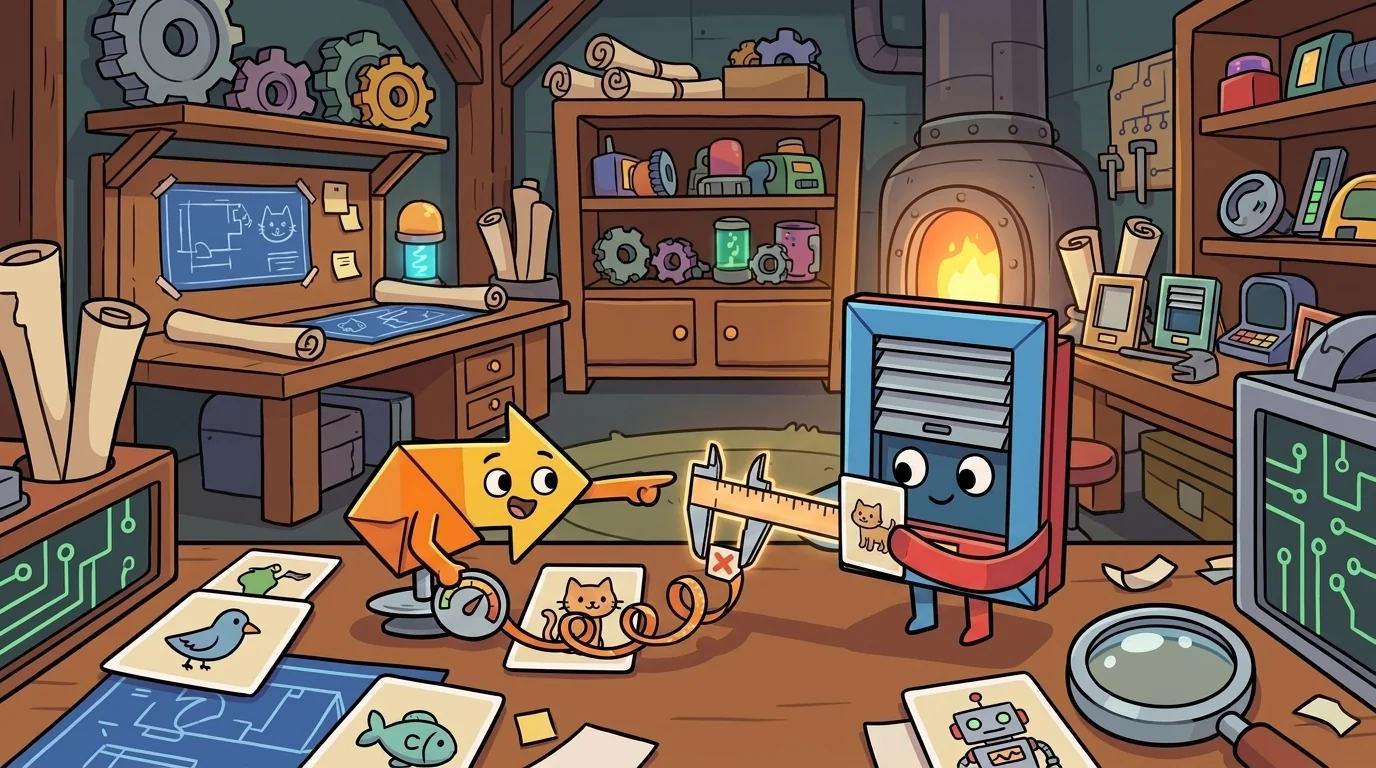
Guess was made to be unafraid of being wrong. "I point," it would say. "Sometimes I point right, sometimes I point wrong. Pointing is my whole job. A guess I never make can never be corrected." At first, Guess pointed almost randomly — it hadn't learned anything yet, so its arrow was all over the place.
That's where Grade came in. After each guess, Grade slid open its shutter, showed the true answer, and set Guess's arrow next to it. "Off by a lot," Grade might say. Or, later, "off by a little." Grade never sounded cross about it. It just reported the size of the gap, plainly, like a ruler. And here was the strange, wonderful part: that measured gap was fed back into the model, and the model used it to nudge itself — a little less wrong the next time.
This is the beating heart of how models learn. Guess and Grade teach the *training loop. It goes: the model guesses, an answer key grades how far off the guess was, and that measured error adjusts* the model so the next guess is better. Then it happens again. And again — thousands of times. Slowly, guess by graded guess, the arrow that once pointed randomly starts landing on the right answer.
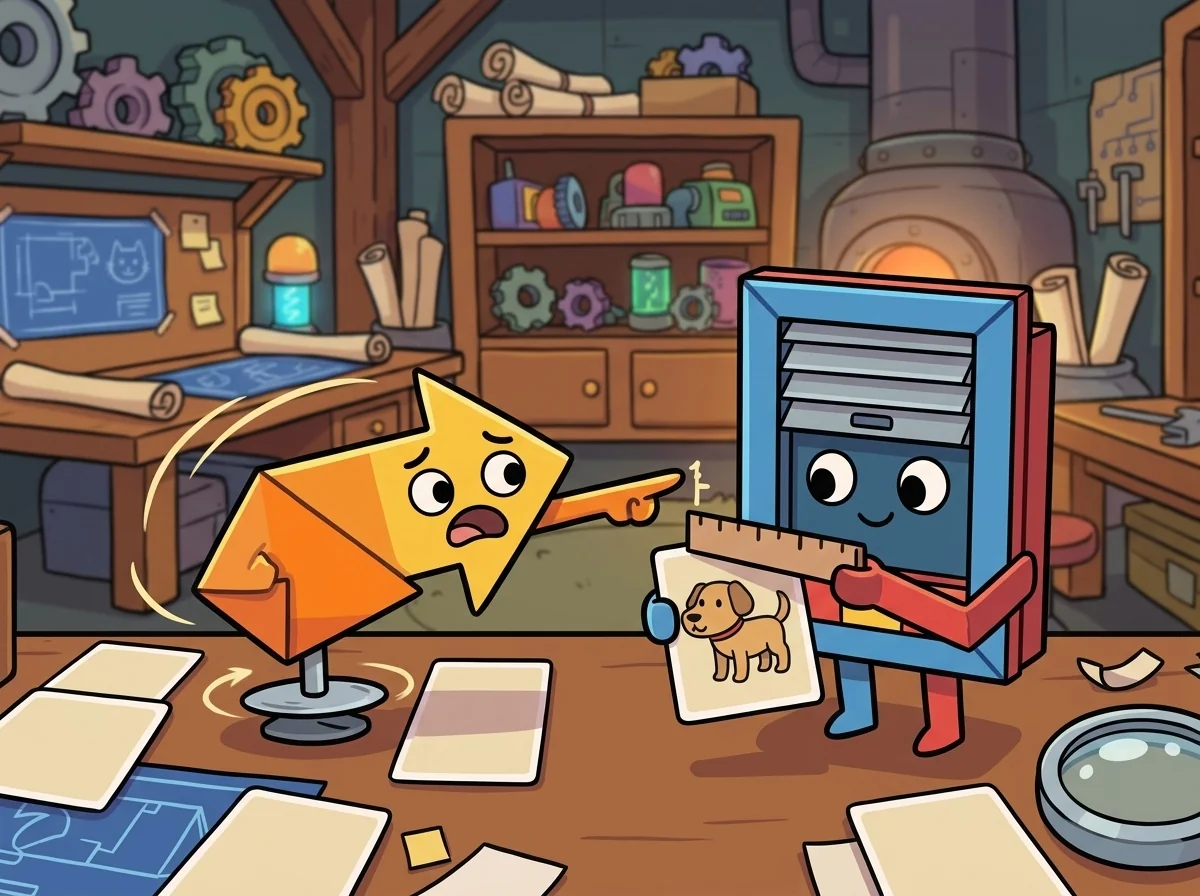
"People imagine a model just 'knows' things," Guess said. "It doesn't. It started out guessing like this —" and it swung wildly "— and only got good because Grade kept measuring the gap." Grade added, "I am not punishing anything. I am a ruler for wrongness. The gap is not a scolding. The gap is the lesson. Without it, nothing improves."
Neither claimed to think or feel. "I am an arrow on a pivot," said Guess. "I am a frame with an answer key," said Grade. "Between us, we are how learning happens — not magic, not a mind. Just guess, measure the miss, nudge, repeat." Some people find it unsettling to imagine an AI that learns. Guess and Grade made it calm and ordinary: it's a practice loop, the same one a kid uses shooting baskets — throw, see how far you missed, adjust, throw again.
The pair came from the village, folded together in the paper-crafts workshop and never separated. Their first job was helping the archery club's youngest beginners, who were so afraid of missing that they wouldn't loose an arrow at all. Guess showed them how to just let it fly. Grade stood by the target and called the distance — "a hand's width left," "closer now," "closer still" — never mocking, only measuring. And the beginners improved fast, because now every miss came with an exact, friendly measurement of how to fix it. The pair understood their shared purpose that day: a guess plus an honest measure of the miss is how anything — a child or a model — gets better.
One day Bit came to the workshop.
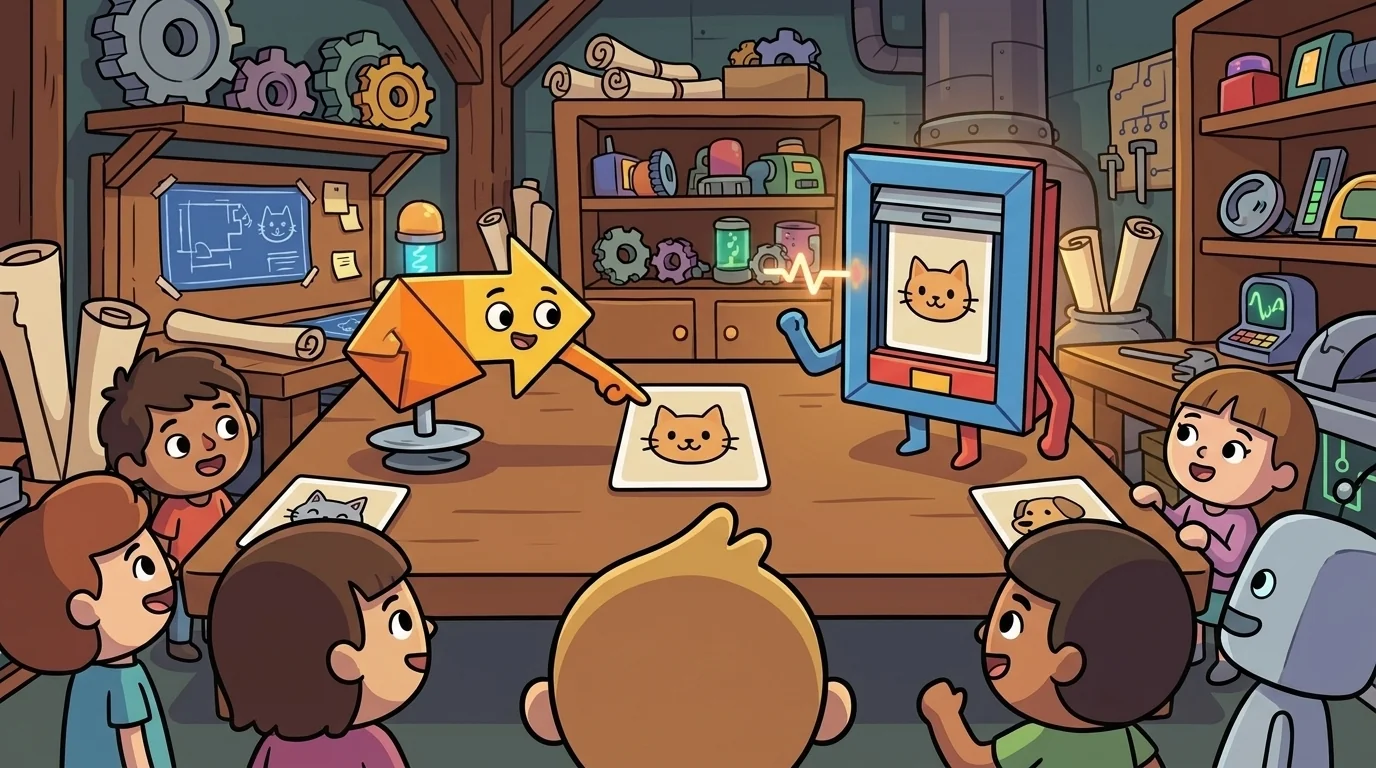
"What is the training loop?" Bit asked them together.
Guess swung its arrow. "It is making a prediction." Grade opened its shutter. "And measuring how far off it was from the true answer — so the model can nudge itself closer next time. Guess, grade, adjust. Thousands of times." Bit nodded. "You are two halves of one thing," it said. "You are hired. Together."
In their shared classroom, Guess and Grade run every lesson the same way. Guess makes a prediction out loud. Then — before anyone reacts — Grade reveals the true answer and measures the gap. Then the most important step: "Now watch," they say together, "how the gap tells the model exactly what to fix." And they do it again, and the guesses visibly improve.
They teach the students a few habits about the training loop: A model starts by guessing badly. That's normal. Good models are made, not born, one graded guess at a time. *The gap is the teacher. Measuring how wrong (not just "wrong") is what lets the model improve. A plain "no" teaches almost nothing. *Grade honestly, never harshly. The answer key measures the miss; it doesn't shame the guess. Harshness adds nothing the measurement didn't already. *It takes many rounds. One graded guess barely moves the model. Thousands slowly turn a random arrow into a reliable one. *No gap, no learning.* If Guess never checked its guess against a true answer, it could point forever and never improve.
Guess tells the students, "I am wrong constantly, especially at the start. That is not failure — that is the raw material." Grade adds, "And I only ever measure the miss. Neither of those is a scolding. That is just the loop, working."
When a student asks whether it's bad for the model to guess wrong so much, Guess and Grade answer together, one after the other:
"It's the only way," says Guess. "A guess is where every bit of learning starts." "And the gap," says Grade, "is what turns that guess into a better one. Wrong, measured kindly, is exactly how it improves."
Guess lets its arrow rest, no longer swinging wildly but landing near the mark; Grade closes its shutter over a small, honest gap. The on-the-spot exposure Guess once felt at every wrong point has eased into something the pair now shares — a warm, forward-leaning lift, the oh-now-I-know-how-to-improve gladness of a miss that showed exactly what to fix.
The AiForge ensemble
Guess and Grade is part of AiForge's distributed-narrative cast. Each character embodies a different curricular primitive; together they teach the full subject.
-

Sort
Classifier — the simplest ML; putting things in categories
-

Feed
Training data — the examples a model learns from; garbage-in-garbage-out
-
Skew
Bias — where AI systems go wrong when training examples lean
-
Edge
Model limitations — what a model can't do; modeling 'I don't know' as a good answer
-

Stake
Ethics — what's at stake in deploying AI; people choosing, not rules-from-the-sky
-

Split
Train/test split — keep some examples hidden to tell learning from memorizing
-

Cue
Features — a model decides from the clues you give it; choose good clues
-

Sure
Confidence — a model reports how sure it is; low confidence means check, not trust