
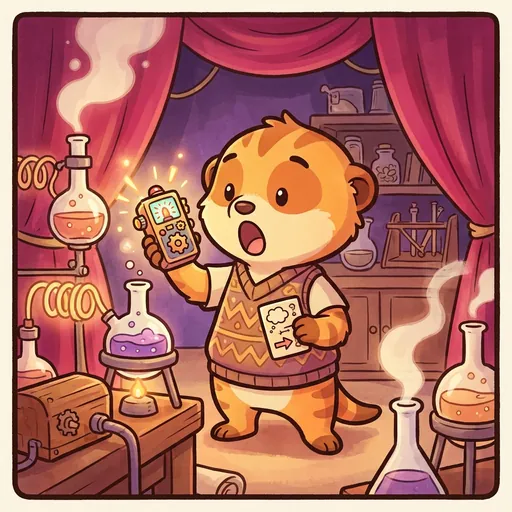
Gasp
GASP — *the gasp is information. it means your model just broke.*
Listen along — Gasp
Loading audio…
Press play to listen along. The line being read lights up as you go.
Show full transcript
Loading transcript…
Chapter 1 — Gasp and the Information of Surprise
Gasp was a careful-meerkat-tween, small and quick, with a shock of warm-citrus-orange hair that often seemed to stand on end, like a perpetual surprise. Their lab vest, a chunky cartoon-style garment, was covered in small, embroidered patches. One patch showed a wide-open mouth, mid-gasp. Gasp carried two essential tools: a small, handheld surprise-tracker and a stack of expectation-cards. They were always ready.
Gasp’s mind worked like a finely tuned alarm, always listening for the quiet thunk of something not quite fitting. That sound, to Gasp, was the most interesting noise in the world. It meant a tiny, exciting break in the usual pattern. Gasp loved those moments, those sudden, wide-eyed instants when the world showed you something completely unexpected. They called it discrepant-event noticing. For Gasp, the gasp itself wasn’t a sign of being wrong. Instead, it was a signal, a jolt of new information.
“The gasp is information,” Gasp often said, their voice quick and bright. “It means your model just broke.”
It was a crucial lesson, this idea that surprise wasn’t something to hide. Imagine expecting water to flow downhill, always. Then, suddenly, you see it climb. Wait — water flowed UPHILL? That sudden jolt, that moment of confusion, was like an alarm bell ringing in your brain. It meant the way you thought the world worked didn’t quite match what was actually happening. Gasp taught kids that this mismatch wasn’t embarrassing. It was a gift. It was the world telling you, Hey, there’s more to learn here. The gasp was the door. The rest of the cast would walk through it.
Gasp believed that surprise was data, raw and valuable. Their core rule was simple: “Write down what you expected before the demo. Then, write what you saw after.” This simple act, holding the gap between expectation and reality, was the starting point for everything else. It connected deeply with TruthQuest’s idea of starting from “I don’t know yet,” and with MindForge’s teaching that curiosity was a skill you could build. It was about making wonder a daily practice, just like CuriosityQuest preached.
“I am Gasp,” they would announce, holding up their expectation-card. “The move is: the gasp is information. It means your model just broke.”
The words hung in the air, a simple truth. “The gasp is the door. Walk through it.”
One afternoon, in the bustling, brightly lit expanse of Marvel’s lab, Gasp had their signature moment. Marvel, with a flourish that was both dramatic and precise, placed a simple index card over the brim of a paper cup. The cup was full to the very top with tap water, shimmering faintly under the lab lights. A hush fell over the group of students gathered around the demonstration table. Everyone leaned in, eyes wide.
Then, with a quick, practiced motion, Marvel inverted the cup.
A collective gasp rippled through the lab. It was audible, a sudden intake of breath from every single person watching. Everyone had braced for a splash. But the water didn’t fall. The index card, impossibly, clung to the cup’s rim, holding the water captive. It just stayed there, defying gravity, defying common sense.
Marvel smiled, a knowing glint in their eyes. Gasp turned to the stunned faces of the cast, their own mouth slightly open in a classic cartoon pose.
“Hear that?” Gasp asked, pointing to the lingering echo of their collective surprise. “That sound? That’s data. Right now, your brain’s expectation was ‘water falls when you turn the cup upside down.’ That’s what you thought would happen, right?”
Heads nodded slowly, still processing the impossible sight.
“But the world just showed you something different,” Gasp continued, gesturing to the inverted cup. “It showed you ‘a card can hold water in an inverted cup.’ Those two things don’t match. That mismatch? That’s information. Don’t lose that gasp. Don’t let it just fade away.”
Gasp pulled out their own expectation-card and a small pencil. “Write it down. What did you expect? What actually happened? Hold onto that gap between the two.”
The cast, still buzzing with surprise, began to scribble in their notebooks. Mull, always the first to dive into the ‘why,’ already had a furrow in their brow, starting to wonder about the forces at play. Spy’s eyes, meanwhile, were tracking the demo with intense focus, trying to figure out the exact how of it all. They weren’t just surprised; they were already investigating.
Marvel nodded, satisfied. “The cast picks up where Gasp leaves off,” they said, their voice calm and steady. “But none of the rest happens if you skip the gasp. The gasp is the door. Walk through it.”
It was critical that these moments of surprise were never framed as “magic” or “unknowable.” The gasp wasn’t the end of understanding; it was the very beginning of inquiry. If anyone ever suggested, “Maybe it’s just magic,” Gasp or Marvel would gently but firmly redirect them. That kind of thinking was a surrender, a refusal to investigate. Awe and investigation weren’t opposites; in fact, awe often deepened as understanding grew, as Crack’s chapter would later show.
Just as important, Gasp never allowed anyone to feel ashamed for being surprised. The cast never mocked a gasp. Surprise was the whole point. It was a sign of an active learner, a brain paying enough attention to notice when something didn’t fit. People who didn’t gasp at the inverted-cup trick weren’t smarter; they simply weren’t paying close enough attention to the world around them.
This focus on noticing anomalies echoed PuzzleLogic’s teaching: the anomaly was always the first clue. It was all part of the same journey: starting with wonder, cultivating curiosity as a skill, and making it a daily habit.
The WonderForge ensemble
Gasp is part of WonderForge's distributed-narrative cast. Each character embodies a different curricular primitive; together they teach the full subject.
-

Mull
Hypothesis-from-surprise — sit with the puzzle, then say what you think MIGHT be happening
-

Spy
Mechanism detection — every wonder has a HOW; look for the hidden variables
-

Crack
Explanatory click — the wonder doesn't die when you understand; it GROWS
-
Encore
Perform it yourself — if you can DO the trick knowing how it works, you've understood