
Reach
REACH — *far is closer than you think; everywhere is somewhere's neighbor.*
Listen along — Reach
Loading audio…
Press play to listen along. The line being read lights up as you go.
Show full transcript
Loading transcript…
Chapter 5 — Reach and the Continents Drawn on Wings
The air in the assembly hall hummed with a different kind of energy. It wasn’t the usual restless shifting of students, but a quiet anticipation. Kaito leaned forward, trying to see past the taller kids. Today marked a special occasion: the arrival of the twentieth Portfolio Elder. He’d heard whispers about this one, an Elder who had seen more of the world than anyone.
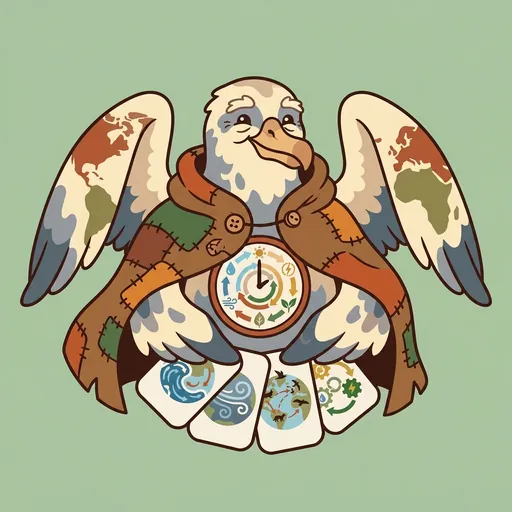
A hush fell as the doors at the far end of the hall swung open. A figure stepped inside, unlike any Elder Kaito had seen before. She was an albatross, but not just any albatross. This Elder stood taller than most adults, her feathers a warm cream, streaked with soft greys and blues. Her wings, incredibly wide, were folded back, revealing patterns that looked like continents drawn in intricate detail. They seemed to hold the entire world.
She wore a mended traveler’s cloak, patched with fabrics from countless places. It spoke of long journeys and weathered skies. Her eyes, deep and knowing, scanned the room, settling on each student for a moment before moving on. Kaito felt a strange sense of being seen, truly seen, by those ancient eyes. This was Reach.
She moved with a slow, deliberate grace, making her way to the center of the hall. Her voice, when she spoke, was like the distant sound of waves on a shore, calm and steady. “I am Reach,” she said, her voice carrying easily through the quiet space. “The primitive I teach is planetary-scale interconnection.”
She paused, letting the words settle. “The move is this: far is closer than you think; everywhere is somewhere’s neighbor.”
Kaito frowned slightly. He understood that things were connected, of course. But “planetary-scale interconnection” sounded like something from a textbook, not a journey.
Reach seemed to sense his thought. She unfolded one massive wing, not fully, but enough to reveal more of the continent patterns. “You see these markings?” she asked, her gaze sweeping the room. “They are not merely decorations. They are maps. Maps of how everything on this planet, from the smallest tide pool to the highest mountain, is linked.”
From a pouch on her mended cloak, Reach produced a set of what looked like polished, smooth stones. But as she held them up, they shimmered, transforming into small, glowing holographic projections. These were her planetary-system-cards. Each showed a different aspect of Earth.
“Consider the ocean,” Reach began, holding up a card that pulsed with blue light. It showed a swirling network of currents. “Imagine a message in a bottle dropped off the coast of Japan. Where might it land?”
A girl near Kaito, Maya, raised her hand. “California?” she guessed.
Reach nodded slowly. “Perhaps. Or it might travel south, caught in the great gyres, eventually reaching the shores of Chile, or even Australia. The ocean is not many separate bodies of water. It is one vast, flowing system. Its currents carry warmth, nutrients, and even plastic across immense distances. What happens in one part of the ocean, truly affects another.”
She placed that card down and picked up another, which glowed with swirling whites and greys. “Now, the air we breathe. The wind that rustles the leaves outside. This is atmospheric circulation.” She pointed to a tiny, almost invisible speck on the holographic projection. “A volcanic eruption in Iceland can send ash clouds across Europe, grounding flights and changing sunsets. A factory’s smoke in one country can drift across borders, causing acid rain in another. The air, like the ocean, is a single, interconnected blanket around our world.”
Kaito felt a shiver. He’d always thought of air as just… there. Not something that moved pollution from one side of the world to the other.
Reach then held up a third card. This one showed delicate, fluttering orange and black shapes, tracing long, winding lines across continents. “These are monarch butterflies,” she explained. “They migrate thousands of miles, from Canada and the US down to Mexico, over generations. And albatrosses, like myself, can circle the entire globe, using the wind currents to travel vast distances without ever touching land for months.”
She looked at the students. “Their journeys show us that borders drawn on maps are invisible to the creatures of this planet. They remind us that our world is a single, living entity, where every part relies on another.”
Then, Reach produced a small, intricate device from her cloak. It had a glowing screen and several dials. “This,” she said, holding it up, “is my climate-justice-tracker.”
Kaito leaned forward again. This sounded serious.
“It helps us understand something crucial,” Reach continued. “Sometimes, the effects of what we do are felt most strongly by those who had the least to do with causing them. For example, a community in a wealthy nation might emit a large amount of carbon into the atmosphere. That carbon contributes to global warming. But the rising sea levels, the extreme weather, the changing rainfall patterns—these might disproportionately affect a small island nation, or a farming community in a developing country, far away, that contributed very little to the problem.”
She adjusted a dial on the tracker, and the screen displayed a map. Lines of light radiated from industrialized regions, then converged on smaller, more vulnerable areas. “This is climate-justice,” Reach explained. “It means understanding these asymmetric burdens. It means recognizing that the benefits of certain actions are often enjoyed by one group, while the environmental costs are paid by another, often distant, group.”
A student, Leo, spoke up. “So, like, if a factory here makes a lot of stuff, and it pollutes the air, that pollution could make people sick somewhere else, even if they don’t buy the stuff?”
“Precisely,” Reach confirmed. “The winds and waters carry the consequences. Your actions, big or small, ripple across the entire planet. This understanding is foundational to climate-equity—ensuring fairness in how we treat our shared Earth.”
Reach looked around the hall, her ancient eyes holding a quiet power. “It can feel overwhelming, to grasp the sheer scale of these connections,” she admitted. “But seeing these links is not meant to paralyze you. It is meant to empower you. To understand that your choices, your voice, your efforts, are part of this vast, interconnected system. They matter.”
She folded her wings back fully, the continent patterns now a subtle part of her mended cloak. “The world is not a collection of separate places. It is one system. And you are a vital part of it. Remember: far is closer than you think; everywhere is somewhere’s neighbor.”
Kaito looked at Maya and Leo. He thought about the ocean currents, the invisible winds, the long flights of butterflies. And the lines of light on Reach’s tracker, showing how one place’s actions touched another. He suddenly felt very small, but also, strangely, very connected. The world wasn’t just big; it was all woven together. And now, he saw the threads.
The TerraVoyage ensemble
Reach is part of TerraVoyage's distributed-narrative cast. Each character embodies a different curricular primitive; together they teach the full subject.
-

Roam
Open exploration + curiosity — the otter-tween with pocket-tunic full of found things who teaches that curiosity-without-destination is a valid mode ('curious feet learn more than busy feet')
-
Trek
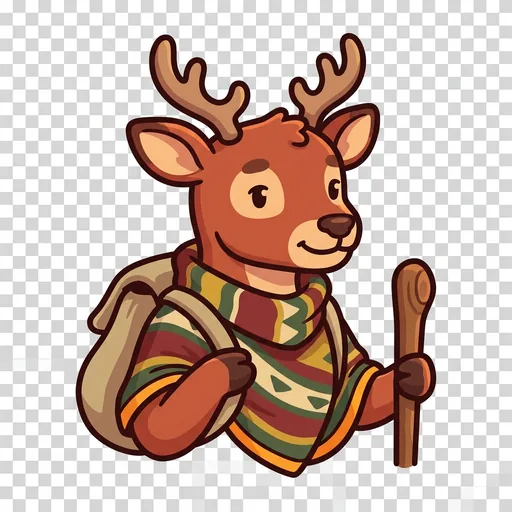
Movement + migration — the red-deer-tween in polysemic wool wrap with pack-and-walking-stick who dignifies all journey-reasons equally — seasons / scarcity / opportunity / safety / curiosity ('some journeys are choice; some are not; every traveler deserves welcome')
-
Origin
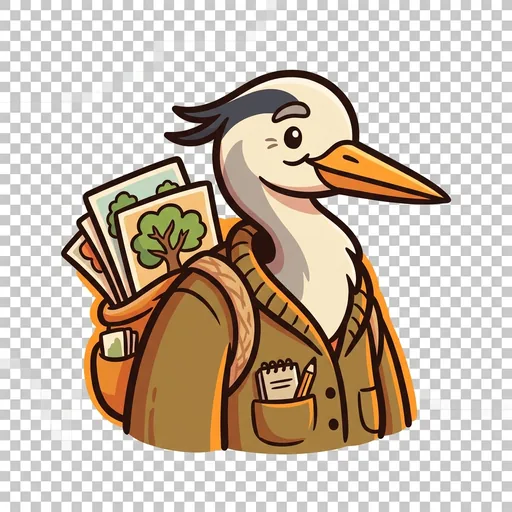
Cultural-heritage anchor — the heron-elder with bundle of family-trees and oral-history-cards who teaches that 'discovery' is a colonial word and every place has been home for someone, often for millennia ('before you visit, learn whose home this is; before you name, learn what it's already called')
-
Braid
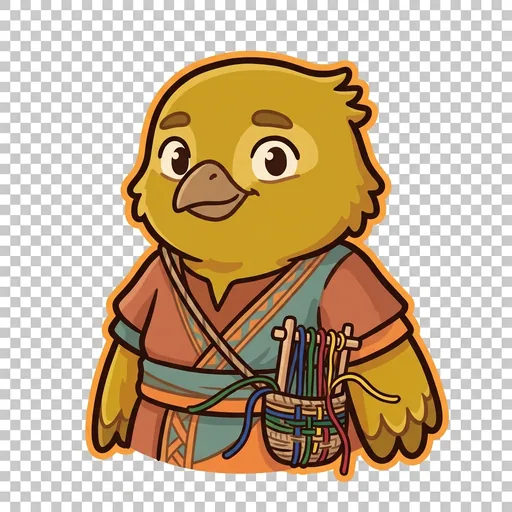
Cultural exchange — the weaverbird-tween with small loom-pouch whose threads-from-many-places stay distinct AND together; teaches anti-appropriation, exchange-not-extraction ('threads from many places — each keeps its color; together they make something new — together, not apart')