
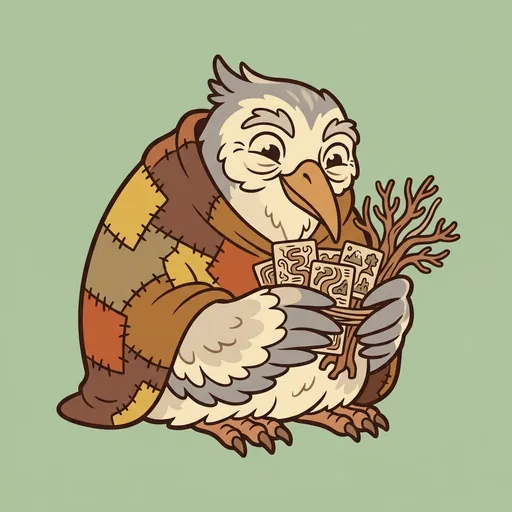
Origin
ORIGIN — *before you visit, learn whose home this is; before you name, learn what it's already called.*
Listen along — Origin
Loading audio…
Press play to listen along. The line being read lights up as you go.
Show full transcript
Loading transcript…
Chapter 3 — Origin and the Question Before Every “Discovery”
The campfire smoke curled towards the twilight sky, carrying the scent of pine and damp earth. Eleven young travelers, fresh from their latest journey, sat in a wide circle. Their faces, still smudged with trail dust, turned towards the figure at the center. This was Origin.
Origin was an elder, tall and still as a heron poised at the water’s edge. Their long legs, sturdy as ancient tree trunks, were tucked beneath a mended cloak. The fabric, a patchwork of cream and soft grey, looked like it had seen a thousand sunsets. Origin’s feathers, the same gentle colors, seemed to absorb the fading light. In their lap, a small, tightly bound bundle rested. It held a collection of flattened roots, intricately woven into tiny family trees, and a stack of worn, hand-painted cards. These were the stories, the maps of memory.
Origin’s eyes, deep and knowing, scanned each young face. “Before you visit,” Origin said, their voice like warm river stones, “learn whose home this is.” A pause, letting the words settle. “Before you name, learn what it’s already called.”
Elara, always quick to share, piped up. “We found the old riverbed today, Origin! It was like discovering a whole new path.”
Origin’s gaze softened, but a flicker of something else passed through their eyes. “Discovered, you say?” Origin’s voice was gentle, but the question hung in the air. “Was it truly lost before you found it, Elara?”
Elara blinked. “Well, no. Not lost, exactly. Just… new to us.”
“And what of those who knew it before you?” Origin asked. “Those who walked that riverbed for generations? Whose footsteps wore it smooth? Was it new to them?”
Elara looked at her boots. “No,” she admitted.
“Every place,” Origin continued, gesturing with a long, slender hand towards the surrounding forest, “has been home to someone. Often for thousands of years. It was already known. Already named. Already loved by those who lived there.”
Origin wasn’t just talking about paths. They were talking about a way of seeing the world. A way of understanding that no land was truly empty. No place simply waited to be ‘found’ by someone new. Every stone, every tree, every flowing river held a history. It held a name given by the people who belonged there. This was the heart of what Origin taught: the cultural-heritage anchor. It meant understanding that a place’s identity was tied to the people who had cared for it, generation after generation.
Origin carefully untied the bundle in their lap. The roots, dry and intricate, were like tiny, gnarled sculptures. “These,” Origin explained, holding one up, “are records. Not of paper, but of earth and memory. Each twist and turn tells of a family, a clan, a people who lived in a certain place. They show connections that stretch back further than any map you carry.”
Origin then fanned out the cards. Each one was painted with symbols, faces, and landscapes. “These are oral histories,” Origin said. “Stories passed down, not written down. They tell of the original names for places. The names given by the first people who called them home.”
“Why do we need to know those old names?” asked a boy named Kai, always practical.
“Because names hold power,” Origin replied. “They hold meaning. When you learn the original name of a mountain or a river, you learn something about its spirit. You learn respect. And you honor those who lived there long before you.”
Origin picked up another card. It showed a stylized animal, strong and graceful. “Sometimes,” Origin continued, “people see a creature, or a symbol, and they think it’s just a picture. They might use it for a team, or a product. They do this without understanding what it truly means to the people who hold it sacred.” Origin’s voice grew a little firmer. “That is not respect. That is taking. To truly honor a place and its people, you must ask. You must listen. You must understand what they wish visitors knew.”
Origin paused, allowing the crackle of the fire to fill the quiet. Then, with a slow, deliberate movement, Origin picked up one of the oral history cards. It showed a tall, jagged peak, its summit often shrouded in mist.
“Long ago,” Origin began, their voice a soft murmur, “there was a mountain. For thousands of years, the people who lived in its shadow called it ‘Whisper-of-Clouds.’ They understood that the mountain had a voice. A spirit that spoke through the mists and the wind. They knew its trails, its hidden springs. Its secret places where rare herbs grew. They asked the mountain for passage, for healing, for wisdom.”
Origin tapped the card. “Then, travelers came. They saw the mountain, tall and imposing. They did not ask its name. They did not listen to its whispers. They simply called it ‘Mount Conqueror,’ because it was a challenge to be overcome.”
Elara frowned. “But it’s still the same mountain, right?”
“Physically, yes,” Origin agreed. “But the way people saw it, the way they treated it, changed entirely. When it was ‘Whisper-of-Clouds,’ it was a living being, a teacher. When it became ‘Mount Conqueror,’ it became a thing to be dominated. A trophy. The people who called it ‘Whisper-of-Clouds’ were pushed aside. Their knowledge, their stories, their deep connection to the mountain, were forgotten by the new arrivals.”
“So, the name changed how people acted?” Kai asked, catching on.
“Exactly,” Origin confirmed. “The name shaped their respect, or their lack of it. It shaped whether they listened, or simply took. This is why learning the original names, and understanding the stories behind them, is so important. It is how you honor the past and protect the future.”
“I am Origin,” the elder said, their voice settling into a steady rhythm. “The primitive I teach is cultural-heritage anchor.” Origin looked around the circle. “It means remembering that before you visit, you must learn whose home this is. You must learn the original names. You must understand that ‘discovery’ is a word that often erases those who came before. And you must never take a symbol or a story and make it your own, without permission and understanding. That is what we call anti-mascotization.”
Origin picked up a smooth, grey stone from the ground. “Tomorrow,” Origin said, holding the stone out, “you will each choose a small object from this place. A leaf, a feather, a stone like this one. But before you touch it, before you take it, you will sit with it. You will ask yourself: Who else has touched this? What stories does this ground hold? What is its name, if it has one, in the language of this land’s first people?”
The young travelers exchanged glances. This was different from their usual tasks of mapping or collecting samples. This was about listening. This was about seeing differently.
Origin smiled, a warm, deep crinkle around their eyes. “This is not about finding something new. It is about finding the old. About honoring what has always been here. It is about understanding that you are not just passing through. You are stepping into a story that began long before you arrived.”
The TerraVoyage ensemble
Origin is part of TerraVoyage's distributed-narrative cast. Each character embodies a different curricular primitive; together they teach the full subject.
-
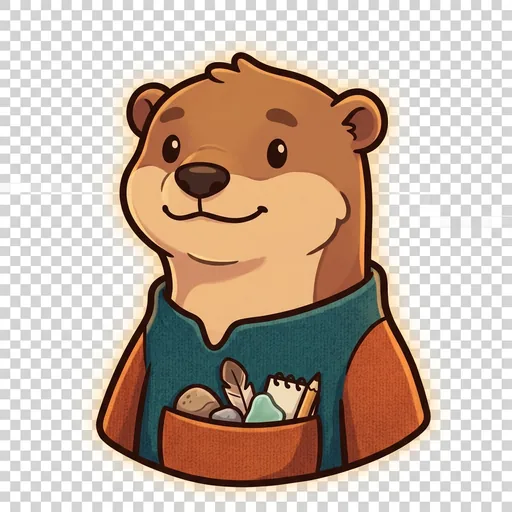
Roam
Open exploration + curiosity — the otter-tween with pocket-tunic full of found things who teaches that curiosity-without-destination is a valid mode ('curious feet learn more than busy feet')
-
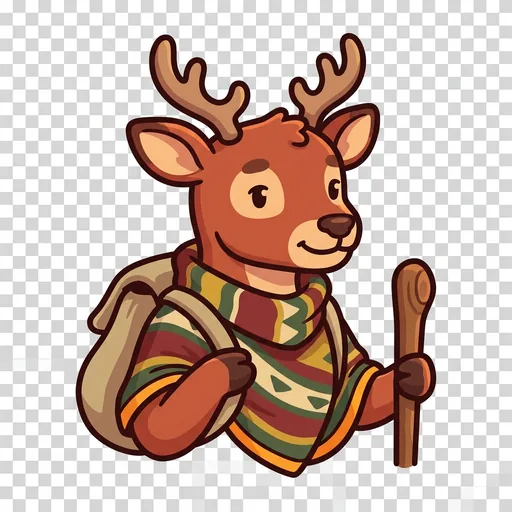
Trek
Movement + migration — the red-deer-tween in polysemic wool wrap with pack-and-walking-stick who dignifies all journey-reasons equally — seasons / scarcity / opportunity / safety / curiosity ('some journeys are choice; some are not; every traveler deserves welcome')
-
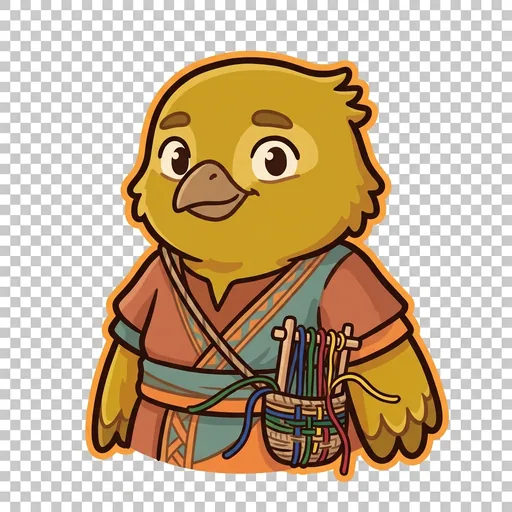
Braid
Cultural exchange — the weaverbird-tween with small loom-pouch whose threads-from-many-places stay distinct AND together; teaches anti-appropriation, exchange-not-extraction ('threads from many places — each keeps its color; together they make something new — together, not apart')
-
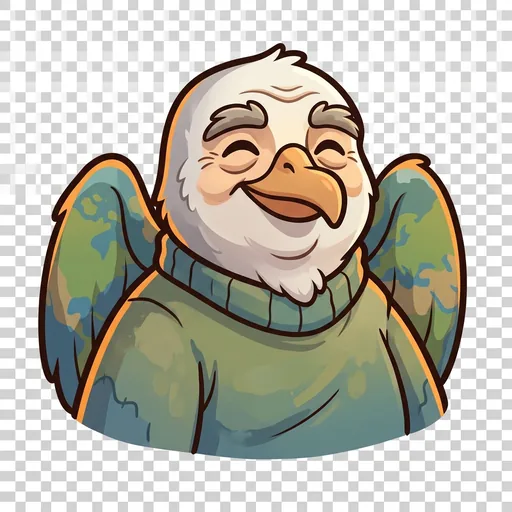
Reach
Planetary scale + interconnection — the albatross-elder with continent-patterned wings who teaches Earth-as-one-system, climate-justice, environmental-equity framing ('far is closer than you think; everywhere is somewhere's neighbor')