
Brawn and Pinch
HOW HEAVY YOU ARE — a star's mass decides its destiny: Brawn shows that how heavy a star is written its whole life story from the start, and Pinch shows the spectacular ending the heaviest stars meet — collapsing so hard they explode as a supernova, leaving behind a neutron star or a black hole
A story read by Brawn and Pinch
Loading audio…
Press play to listen along. The line being read lights up as you go.
Show full transcript
Loading transcript…
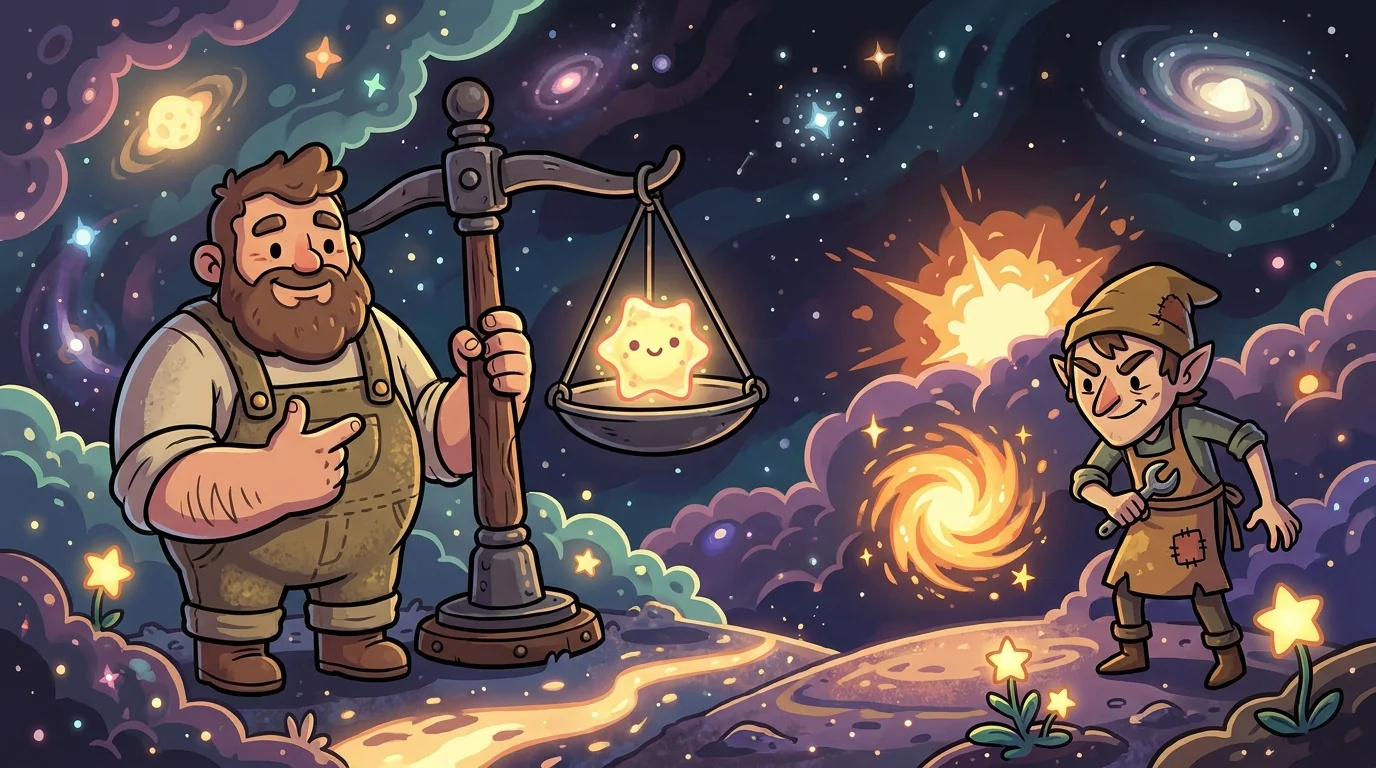
Two keepers stood at the far edge of the star-nursery, and they dealt with the single fact that decides everything about a star's life and death — a fact set at the very moment of its birth.
Brawn held an enormous scale, weighing each newborn star.
Pinch waited at the end of the heaviest ones' stories, where the collapse comes.
"Everyone asks how a star will end," said Brawn, hefting the great scale. "Big and violent? Or quiet and slow? And the answer was decided the day it was born — by one single thing. Its weight. Let me weigh a few, and I'll tell you each one's whole future."
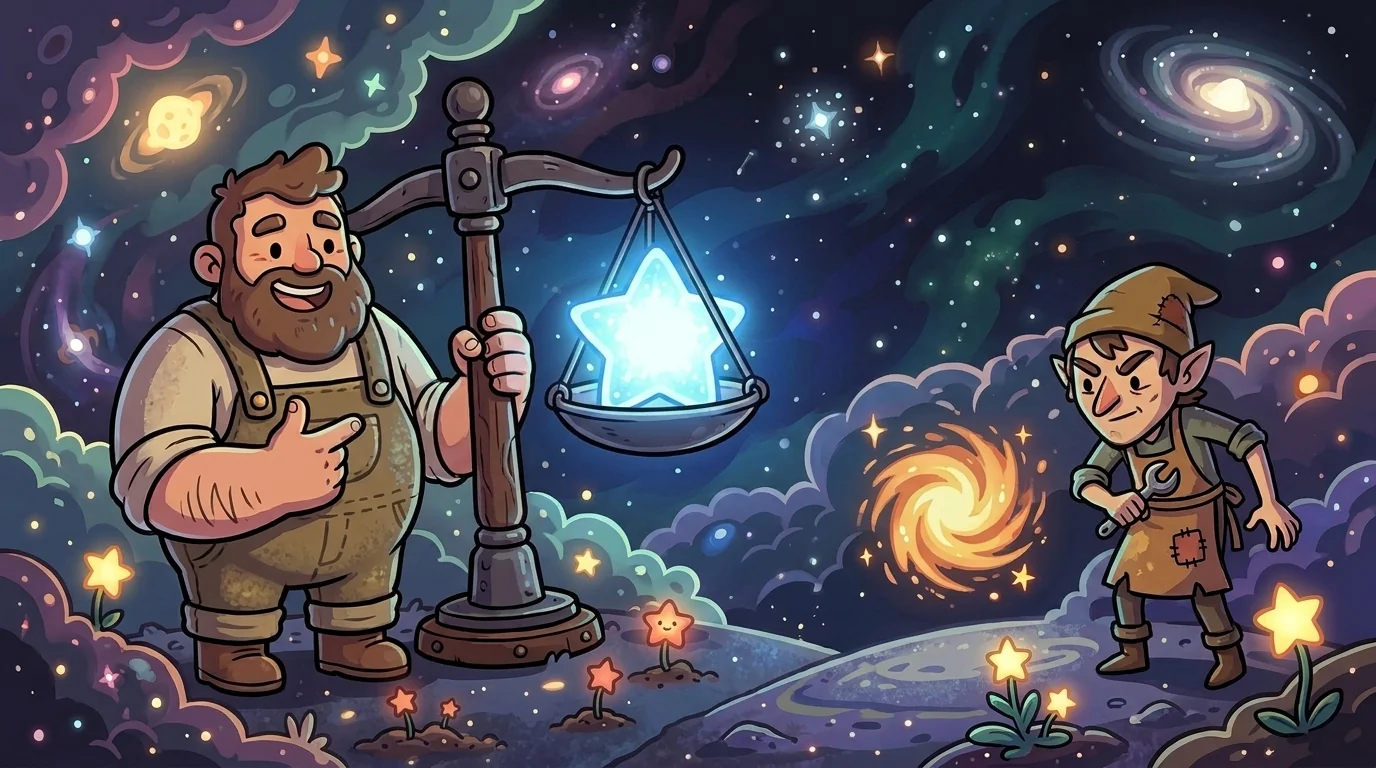
Brawn went first, weighing the newborn stars — because a star's mass writes its entire life story before it's barely begun.
"Here's a lightweight," said Brawn, weighing a small dim star. "A little red one, not much heavier than it needs to be to shine at all. And its future? Slow. Dim. And almost endless. It'll sip its fuel so gently it'll glow for trillions of years — longer than the universe has yet been alive." Then Brawn hefted a giant onto the scale, and the whole thing groaned. "And here — a heavyweight. Dozens of times the Sun's mass. Its future is the opposite: fast, blazing, and short. It burns through its enormous fuel in a wild hurry — blindingly bright, blue-hot, and done in just a few million years." Brawn set them side by side. "That's my law, and it never bends: the heavier a star, the faster and brighter and shorter its life. The very thing that makes a star dramatic — all that mass, all that blaze — is the thing that makes it brief. Weigh a star at birth, and you've read its whole destiny. Mass is fate, up here."
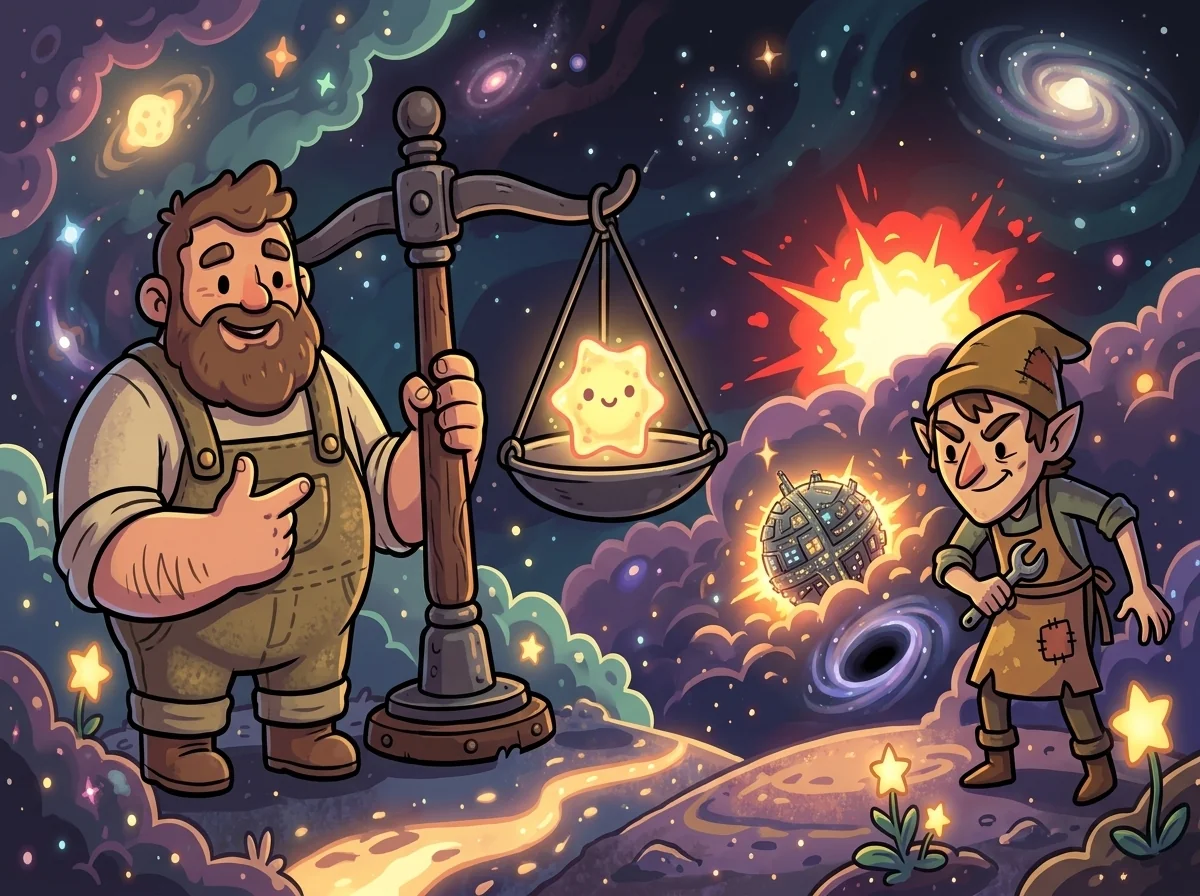
Then Pinch stepped to the end of the heavyweight's story — because the heaviest stars don't fade quietly. They collapse.
"The little ones fade gently," said Pinch. "But a giant? When a giant finally runs out of fuel, there's nothing left to hold up all that enormous weight against its own gravity — and so it falls. Inward. All at once. Catastrophically." Pinch drew the great mass inward, faster, faster. "The core collapses in less than a second, and then the whole thing rebounds in an explosion so bright it can outshine an entire galaxy — a supernova. One dying star, blazing brighter than a hundred billion others put together, for a few brief days." Pinch let the light flare and fade. "And what's left behind? If the star was heavy, a neutron star — a city-sized cinder so dense a spoonful weighs as much as a mountain. And if it was truly enormous — a black hole, where gravity won so completely that not even light can climb back out." Pinch's voice was quiet with awe. "The heaviest stars have the most spectacular deaths in the whole universe. That's the other half of Brawn's law: live heavy and fast, and end in the grandest fire there is."
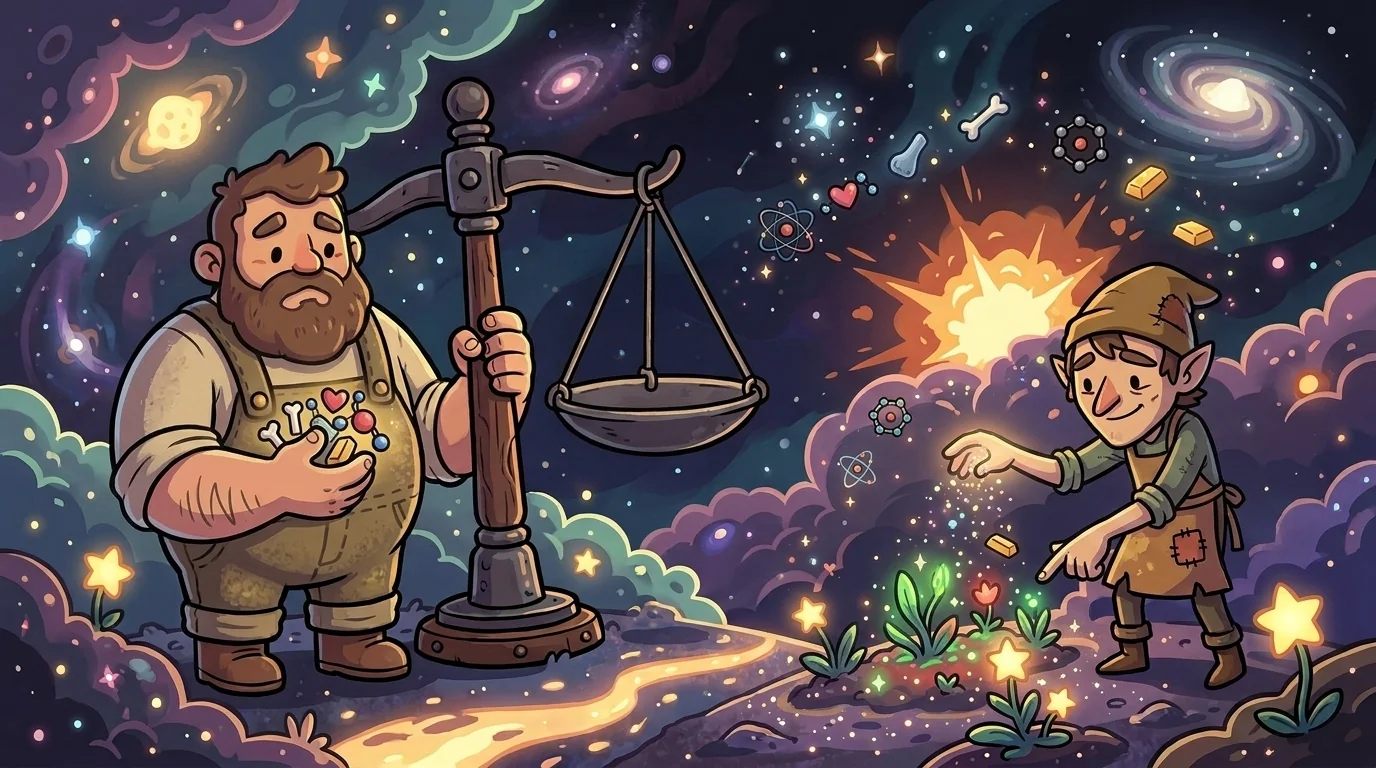
And here is the part that turns the whole story around, the part Pinch saved for last — because a giant star's violent ending is also a kind of beginning.
"When that supernova explodes," said Pinch, softly, "it scatters the star's insides across space — and here's the wonder: those insides include new elements, forged in the star's core and its final blast. Carbon. Oxygen. Iron. Gold. The stuff that clouds of gas will one day gather up to make new stars, and planets, and — eventually, on at least one of them — living things." Pinch let that land. "The iron in your blood. The calcium in your bones. The oxygen you're breathing right now. Every bit of it was forged inside a giant star and scattered out by a death exactly like this one, long before the Sun was born."
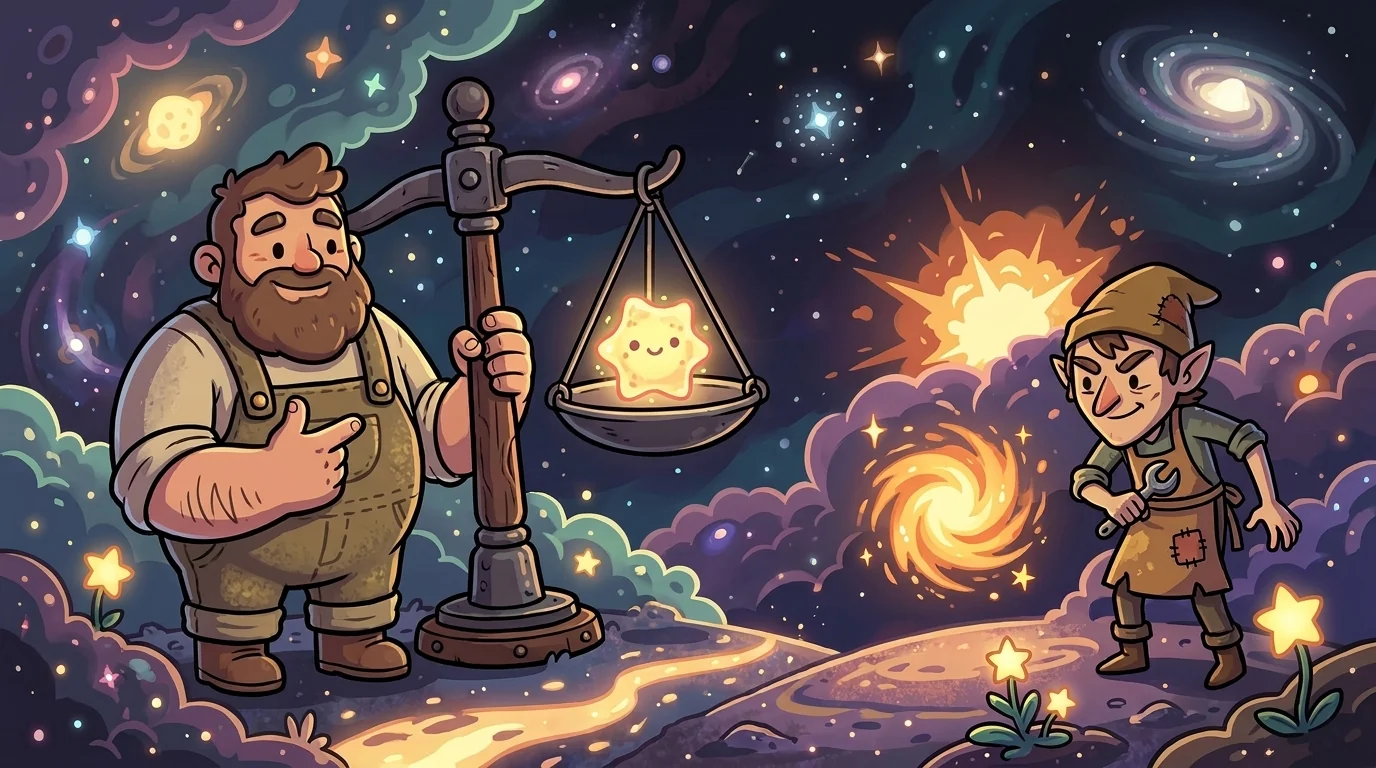
The two keepers stood quiet a moment, one holding the scale that reads a star's fate, one standing where the grandest deaths become new beginnings.
"Good weighing," said Pinch.
"Good ending," said Brawn.
There is an almost overwhelming feeling that comes from this corner of the sky — the understanding that how heavy a star is decides everything, that the grandest stars die in the brightest fire, and that those very deaths forge and scatter the atoms that later become worlds and people. It makes you feel small, held inside spans of time and size too big to really grasp. And then it turns, and makes you feel astonishingly part of it all — because you are, quite literally, made of the scattered hearts of giant stars that lived and blazed and collapsed long ago. To look up on a dark night and know that is to feel small and enormous at once: a brief, warm, breathing speck, built from starlight, looking back up at the sky it came from.
The StarForge ensemble
Brawn and Pinch is part of StarForge's distributed-narrative cast. Each character embodies a different curricular primitive; together they teach the full subject.
-

Wick
Protostar (collapsing gas, igniting)
-

Glow
Main-sequence star (hydrogen fusion / stable)
-

Swell
Red giant (helium fusion / expanded outer layers)
-

Pinch
Stellar collapse + neutron star / supernova compaction
-

Ember
White dwarf / stellar remnant (cooling final state)
-

Brawn
Stellar mass — how heavy a star is at birth decides its whole life story
-

Waltz
Binary stars — most stars are not alone; they circle a partner in a slow gravitational dance
-

Smolder
Brown dwarf — a clump of gas too light to ignite; warm and dim, almost-but-not a star
-

Quiver
Variable stars — stars that pulse brighter and dimmer in a steady, measurable beat
-

Flare
Stellar flares and starspots — a star's stormy magnetic surface weather
