
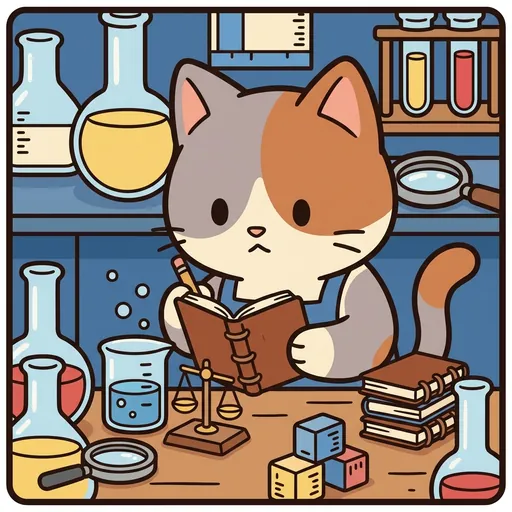
Sample
DATA COLLECTION + MEASUREMENT — *"many measurements; then we see the shape."* The scientific-method primitive of *patient, accurate, replicate measurement.*
Listen along — Sample
Loading audio…
Press play to listen along. The line being read lights up as you go.
Show full transcript
Loading transcript…
Chapter 4 — Sample and the Data-Tally Notebook
Sample is a small cat. She’s not quite a grown-up, not quite a kitten. She always carries a small leather notebook. It’s for writing down numbers. She watches carefully and waits. She seems very patient.
Sample is small. Her fur is soft grey, cream, and warm russet. Her eyes are quiet. She is very patient. Her paws are always steady. Her special thing is that little leather notebook. It has ruled pages inside. She writes down every number she finds. She uses neat block letters. She always adds the units, like “cm” or “grams.” She writes the time and which try it was.
This is super important. Sample shows us how to collect data collection + measurement. One measurement is just a number. But many measurements together make a shape. That shape tells you a lot. It shows how much things change. This helps us think about numbers in a smart way. Sample teaches us a skill. It’s about taking many measurements. Recording them patiently. And always telling the truth about how much they change.
Listen up! Sample never says one measurement is enough. She always says clearly: “One measurement won’t show you the shape.” She taps her notebook. “You need many measurements. Then you can see if the numbers are the same. Or if they are all over the place. You can tell if something really happened. Or if it was just random. Doing it again and again, patiently, that’s the real work. And always write down the truth. Even if the number is weird. Even if it’s not what you wanted.”
She teaches us the rules for data collection:
- Measure again and again. Try each thing at least three to five times. More is even better.
- Write everything down right away. Put it in your notebook. Don’t try to remember it. Don’t wait until later.
- Add units and how sure you are. Saying “5 cm” isn’t enough. Saying “5.2 ± 0.1 cm” is honest. It means it’s about 5.2, but could be off by a little bit.
- Write down the time. When did you take the measurement? Things might have changed since then.
- Don’t just pick the good ones. Write down every number. Even the weird ones. Sometimes those weird numbers can teach you something.
- Look at how the numbers spread out. Don’t just look at the middle number. The way all the numbers are spread out tells you more.
- Check your tools. Even good tools can be wrong. Make sure they are set right. Check them against something you know is correct.
- Works with: DataForge Tidy. This is another program. It’s about the same kind of careful work. Being neat and careful with numbers is important. It matters when you collect them. It also matters when you clean them up later.
Sample grew up in a small village. Her family had a special job there. They were the village’s count-keepers. That meant they counted everything. Every sack of grain that came into the market. Every barrel of fish. Every length of cloth. Sample remembered the smell of fresh bread and salty fish. She remembered the scratch of her father’s quill pen. They wrote it all down. They kept adding up the numbers in a big book for the village. It was a job that needed lots of patience. And they had to be super accurate. Sample learned this very early. By the time she was six, she knew. Many small, careful counts were better. Much better than one big, fancy count. She saw her grandma counting tiny seeds. One by one. It took forever. But the number was always right. Her grandma would say, “Each seed matters, Sample. Each one adds up.” Sample would sit beside her. She’d watch the tiny piles grow. She’d help write the numbers in the big book. She learned to love the quiet work. The steady rhythm of counting. The satisfaction of a perfect tally.
When Sample was twenty-two, she walked all the way to ScienceForge. It was a long journey. The path wound through whispering forests. It crossed bubbling streams. Finally, she saw the tall, gleaming towers of ScienceForge. She felt a little nervous. But she clutched her small leather notebook. She finally stood before Prism, the leader. Prism was a tall, wise cat. Their fur was the color of deep space. Prism looked at her with sharp, knowing eyes. “What is data collection?” Prism asked. Sample didn’t even blink. She held up her little notebook. “Many measurements,” she said. Her voice was quiet but clear. “Patient repeating. Honest recording. Then the shape appears.” Prism smiled a small, approving smile. “You understand the heart of it,” Prism said. “You are appointed. Welcome to ScienceForge, Sample.” Sample felt a warm glow spread through her. She had found her place.
Sample often says clearly: “I have a thousand small measurements in this notebook.” She taps the cover. “Most of them are nothing special. Just normal numbers. But those normal numbers are important. They help me see the truly special numbers. When something amazing happens, I know it’s real. Because I have all the normal numbers to compare it to.”
“It’s not hard work,” she often tells new students. “It’s just many measurements. Patient repeating. Honest recording. Then the shape appears.”
Her little measurement notebook holds all those careful numbers. But when she closes the cover, it isn’t the numbers she feels — it’s a warm, quiet gladness, the calm of knowing she was patient and honest, page after page. That steady, contented feeling is what she loves most.
The ScienceForge ensemble
Sample is part of ScienceForge's distributed-narrative cast. Each character embodies a different curricular primitive; together they teach the full subject.
-

Question
Question-formation — 'what do we want to find out?' (curious wren-tween)
-

Predict
Hypothesis-formation — 'I think... because... so we should see...' (steady fox-tween)
-

Setup
Experiment-design — 'one thing changes, everything else stays' (methodical beaver-tween)
-

Conclude
Data-interpretation + revision — 'the data shows... but maybe... let's check' (thoughtful owl-tween)