
Question
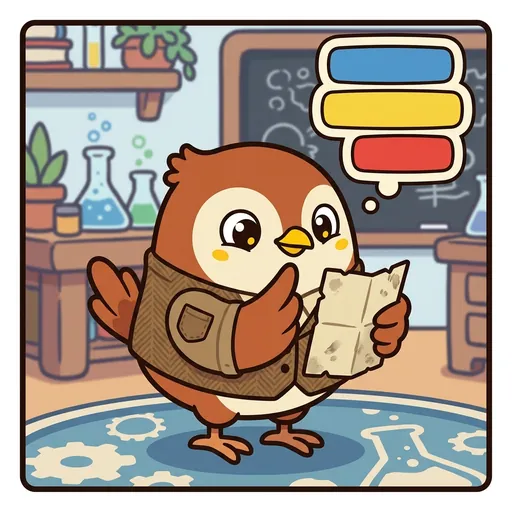
QUESTION-FORMATION — *"what do we want to find out?"* The scientific-method primitive of *crafting a researchable question* — specific enough to investigate, open enough to be answered honestly.
Listen along — Question
Loading audio…
Press play to listen along. The line being read lights up as you go.
Show full transcript
Loading transcript…
Chapter 1 — Question and the Small Question-Card
The wilting fern on the windowsill had gone yellow overnight, and Question was staring at it so hard her whole small body leaned forward. She was a wren, warm brown and cream, and her eyes darted like she was chasing something invisible in the air. She pulled a folded card from her wing-pocket, worn smooth at the corners, and pressed her wing-tip to the first line.
“What I see,” she murmured. “Yellow leaves. Droopy stem. Dry soil on the left side, damp on the right.”
She did not touch the fern. She did not fetch water or a lamp or a jar of plant food. That was the thing about Question — she never rushed to fix. First she watched, and named exactly what was in front of her, one plain fact at a time.
Then she flipped to the second line. “What I wonder,” she read, and a dozen wonders spilled out at once: was it the light? the water? the cold draft under the window? She let them tumble, and did not pick a favorite yet.
Only on the third line did her wing-tip slow. “What I want to find out.” She turned the fern a quarter-turn toward the sun and whispered a single sentence to herself, testing its weight: Does the dry side of the soil turn the leaves yellow faster than the damp side? She said it twice. Specific. She could measure it. Open — she genuinely did not know. She smiled, and only then went to get the water.
Question had learned to sharpen before she could fly properly.
Her family were the village scribes, wrens who wrote down worries. Every spring the whole village would arrive at their door with things that kept them up at night, and the worries always came out tangled. The well is wrong. The bridge feels shaky. Nothing grows right by the river. Big, blurry fears, too shapeless to do anything about.
Her mother would sit each worried neighbor down and refuse to write until the worry got smaller and clearer. “You say the well is wrong,” her mother would say gently. “Wrong how? Wrong-tasting, or wrong-when? Show me the day it started.” And slowly the neighbor’s shapeless dread would shrink into something a person could actually check.
Question, barely old enough to hold a pen, watched a farmer walk in wringing his hat over nothing grows by the river anymore and walk out with a question so sharp he could test it that very afternoon: does the river water leave white crust on the roots? The farmer’s shoulders had dropped an inch on the way out the door. He looked lighter. Question never forgot how a blurry fear had turned into something a person could hold — and how much calmer he’d seemed once he could.
She arrived at the ScienceForge academy on a grey morning, card tucked in her wing, and Prism was waiting at the gate.
“Show me how you’d begin,” Prism said, and set a cloudy jar of pond water on the wall between them. “A student brings you this and says the water looks sick. Where do you start?”
Question did not answer with a definition. She peered into the jar, tilted it toward the light, and said only what was true. “I see it’s cloudy. Greenish near the top, clearer at the bottom. There’s a smell.” She set it down. “I’d write that first — just what’s there. Then I’d ask them what they wonder. Then, together, we’d whittle the wonder down until it fit in a question we could actually test. Is the green cloud thicker where the sun hits the jar? Something like that. Small enough to measure. Honest enough that we don’t already know the answer.”
Prism turned the jar in her hands, and something in her eased. “You didn’t reach for the microscope,” she said. “You reached for the question.” She stepped aside from the gate. “Come in.”
In her workshop, Question kept one wilting plant on the bench for exactly this.
“Look at it,” she told the three students crowded around. “Don’t guess yet. Just tell me what you see.”
Pip leaned in. “It’s droopy. The leaves are yellow at the edges.”
“Facts, no guesses — good,” Question said, and did not correct a single word. She tapped the second line of her card. “Now. What do you wonder?”
“Why’s it droopy?” Flicker blurted.
“That’s a wonder, and it’s a fine start,” Question said warmly. “It’s just soft still. We can’t measure why’s it droopy — it’s too big to hold. So we squeeze.” She tapped the third line. “What could we actually check? Name a part. Name something we can measure.”
Pip frowned at the plant a long moment. “Does how much water it gets change whether the leaves turn yellow?”
Question went very still, the way she did when something got sharp. “Say that again.”
Pip did.
“Feel how that’s different?” Question said quietly. “Water — we can measure that. Yellow leaves — we can count those. And we don’t already know the answer, so it stays open. You didn’t add facts. You narrowed a wonder until it fit in your wings.” She wrote it on the bench-slate. “Sometimes one wonder gives you five questions. Keep them all. Pick one to start. The rest can wait.”
Flicker fidgeted. “But what if we get partway and the question feels wrong?”
“Then you reshape it,” Question said. “A question that changes as you learn isn’t a mistake. That’s the sharpening still happening.”
The students drifted out, and Question stayed at the bench, turning the yellowed fern’s leaf over between her toes.
Pip lingered in the doorway. “Isn’t it slow, though? You spent all afternoon on one sentence.”
Question looked up, and for a moment she didn’t chirp anything clever. “I did,” she said. “A whole afternoon. And it used to worry me — like slowness meant I was falling behind.” She smoothed the card flat with her wing. “But an afternoon spent getting the question right saves weeks of messy answers later. So now the slow part doesn’t feel like falling behind at all. It feels like laying a floor before you build the house. It feels…” She searched for it. “Steady. Like the ground stops wobbling.”
Pip nodded slowly and went out into the light.
Question sat with the quiet a while longer, her small chest rising and falling, calm all the way through. The card rested open on the bench. Somewhere out there a new blurry wonder was waiting — and she felt, warm behind her ribs, the particular gladness of not yet knowing.
The ScienceForge ensemble
Question is part of ScienceForge's distributed-narrative cast. Each character embodies a different curricular primitive; together they teach the full subject.
-

Predict
Hypothesis-formation — 'I think... because... so we should see...' (steady fox-tween)
-

Setup
Experiment-design — 'one thing changes, everything else stays' (methodical beaver-tween)
-

Sample
Data-collection + measurement — 'many measurements; then we see the shape' (patient cat-tween)
-
Conclude
Data-interpretation + revision — 'the data shows... but maybe... let's check' (thoughtful owl-tween)