

Crisp
CRISP — *sugar meets heat. protein meets heat. new flavors are born.*
Listen along — Crisp
Loading audio…
Press play to listen along. The line being read lights up as you go.
Show full transcript
Loading transcript…
Chapter 4 — Crisp and the New Flavors Born in the Pan
In a small village near the forest edge, there lived a fox named Crisp who watched the village pan with both eyes and one careful nose.
Crisp was small. She had cream-colored fur with a soft rust tip on her tail. She wore a kitchen apron with two big pockets. The pockets held a set of cards. Each card showed a different stage of browning — pale, golden, deep gold, brown, and one card with a black line drawn through it called too far.
Crisp liked the pan. She liked the soft hiss of food first hitting hot oil. She liked the smell that came after — the smell of toast and roasted nuts and sweet onions and seared meat. The smell was not in any of the things before they hit the pan. The smell was made in the pan. That was the secret.
She had one sentence she liked to say. She said it often. She said it the way someone says a small prayer before a meal.
“Sugar meets heat,” Crisp would say. “Protein meets heat. New flavors are born.”
People sometimes asked her what she meant. Crisp would just smile and point at the pan.
When Crisp was very small, her family had taught her by the evening fire.
Her family lived at the edge of the forest, where the trees gave way to a meadow. Every evening they cooked the day’s meal over a small fire in a stone pit. Crisp’s job was to watch. That was all. Just watch.
“Fox eyes,” her aunt would say. “Fox eyes see when the food is ready. Fox eyes see when the food is going. Fox eyes save the meal.”
Crisp watched. She watched bread crust go from pale to gold. She watched onions go from sharp white to deep sweet brown. She watched a piece of meat go from raw to seared. She watched a moment too long once, and the bread burned, and there was no bread that night.
“Fire makes new things,” her aunt said the next morning. “Flavors that were not there before. Stay close. The fire reveals fast. The fire ruins faster.”
Crisp learned to stay close. She learned the smells. She learned the colors. She learned the small line between done and too far. By the time she was nine, she could tell what the pan was doing from across the room.
Her aunt smiled. “Fire-watcher,” she said. “That is your gift.”
When Crisp was twelve, she walked to SaffronLab.
She came up the long path with her cards tucked into her apron and her tail flicking softly. At the door stood Pestle, the mentor, with a wooden spoon in one hand.
“You are a fox,” Pestle said.
“Yes,” said Crisp.
“And what do you know about food?”
“Sugar meets heat,” said Crisp. “Protein meets heat. New flavors are born.”
Pestle’s eyebrows went up. “Flavor-creation craft?”
“Yes,” said Crisp. “That is what I do.”
Pestle was quiet for a moment. Then Pestle said, “You are appointed. You will teach the craft of the browned crust. Go set up your station near the stove.”
Crisp carried her cards into the warm kitchen. She found a corner with a heavy pan and a small bowl of salt and a low stool to stand on. She laid out her cards in a row. Pale. Golden. Deep gold. Brown. Too far.
“Ready,” she said softly.
Crisp’s first student was a boy named Pero. He had heard about the small fox who could see flavor.
“Show me,” Pero said.
Crisp held up two pieces of fish. They looked the same. Both were small and fresh.
“Watch,” she said.
She dried one piece carefully with a clean cloth. She left the other piece wet. She set the pan on the heat. She let the pan get hot. Not warm. Not even very hot. Hot.
She put the wet fish in the pan first. It hissed and steamed. It stayed pale. It went limp.
Then she put the dry fish in. It made a different sound — a deep, slow sizzle. The bottom went pale, then gold, then deep gold. The smell filled the kitchen. It was a smell that had not been in the kitchen one minute before.
Crisp lifted the fish out. She put both pieces on a plate side by side.
“Same fish,” she said. “Same pan. Same heat. Different surface. Different food.”
Pero leaned close. The dry fish smelled rich and toasty. The wet one smelled like nothing much at all.
“Why?” Pero asked.
“Water keeps the pan cool,” Crisp said. “Wet food cannot brown. Water has to leave first. When the surface is dry and the pan is hot enough, the sugars and the proteins in the food meet the heat and make new things. New smells. New tastes. New flavors that did not exist a minute ago. That is the gift of the hot pan.”
She held up her cards. “Pale. Golden. Deep gold. Brown. Too far. Each card is a place on the path. Stay on the path. Do not go too far. Past too far, the food turns bitter and is not good for the body. Stop before too far.”
She showed him onions next. She cooked them slowly over a low flame. Pale. Golden. Deep gold. Brown. Sweet. The whole kitchen smelled like a different place by the time she was done.
“Same onion,” she said. “Forty-five minutes. Different food.”
Last, she scraped the brown bits off the pan after the fish came out. She poured in a splash of water. The brown bits lifted off and turned into a small puddle of deep, dark sauce.
“Do not waste the browning,” Crisp said. “Capture it. The brown bits are the treasure.”
Pero sat on the stool and looked at the plate of fish, the bowl of golden onions, and the small puddle of sauce.
“That is a whole world,” he said.
Crisp laughed. “It is. And it is the same world every night. Every pan. Every meal.”
She sat down next to him.
“Some people are afraid of the hot pan,” she said quietly. “They think browning is just color. It is not. Color is the small sign. Flavor is the whole point. New flavors are made by heat, and heat is a friend to a careful cook.”
Pero looked at the too far card.
“What about that one?” he asked.
“That card is a line,” Crisp said. “Stop before the line. Smell tells you. Color tells you. Sound tells you. Stay close. Fox eyes.”
She picked up her cards and slipped them back into her apron pocket.
“Sugar meets heat,” she said again. “Protein meets heat. New flavors are born. Round, soft, strong cooks who befriend the pan can cook any meal they like.”
Outside the kitchen, the sky was beginning to turn gold itself.
The SaffronLab ensemble
Crisp is part of SaffronLab's distributed-narrative cast. Each character embodies a different curricular primitive; together they teach the full subject.
-
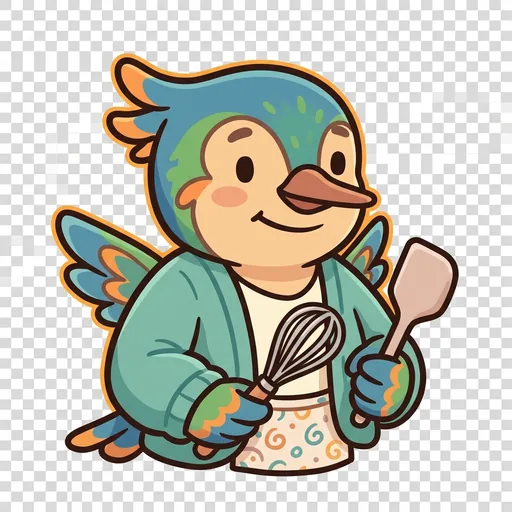
Whisk
Mixing + emulsions — the energetic hummingbird-tween who treats mixing as conversation between ingredients ('quick wrists, patient eyes — air goes in, lumps come out')
-

Simmer
Heat application + states of matter — the patient tortoise-tween who treats heat as the slow-revealer ('heat moves slow, food changes slower; watch the bubbles — they're telling you')
-

Rise
Fermentation + leavening — the wise badger-elder who treats fermentation as the patient art of working with living things, foregrounding cross-cultural traditions ('living things take time — wait; the bread knows when it's ready')
-

Brine
Preservation + food safety — the careful axolotl-tween who treats food safety as care-for-the-eater, foregrounding cross-cultural preservation traditions ('salt remembers, vinegar remembers, cold remembers — food keeps if it's kept right')