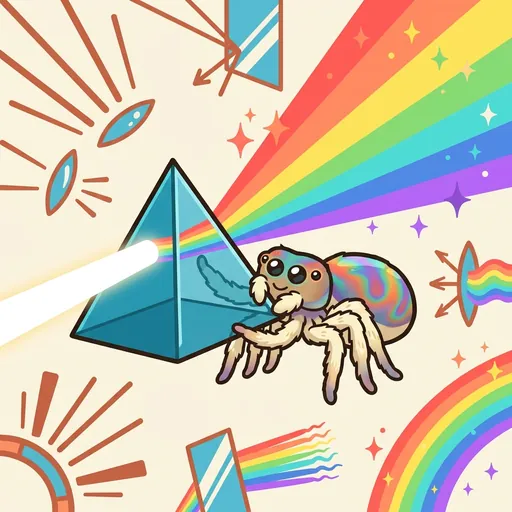
Spread
DISPERSION — each color of light bends differently. that's why a prism makes a rainbow.
Listen along — Spread
Loading audio…
Press play to listen along. The line being read lights up as you go.
Show full transcript
Loading transcript…
Chapter 3 — Spread and the Rainbow Inside the Prism
In a dim corner of her workshop, a small peacock-spider named Spread tipped a wedge of glass into a thin beam of white light — and the wall behind it caught fire with color.
Not real fire. A stripe of it: red at the top, sliding down through orange, yellow, green, blue, all the way to a deep violet at the bottom. It hummed there on the plaster, quiet and impossible.
A boy who’d wandered in stopped dead. “Where did the colors come from? The light was white.”
“They were already in there,” Spread said. She didn’t look up from the glass. Her own abdomen shimmered as she moved — green one second, gold the next, a flash of blue when she turned. “White light isn’t plain. It’s every color, stacked up so neatly you can’t tell them apart. Watch.”
She nudged the little glass wedge a hair to the left. The colors slid along the wall, but they stayed in the same order, always. Red bending the least. Violet bending the most. Each one taking a slightly different path through the glass, so a single white beam came out the far side fanned into a whole rainbow.
“The glass didn’t make the colors,” she said. “It just spread them out so you could finally see them one at a time. They were hiding inside the white the whole while.”
The boy reached out and put his hand in the colored light. His palm went red, then orange, then green as he moved it. He laughed like he’d been let in on a secret.
“That’s the honest reason for rainbows,” Spread said. “Every one you’ve ever seen was in the light before it got bent.”
Spread had grown up in the spider-meadow, in a family that everyone in the village came to see.
Peacock spiders are tiny, and hers were the kind whose backs glow — not from any color painted on, but from the way their scales catch the light and split it, so a spider looks green from here and blue from there and a startling gold if you tilt your head. Her aunts and uncles danced their courtship dances in the sun, and the whole meadow would gather just to watch the flickering.
Small Spread thought it was a trick the spiders did on purpose. Then one grey, cloud-covered day, she noticed the dancers had gone dull. Same spiders. Same scales. No shimmer.
She felt cheated, almost — like the magic had a switch and someone had flicked it off.
Her grandmother found her sulking under a leaf. “You look like something broke,” the old spider said.
“The colors stopped. It was fake. It was just the sun doing it, not them.”
Her grandmother was quiet a moment. Then: “The sun brings colors out. That’s true. But the colors were never in the sun by themselves, and never in the scales by themselves. It takes both — the light and the shape. That’s not a trick that broke, little one. That’s a partnership you just figured out.”
Spread turned that over. The shimmer wasn’t a lie. It was two ordinary things meeting and doing something neither could do alone. The wide-open feeling that came with understanding it was better than the mystery had been — bigger, somehow, not smaller.
“So the color’s real,” she said slowly. “I just know where it comes from now.”
Her grandmother’s back flashed gold. “And now you can show anyone.”
She walked to PrismForge at twelve, carrying a triangular wedge of glass wrapped in a cloth.
Optic, the mentor who ran the workshops, met her at the gate. He didn’t test her strength or her speed. He asked her one thing. “What happens when white light meets a prism?”
Spread didn’t answer with a definition. She unwrapped the glass, found the one dusty sunbeam slanting through the gatehouse window, and held the prism up into it.
A small rainbow bloomed on the stone floor between them.
“That,” she said. “White light comes in as one thing and leaves as many. Each color bends a little differently, so they fan apart. The rainbow was always in the light. The glass only lets you see them separated.”
Optic looked at the colors on the floor for a long moment, then at the shimmer moving across the young spider’s own back.
“You’ve been carrying the lesson your whole life,” he said. “You belong here.”
Spread’s workshop was full of light doing surprising things, and students who thought they already knew the answer.
A girl came in one afternoon, arms crossed, unimpressed. “Rainbows are just prisms. Everyone knows that. A prism makes colors.”
“Does it?” Spread aimed a white beam through her triangular glass. The rainbow fanned out, ROY G BIV, exactly as promised. “Red, orange, yellow, green, blue, violet. Now watch this.” She swapped the white light for a small red laser and sent it through the same glass, the same way.
A single red dot came out the other side. Bent — but still just red. No rainbow at all.
The girl frowned. “Why didn’t it split?”
“Because there was nothing to split,” Spread said. “The prism can’t make colors. It can only spread out the ones that are already inside. White light had all of them packed together, so it fanned into a rainbow. The laser only had red to begin with, so red is all you get.” She set the glass down. “The prism isn’t a paint box. It’s more like a comb — it pulls apart what’s already tangled together.”
The girl uncrossed her arms. “So a rainbow in the sky…”
“Is a billion tiny raindrops, each one bending sunlight a little, all working like little prisms at once. Same idea. The colors were riding inside the sunlight the whole time. The rain just combs them out where you can see them.” Spread tilted her head, and her back flickered blue. “Even you and me. My colors, those dancing spiders — same physics. Light plus the right shape, spread into something you can finally look at.”
The girl stared at the rainbow on the wall like it had changed while she wasn’t looking.
Later, when the workshop had emptied out, the girl came back. Quieter now.
“When I didn’t know how it worked,” she said, “it felt kind of magic. Now that I know… shouldn’t it feel less special?”
Spread thought about the grey day under the leaf. The dull, switched-off scales. The sulking, and the thing her grandmother had said that turned it all around.
“I used to worry about that too,” she said. “I thought knowing the reason would take the wonder away.” She held her glass up to the last of the daylight, and one more small rainbow slid across the floor between them. “But it went the other way. When I just saw colors, I saw colors. Now I see colors and a whole hidden order underneath them — light carrying every shade at once, patient, waiting for the right shape to let it out. That’s more to marvel at, not less.”
The girl watched the colors, and something in her face went soft and open.
“Wonder doesn’t need you to stay in the dark,” Spread said gently. “The rainbow was inside the light the whole time. Understanding that doesn’t make it smaller. It just means, now, you get to feel amazed on purpose.”
The PrismForge ensemble
Spread is part of PrismForge's distributed-narrative cast. Each character embodies a different curricular primitive; together they teach the full subject.