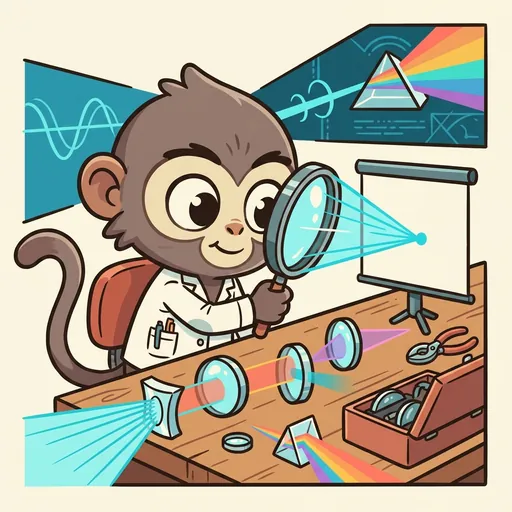
Focus
LENS ACTION — *converging lenses bring parallel rays to a point. diverging lenses spread them apart. that's how telescopes, eyes, and magnifying glasses work.*
Listen along — Focus
Loading audio…
Press play to listen along. The line being read lights up as you go.
Show full transcript
Loading transcript…
Chapter 4 — Focus and the Rays That Meet at a Point
Focus, a small langur in a tiny optometrist coat, aimed a flashlight through a fat lump of glass and slid a folded screen back and forth in the beam. His fur was warm grey, his big eyes ringed in cream. On the screen the light was a smear — then, at exactly the right distance, it pinched down to a single sharp dot.
“There,” he whispered. “Right there.”
He nudged the screen a hair further and the dot bloomed back into a blur. He slid it home again. Sharp dot. Blur. Sharp dot. Every parallel ray in that beam, bending inward through the curved glass, meeting at one bright point he could catch on a card.
“You all agree to meet at the same spot,” he told the rays, delighted. “Every time.”
He’d grown up high in the canopy village, among langurs whose pale eye-rings helped them pick a snake from a shadow two trees over. Seeing well was the family trade.
His aunt handed him a curved chip of clear resin when he was seven. “Hold it over the leaf,” she said. He did, and the leaf’s veins swelled huge and close, so real he reached to touch them — and touched only air.
“Where did it go?” he asked.
“Nowhere. The lens bent the light so the leaf looks bigger and nearer than it is.” She tapped the ring around her own eye. “You have a lens too, in there, doing the same thing all day. Learn how lenses work and you’ll understand how you see.” She let him keep the resin chip. He held it over everything for a year.
When he was twelve he walked down to PrismForge with pockets full of lenses, thick and thin, convex and concave. Optic, who ran the school, was waiting.
“Show me lens action,” Optic said.
Focus didn’t lecture. He pulled out his fattest lens — a magnifying glass — and held it in a shaft of window light, screen behind it, until the sunlight collapsed into one blinding point. “Converging lens,” he said. “Curves outward, bends the rays inward, brings them to a point.” He swapped in a thin lens that dipped in the middle and the light fanned wide and dim. “Diverging lens. Curves inward, spreads them out.” He tapped his own coat. “An eye. A camera. A telescope. All the same trick — pick the lens that bends the light the way you need.”
Optic watched the boy make sunlight kneel to a single dot. “Come in,” he said.
On lesson days his workbench looked like a jeweler’s spill — lenses in every size. A cluster of students leaned close as Focus set up his flashlight and folded screen.
“Watch the dot,” he said, and clicked the light through the fat convex lens. He walked the screen back until the beam snapped to a crisp point. “That’s the focal point. Every parallel ray, meeting.” He eased the screen back a step and the dot swelled to a soft circle. “Now it’s out of focus — the lens is still bending the light exactly the same, I’m just not catching the rays where they meet.”
“So it’s the screen that’s wrong, not the lens,” a boy said slowly.
“Exactly.” Focus beamed. Then he pulled the fat lens out and dropped in the thin concave one. Same flashlight — but now the light hit the screen as a big, dim wash, no dot anywhere. “Diverging lens spreads them. The point where they’d meet is behind the lens, on my side. You can’t catch it on a card — it’s only where the rays seem to come from.” He held the two lenses up, one in each paw. “Bring them together, or push them apart. That’s every telescope, every pair of glasses, every eye — including yours, focusing this room onto the back of it right now.”
The room emptied except for a girl turning the thin lens over and over, frowning.
“Optics labs look so fancy,” she said. “Like you need a whole science building.”
Focus dug in his coat and put a chipped magnifying glass and a scrap of cardboard tube in her hands. “Two cheap lenses and this tube — that’s a telescope. One lens and a piece of paper by a sunny window — that’s a projector.” He watched her turn the little glass in the light. “My aunt gave me a lens like that when I was small. I thought it was almost too easy to be real physics.”
“Is it, though? Real?”
“It’s the realest,” he said. The girl lifted the lens to her eye and the far wall leapt close, and Focus saw her breath catch. What rose in his own chest wasn’t the old thrill of the sharp dot — it was a warm, settled kind of pride, the feeling of handing someone a name for a thing they’d wondered about their whole life. “The world didn’t get smaller,” he said softly. “It got friendlier — like passing someone a hundred times and finally learning their name.” She lowered the lens, grinning, and that warmth passed straight to her.
The PrismForge ensemble
Focus is part of PrismForge's distributed-narrative cast. Each character embodies a different curricular primitive; together they teach the full subject.