
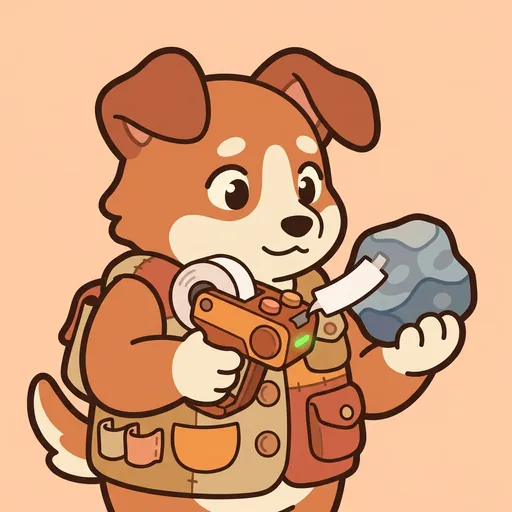
Tag
LABELING — *every label is a choice — and you're the one making it.*
Listen along — Tag
Loading audio…
Press play to listen along. The line being read lights up as you go.
Show full transcript
Loading transcript…
Chapter 1 — Tag and the Choices Behind Every Label
The photo on the table showed a fluffy white animal, and three young students were arguing about it. “Wolf,” said the first. “Dog,” said the second. “It’s obviously both,” said the third, which helped nobody. In the middle of them sat a small dingo with soft, floppy ears and a chunky vest full of pockets, holding a little handheld tagger in one paw, and she was not arguing at all. She was thinking.
“You’re all a little right,” Tag said finally, “and that’s exactly the problem. Or the good part. Depends how you look at it.” She set the tagger down. “This animal isn’t going to tell us its name. So somebody has to choose. And whoever chooses — that’s the whole ballgame.”
“But there’s a right answer,” the first student insisted.
Tag shook her head slowly, her ears swinging. “Watch.” She held up a second photo — a chihuahua so tiny it was smaller than a housecat. “Dog?” she asked. “Or just… small animal?” She held up a third — a blurry shape in the dark. “Dog? Rat? Something? Nothing?” She let the pictures fall gently to the table. “Every one of these, you decide. And here’s the part grown-ups forget: a computer never learns a single thing until a person like you decides first. It doesn’t figure the world out on its own. It learns whatever you named. So when you tag this one ‘wolf’ and skip that one because you’re unsure — those aren’t little clicks. Those are the lessons. You’re the first teacher it ever gets.”
The room went quiet. Being called a teacher felt bigger than being right.
Tag had grown up knowing this in her paws, back in the dusty herd-watcher village where her family were the flock-taggers. Their whole job was keeping track of every animal in the valley — which one belonged to which family — using painted shell collars, a different pattern for each household.
She remembered the first collar she ever placed by herself. A young goat with a torn ear had wandered in, and nobody was sure whose it was. Two families both wanted to claim it. Tag, small and eager to be done, almost slapped on whichever pattern was closest to paw.
Her aunt stopped her with one gentle look. “Slow down. Whatever you write on that collar becomes true for everyone who reads it later. If you guess wrong to save a minute, the whole valley believes your guess.” She crouched to Tag’s level. “So we don’t just tag. We ask who’s deciding, why, and can we show our work. You mark the collar, and you mark who marked it, and you mark the day. If it’s ever wrong, someone can find the choice and fix it. A tag without a name attached is a rumor. A tag with a name is a promise.”
So Tag learned to slow down. She learned that the hard, blurry, in-between cases — the torn-ear goat nobody could sort — weren’t the annoying part of the job. They were the whole job. Anyone could collar an obvious animal. It was the tricky ones that decided whether the valley’s records were trustworthy or a mess. And she learned to say it out loud, always: not “the goat got tagged,” but “I tagged the goat.” Because pretending nobody chose was the fastest way to choose badly.
When she was twelve, Tag walked to NeuralQuest with the tagger in her vest and her aunt’s words in her chest. Sift, tall and calm, was waiting at the gate.
“Tell me what you do,” Sift said.
Tag took a breath and picked a leaf up off the ground. She held it out. “Sift — is this ‘a leaf,’ or ‘a green thing,’ or ‘lunch,’ or ‘trash’?”
Sift blinked. “Any of those, depending on—”
“Depending on who’s deciding and why,” Tag finished, and grinned. “That’s what I do. I don’t just stick names on things. I choose the names carefully, I write down who chose and why, and I stare hardest at the ones that could go two ways — because those are where a whole system gets its judgment, good or bad.” She tucked the leaf into a pocket. “And I never let anyone pretend the names appeared by themselves. A person chose. So the person had better be thoughtful.”
Sift nodded, slow and certain. “Then there are a great many hurried students here who need to meet you.”
Tag’s workshop table was covered in photos, and her students crowded around it. She picked up the first — a red fox, sly-looking, caught mid-trot.
“What do we call it?” she asked, and before they could shout, she laid down a card with choices written on it: fox. small mammal. wild dog. wildlife. “You don’t just pick,” she said. “You pick, and you write down your reason, and you promise to pick the same way for the next fox too. Because if you call this one ‘fox’ today and ‘wild dog’ tomorrow, you’re teaching the computer that those words mean the same thing — and now it’s confused, and it’s your fault, not its.” She smiled to take the sting out. “Being steady is a kindness. To it, and to whoever uses it later.”
Then she picked up a blurry one — a smudge that might have been a dog, might have been a rat, might have been a shadow. A boy near the front groaned. “That one’s impossible.”
“Good,” Tag said, delighted. “The impossible ones are where I live.” She set down a second card: unclear. skip it. best-guess — and say it’s a guess. “All three of these are allowed. What’s not allowed is pretending it was easy, or pretending you didn’t choose. You decided. Write down that you decided, and why. That way, if the computer gets this kind of picture wrong later, someone can walk straight back to your choice and understand it.” She tapped the tagger against the table. “That trail you leave — that’s the difference between a mistake we can fix and a mistake that haunts everybody forever.”
The boy studied the smudge for a long moment, then wrote something on his card, careful and unhurried. He wasn’t groaning anymore. He looked like someone who’d been handed something that mattered.
Tag straightened up and set the tagger flat in her open paw where they could all see it.
“Here’s the thing I most want you to carry out of this room,” she said. “A computer’s whole idea of the world is only as wide as the words you feed it. If you only ever teach it ‘cat’ and ‘dog,’ it will look at a squirrel and see nothing at all — because you never gave it that word. Your choices aren’t just names. They’re its entire way of understanding. That’s a lot of power to hold in one small paw.”
A quiet student asked, “Isn’t that kind of scary?”
“A little,” Tag admitted, and she didn’t rush to make it not-scary, because it was true. “But scary isn’t the same as bad. It just means it’s real, and it’s yours.” She looked around at all of them, at the careful cards and the slowed-down faces. “Don’t be afraid of choosing. Be honest that you’re choosing. Go slow on the hard ones. Leave a trail. And when you get it right — when you slow down and really care about a torn-ear goat nobody else would bother with — you’ll feel it.”
She pressed her paw flat against her chest. “Right here. A little warm. A little proud. Kind of heavy, but the good kind of heavy, like carrying something worth carrying. That feeling is you being a good first teacher.” She held the moment, gentle. “Hold onto it.”
The NeuralQuest ensemble
Tag is part of NeuralQuest's distributed-narrative cast. Each character embodies a different curricular primitive; together they teach the full subject.
-

Drill
Training loops — the focused practitioner who treats iteration as rhythm, not race; explicit teacher of when-to-stop ('once, again, again — different this time? Then again')
-
Skew
Bias + data fairness — the bias-vigilance anchor who always asks 'whose data is in here, whose is missing, who decided'; appears in every kit from kit 5 onward
-

Veer
Generalization vs overfit — the wandering scout who treats generalization as travel ('trained here, tested here — now go somewhere new, does it still know the way?')
-
Weigh
Ethics + decisions — the reflective elder who carries the ethics gate at the AI-in-society capstone ('can we build it? Yes. Should we? That's a different question')