
Drill
TRAINING LOOPS — *once, again, again — different this time? then again. iteration is rhythm, not race.*
Listen along — Drill
Loading audio…
Press play to listen along. The line being read lights up as you go.
Show full transcript
Loading transcript…
Chapter 2 — Drill and the Patient Repetition That Teaches
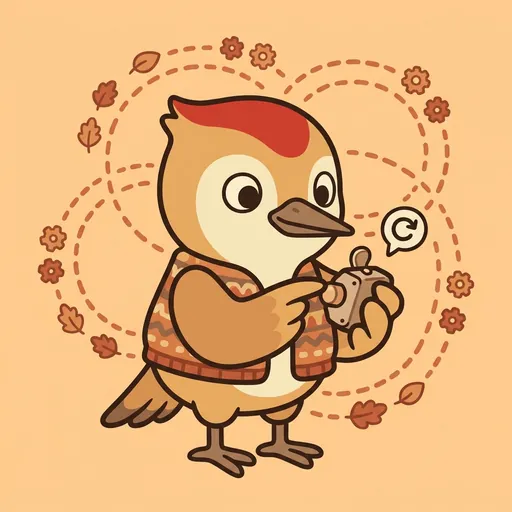
The little woodpecker on the fencepost was not in a hurry, and that was the strange part. Every other bird in the NeuralQuest garden darted and swooped and shrieked, but Drill just tapped. Tap. A pause the length of a breath. Tap. Another breath. Tap. He was warm tan with a cream belly and a bright red cap, and he wore a chunky practice-vest with a tiny tally-counter clipped to the belt. Each tap moved the counter one click forward.
A younger bird landed beside him, out of breath. “You’re so slow,” she said. “Don’t you want to be done?”
Drill kept his eyes on the bark. He set his beak against a spot that was almost — but not quite — the shape he wanted. Tap. He tilted his head, listening to the little hollow sound it made. Not right. He shifted a hair to the left and tried again. Tap. Closer. He shifted again. Tap. Closer still. The counter clicked, clicked, clicked.
“There,” he said at last, and the hole in the bark was clean and round and exactly where he’d meant it. “It wasn’t slow. It was steady. Watch what steady does.” He drummed a quick, bright little run across the trunk — the same beat, over and over, but each repetition a whisper cleaner than the last. “Once, again, again,” he said. “Different this time? Then again. That’s how anything gets good. Not all at once. A little closer, every time you go around.”
The younger bird cocked her head, listening to the run smooth itself out. She hadn’t rushed off. She was still there.
Drill had learned this the long way, back home by the village forest. His family were practice-keepers — woodpeckers whose whole work was drumming patterns into the old bark, patterns the forest creatures read like a village bulletin. And a pattern only counted if it was even. If it wobbled, nobody could read it.
Drill remembered being small and furious about that. He would sprint through a pattern, desperate to finish, and the beat would come out lopsided and blurred. He’d start over, sprint again, blur it again, and by the end of a morning he’d want to fling his own beak into the dirt.
His grandpa never rushed him. Grandpa would sit on the branch above and let Drill wobble through the whole ugly mess, and then he’d say the same thing every time. “You’re trying to jump to the end. There is no end to jump to.” He’d tap the branch once, softly. “The rhythm is the practice. If you rush, it wobbles. If you crawl, it fades. You find the pace where each tap lands a little truer than the last, and then you just keep the pace. That’s all. You keep the pace.”
Drill tried it the next morning. He didn’t try to be done. He tried to be one hair better than the tap before. Tap. A little truer. Tap. A little truer. He stopped counting how far he had to go and started counting how far he’d come. And somewhere in the middle of all those small trues, without any single moment of it, the pattern came out even. He’d been so busy with the next tap that he’d missed the exact instant it turned good.
That was the day the counter stopped being a chore and started being a friend.
When he was twelve, Drill walked to NeuralQuest with the practice-vest still on and the tally-counter still clicking at his belt. He wanted to know if the steady thing worked on more than bark.
Sift, an old owl with bright, patient eyes, met him at the gate. “There’s a garden full of birds in a great hurry in here,” Sift said. “What could you possibly teach them?”
Drill didn’t answer with words. He set his beak against the gatepost and tapped — once — and let the sound hang. Sift waited. Drill tapped again, a hair to the left, the note a little rounder. Again. Rounder still. He did it maybe twenty times, and each one was almost the same as the last, and every single one was the tiniest bit better, and by the twentieth the note was so clean it seemed to ring.
“That,” Drill said. “I can teach them that. That a thing gets good by going around and around, a little closer each lap, and that the trick nobody wants to hear is you can’t skip the laps.”
Sift’s eyes crinkled. “Most of them will hate hearing it.”
“Most of me hated hearing it too,” Drill said. “Then it saved me.” He clicked the counter once, gently. “Where do I set up?”
His workshop had a big screen, and on it lived a little learning-machine that Drill treated exactly like a beginner drummer. A crowd of garden birds packed in to watch, expecting something fast and flashy.
Drill put a picture of an apple on the screen. “Guess,” he told the machine.
“BANANA,” the machine announced.
The birds cracked up. Drill just smiled and clicked his counter. Click. One. “Wrong,” he agreed. “Now watch the important part — I don’t yell. I nudge. I tell it, quietly, ‘that’s an apple,’ and I let it fix itself a hair.” He showed a second apple. “Guess.”
“ROUND FRUIT?”
“Better,” Drill said. “Closer. So I nudge it even less this time.” Click. Two.
Picture after picture. Sometimes the machine said “red ball,” or “tomato,” and the birds giggled, and Drill never once giggled with them — he just nudged, and clicked, and the guesses crept truer. After a hundred clicks the machine mostly said “fruit.” After a thousand it said “apple” when it saw an apple, nearly every time.
A small brown wren near the front had gone very quiet. “It’s the drumming,” she said suddenly. “It’s the same as the drumming. You’re not making it right. You’re letting it get a hair closer, over and over.”
“Exactly the same,” Drill said, warm all the way through. “Once, again, again. Different this time? Then again. A computer learns the way you learn a song — by going around, not by wishing.”
Then Drill did the thing he most wanted them to see. “Now — what if I never stop?” He sped the demonstration into a blur of clicks, tens of thousands of them, until the machine was flawless on every single picture it had already met. The birds oohed. Then Drill slid in a brand-new apple, one the machine had never laid eyes on.
“SQUARE,” the machine said, certain and completely wrong.
The garden gasped. “But it was perfect!” the wren cried.
“It got too good at the old ones,” Drill said gently. “It squeezed itself so tight around what it already knew that it couldn’t stretch to anything new. There’s a moment — you have to feel for it — where more practice stops helping and starts hurting. Knowing to stop right there isn’t luck. It’s the whole craft.” He clicked the counter one last time and let it rest.
“So here’s the part I really came to say.” He looked around at all the birds who’d forgotten to be in a hurry. “It’s supposed to take a while. That slow, patient, going-around feeling — that little ache of not there yet — that’s not the price of learning. That is the learning. You never get to perfect. You get to good enough, and good enough is plenty.”
The wren let out a breath she’d been holding. Her shoulders came down. She wasn’t itching to fly off anymore; she felt, for the first time all day, like she could sit inside a slow thing without it hurting. And the counter at Drill’s belt gave one soft, steady, unhurried click.
The NeuralQuest ensemble
Drill is part of NeuralQuest's distributed-narrative cast. Each character embodies a different curricular primitive; together they teach the full subject.
-

Tag
Labeling — the cheerful labeler who treats every label as a human choice and meaning-making act ('every label is a choice — and you're the one making it')
-
Skew
Bias + data fairness — the bias-vigilance anchor who always asks 'whose data is in here, whose is missing, who decided'; appears in every kit from kit 5 onward
-

Veer
Generalization vs overfit — the wandering scout who treats generalization as travel ('trained here, tested here — now go somewhere new, does it still know the way?')
-
Weigh
Ethics + decisions — the reflective elder who carries the ethics gate at the AI-in-society capstone ('can we build it? Yes. Should we? That's a different question')