Plan
PLAN — *the math of choosing with limited resources. every yes is also a no.*
Listen along — Plan
Loading audio…
Press play to listen along. The line being read lights up as you go.
Show full transcript
Loading transcript…
Chapter 4 — Plan and the Yes That Is Also a No
On the long bench in the middle of the village-storage-yard, a squirrel-tween named Plan tipped exactly twenty acorns out of a small bin and spread them into a neat row.
Then he stopped and looked at them for a while, the way some people look at a puzzle before they touch it.
A younger squirrel scampered up, cheeks already half-full. “That’s a lot of nuts just sitting there. Why aren’t you eating?”
“Because I’ve only got twenty,” Plan said, “and I want more than twenty things.”
He slid five acorns to the left, into a shallow dish marked now. “Five to eat today — I’m hungry, that counts.” He pushed ten to the middle, into a deeper bin. “Ten into the winter store.” He nudged the last five to the right, toward a little basket. “Five to share with the burrow down the hill; they had a thin autumn.”
“But now you can’t eat the other fifteen,” the younger squirrel said, frowning.
“Right.” Plan didn’t sound bothered. “Every yes is also a no. If I eat all twenty right now, I’ve said no to winter and no to sharing without ever deciding to. This way I decided.” He tapped the now dish. “I still get today. I just chose it on purpose instead of by accident.”
The younger squirrel stared at the three little piles, then at their own stuffed cheeks, and slowly — a little guiltily — put one acorn back.
Plan had not always been so calm about it.
The first winter he could really remember, his family had run short. He’d been small, and in the bright warm days of October the yard had been buried in acorns, more than anyone could count, and he’d eaten and eaten because it felt like there would always be more. By February the bins were scraping empty, and he remembered the exact ache of it — a tight, worried feeling under his ribs, staring at a nearly-bare shelf, thinking where did it all go?
His grandmother had sat beside him then. She hadn’t scolded him. She’d just said, softly, “It didn’t vanish, you know. Every acorn you ate in October was a choice — you just made it without looking. That’s the only part that hurts. Not that you spent. That you never got to decide.”
“I didn’t know it would run out,” Plan had whispered.
“Now you do.” She’d handed him a single acorn. “So next autumn you’ll lay them out where you can see them. And you’ll pick which yeses on purpose. When you choose with your eyes open, even a small store feels bigger — because none of it got away from you.”
Plan had held that one acorn a long time. The worried ache didn’t disappear, but it changed shape. It became something he could work with.
He walked to MintForge at twelve, because a place that studied money ought to understand the kind of choosing his grandmother had taught him — the kind where you can’t have everything, so you decide.
Penny, the mentor who ran the workshops, met him at the gate and asked just one thing. “What does it mean to make a budget?”
Plan didn’t answer with a speech. He set his bin on the ground, counted out a small handful of acorns, and laid them in three little piles — some here, some there, some set aside — right there in the dirt.
“It’s choosing where limited things go,” he said. “You can’t put the same acorn in two piles. So you decide which yeses. And whatever you pick, you’re letting the other choices go. That’s the cost — not money, exactly. It’s the thing you gave up.”
Penny looked at the three careful piles in the dirt for a long moment. “You belong here,” she said.
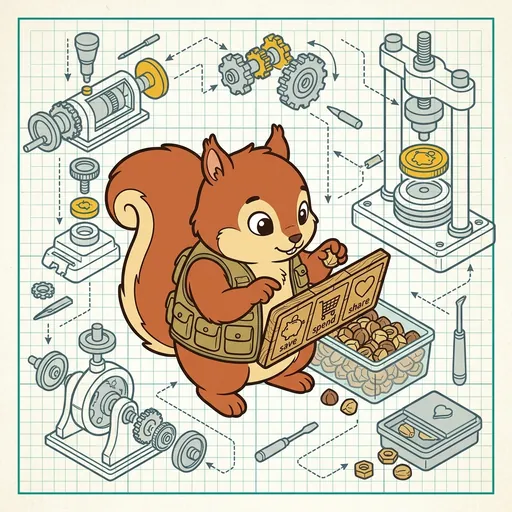
Plan’s workshop had a wide bench, an allocation-board with three chalked columns — keep, spend, share — and a bin of acorns that never seemed to run low.
A girl came in one afternoon, arms crossed, cross with herself. She had twelve coins saved and a list twice that long. “I want the paints and the book and to save for the bike,” she said. “I can’t have all of it. Budgeting just means I have to give stuff up. It’s the worst.”
Plan slid the bin toward her. “Twelve acorns. Same as your twelve coins. Put them where your wants are.”
She dropped six by paints, four by book, two by bike, then stared at the empty space where more should have gone. “See? Nothing left for the bike, basically.”
“So the bike’s the cost of the paints and the book,” Plan said. “That’s the true price — not the coins, the thing you gave up. Does putting six by the paints feel like the worst thing?”
She thought about it. ”…No. I really do want the paints.”
“Right. It’s not that you’re losing.” He gathered her acorns back into her hand. “It’s that you get to aim. Watch.” He took the bin and split his own into keep, spend, share — clean and unhurried. “I didn’t say no to fun. I said yes to some fun and yes to next month. Nothing snuck past me.” He let her lay hers out again, slower this time, and she moved three acorns from paints to bike, testing it, and grinned when it felt right. “The first split is always a little wrong,” Plan said. “You just did your second. It’s already better.”
The girl laughed. “So I can change it?”
“Every time. That’s the whole craft. Lay it out, choose on purpose, see what happens, fix it next round.”
Later, when the bench was quiet, the girl came back with one last question. She was gentler now.
“When you give something up,” she said, “the thing you didn’t pick — doesn’t it just feel bad? Like a little loss every time?”
Plan thought about the near-empty shelf, and the ache under his ribs, and the one acorn in his grandmother’s paw.
“It used to, for me,” he said. “When the choosing happened to me. But when I lay everything out and pick with my eyes open —” he spread a hand over the three little piles, ”— the letting-go stops feeling like losing. It feels more like aiming. Steady. Like you’ve got both feet under you.” He looked at her kindly. “You didn’t fail to get everything. Nobody gets everything. You did the braver thing. You chose.”
The girl nodded slowly, and Plan watched the crossed arms come uncrossed — the tight, worried set of her shoulders going soft, the way, years ago, his own had.
He didn’t say the rest out loud, but he felt it, warm and sure and settled: the choosing was never the sad part. The sad part was letting it happen by accident. Once you decide on purpose, even a small handful feels like plenty.
The MintForge ensemble
Plan is part of MintForge's distributed-narrative cast. Each character embodies a different curricular primitive; together they teach the full subject.