
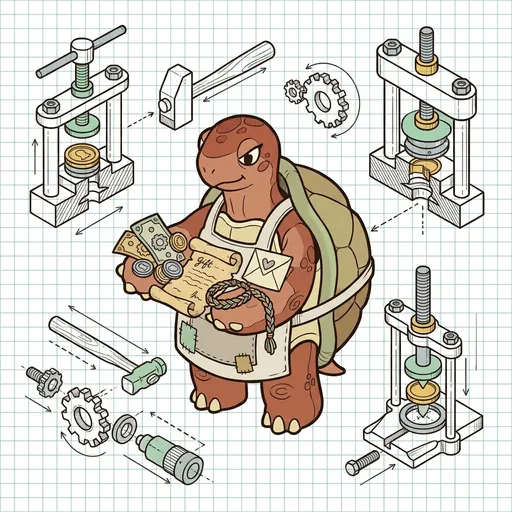
Coin
COIN — currency and exchange, and the things money can't measure.
Listen along — Coin
Loading audio…
Press play to listen along. The line being read lights up as you go.
Show full transcript
Loading transcript…
Chapter 1 — Coin and the Many Things Money Can’t Measure
The market at MintForge was already loud by the time Coin set up her table. She was a small turtle in a chunky apron with far too many pockets, and she moved slow, the way turtles do, laying things out one at a time. A stack of copper coins. A crinkly paper bill. A faded gift certificate for one free scoop of ice cream.
Then, from the deepest pocket, she pulled two things that were not money at all: a friendship bracelet of bright woven string, and a folded thank-you note with a wobbly sun drawn on the front. She set those in the very middle of the table, right where everyone could see.
A boy stopped, looking confused. “Why’s the bracelet on the money table?”
Coin smiled and tucked her chin. “You’ll see,” she said. “Sit a minute.”
Coin had grown up in this market. Her family ran a fair-trade stall, and when she was little she used to sit under the table and watch feet go by — the shuffle of shoppers, the careful count of coins into open palms.
One evening, after the stalls closed, she’d found her grandmother crying happy tears over a jar of jam a neighbor had left as thanks. “That jam isn’t worth a single coin,” young Coin had said, puzzled. “So why does it make you cry?”
Her grandmother had laughed and wiped her eyes. “Because a coin buys the apple, little one. But it can’t buy what that neighbor felt for us. Two different kinds of worth. Learn to tell them apart, and you’ll never be fooled by a price tag again.”
Coin never forgot it. Some things you could count. Some things you could only feel. And the trouble started when people mixed the two up.
When she was twelve she carried her apron down to the market’s oldest trader, an owl named Penny who kept the scales.
Penny peered at her over half-moon glasses. “Tell me, child. What is money, really?”
Coin didn’t reach for a coin. She reached for the bracelet. “Money is a tool,” she said. “A good one. It lets you trade an apple for a coin, and a coin for bread, without having to find one exact person who has bread and wants apples. It holds still while it waits — an apple rots, but a coin keeps. And it gives everything a number so you can compare.” She held the bracelet up to the light. “But it can only measure the things that have a price. This one doesn’t. And it’s still the most valuable thing I own.”
Penny’s feathers ruffled with pleasure. “Then the table is yours,” she said.
Now, at her own table, Coin picked up a single copper coin and turned it so it caught the sun.
“Watch,” she told the little crowd. “This coin can buy an apple. Trade it at any stall — the seller takes the coin, you take the apple. That’s what a coin is for. It moves worth from your pocket to theirs.” She dropped it back on the pile with a bright clink.
Then she lifted the friendship bracelet. “This can’t buy an apple. Nobody would take it at a stall.” She let that sit a second, then leaned in. “But a girl named Wren wove this for me because I helped her carry water when she was sick. Tell me — what stall sells that?”
The crowd was quiet.
She unfolded the thank-you note, gentle as opening a wing. “And this,” she said. “It cost the person nothing and it can’t be spent anywhere. It just says: I saw what you did, and it mattered.” She smoothed the wobbly sun with one claw. “Try putting a price on being seen.”
The boy who’d asked about the bracelet spoke up, quieter now. “So the coin’s worth more, though. Right? Because it can actually buy stuff.”
“Ah.” Coin set the coin and the bracelet side by side. “The coin is worth more at the stall. The bracelet is worth more at bedtime, when you’re remembering who’s on your side.” She looked around the little circle. “Both are real. They just measure different things. The mistake — the only real mistake — is thinking the coin measures everything.”
She gathered her tokens back into her apron, slow, one pocket at a time, and let the last thought settle.
“Some of you have more coins than the kid next to you. Some have fewer. And I promise you,” she said, and her voice went soft and firm at once, “that number is not a measure of you. Not your kindness, not your cleverness, not one thing about who you are. A full pocket doesn’t make a good person, and an empty one doesn’t make a lesser one. The coin was never built to weigh that.”
Across the circle, a girl with quiet eyes reached up and touched the woven bracelet on her own wrist — one she hadn’t thought about all day. A warm, steady feeling rose in her chest, the kind that makes your shoulders come down from your ears. She wasn’t thinking about coins at all anymore. She was thinking about the friend who’d tied that string for her, and how safe and glad it made her feel to be somebody’s somebody.
Coin caught the look, and smiled to herself. That feeling — right there — was the whole point.
The MintForge ensemble
Coin is part of MintForge's distributed-narrative cast. Each character embodies a different curricular primitive; together they teach the full subject.
-

Tag
Percentage + markup — the transparent math of how prices are built
-

Grow
Compound interest — patient math of money over time
-

Plan
Budget allocation + opportunity cost — the math of choosing with limited resources
-

Tilt
Risk + variability — the math of uncertain outcomes, distributions over destinies