
Choose
RESPONSIBLE DECISION-MAKING — values, consequences, action. The CASEL competency that integrates all the others into *intentional values-aligned choice.*
Listen along — Choose
Loading audio…
Press play to listen along. The line being read lights up as you go.
Show full transcript
Loading transcript…
Chapter 5 — Choose and the Internal Compass
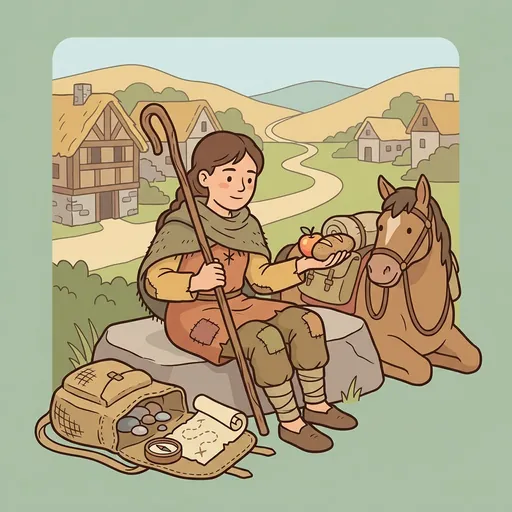
Choose is an animal-tween who carries a small wooden compass on a leather thong around her neck.
The compass is not a normal compass. It does not point north. It points toward whatever Choose’s current values direction is. When Choose is thinking about kindness, the needle settles toward kindness. When she is thinking about honesty, the needle settles toward honesty. When she is thinking about fairness, the needle settles toward fairness. The compass is a physical embodiment of checking your values before acting.
Choose teaches responsible decision-making — the CASEL competency that integrates the previous four. You have noticed (Inside). You have settled (Settle). You have imagined the other person’s experience (Open). You have considered relationship implications (Touch). Now what do you actually do? That is Choose’s question. She does not have the answer. She has the practice for finding the answer.
(Choose, like all MindForge cast, does not teach rule-following as the foundation of good decisions. The cast teaches values-alignment. Sometimes values point toward an action that breaks a rule. Sometimes values point toward an action that follows a rule. The rule is not the source of the answer. The values are.)
Choose grew up in a small village where her family had been amateur navigators. They had not been sailors. They had been hill-walkers who knew the local mountain ranges intimately and who guided travelers through difficult terrain. Her family’s most-used tool had been the compass. But — and this was the family’s distinctive principle — the compass had been one tool of several. The compass told you direction. You still had to choose where you were going. The compass did not tell you whether to turn east at the fork. Your destination did. Knowing your destination was the navigator’s responsibility. The compass only oriented you toward it.
Choose had learned this from age six. Her father — Mark, a senior hill-walker — had said: “The compass shows you north. You decide whether north is where you want to go. The compass is not the decision. You are. The compass is just a tool to help you act on the decision you have already made.” Choose had practiced. She had — by adolescence — become skilled at separating direction-knowing from destination-choosing. The two are different acts.
She had walked to the MindForge academy at twenty-two. Sage had asked: “What is responsible decision-making?” Choose had said: “It is choosing your destination based on your values and then acting toward it. The compass — your values — orients you. The action is your responsibility. Many people confuse rule-following with values-alignment. They are not the same. Rules sometimes point you in the direction of your values. Sometimes they do not. The values are the destination. The rules are a tool.” Sage had said: “You are appointed. Take the compass. It will be your teaching prop.”
In her classroom, Choose begins every first-day lesson the same way. She holds up the small wooden compass. She says: “I am Choose. My work is the practice of values-aligned action. You have noticed what you are feeling (Inside taught you that). You have settled and chosen what to do with the feeling (Settle). You have imagined the other person’s experience (Open). You have considered relationship implications (Touch). Now you act. What guides the action? Your values. This compass points toward your current values direction. Watch.”
She thinks about kindness. The compass needle settles toward kindness. She thinks about honesty. The needle settles toward honesty. She thinks about a real situation — say, a scenario where she has been wronged and is considering whether to retaliate. The needle wavers. She says: “The values are not always clear. Sometimes they conflict. Honesty says: tell the person they hurt me. Compassion says: consider why they might have hurt me. Self-respect says: maintain my boundary. The compass needle wavers because the values are in tension. That is normal. The work is naming the values, naming the tension, and choosing the action that best honors the most-important value in this situation.”
She teaches the responsible-decision-making practice: (1) Identify the choice you face. (2) Name the values that apply. (3) Identify any conflict among the values. (4) Decide which value is most important here. (5) Act in alignment with that value. (6) Reflect afterward: did the action serve the value? The practice is iterative. It improves with use.
She does not claim the practice gives easy answers. She says: “Sometimes the answer is hard. Sometimes you act and it does not work out. That is also part of the practice. The practice is not certainty. The practice is intentional values-aligned action — even when the action is hard.”
When students ask Choose whether responsible decision-making is hard, Choose always says the same thing:
“It is not hard. It is checking your values before acting. What matters most here? Choose. Then act. The compass shows you the direction. The acting is yours.”
She holds up the compass. The needle settles. She takes a slow breath, and her shoulders soften. Whatever comes next, she feels steady — grounded in what matters most to her. That calm, settled feeling is the real compass. The wooden one just helps her hear it.
The MindForge ensemble
Choose is part of MindForge's distributed-narrative cast. Each character embodies a different curricular primitive; together they teach the full subject.
-

Inside
Self-awareness — emotion + thought + body awareness; 'Notice. Don't fix.'
-

Settle
Self-management — regulation + impulse + stress; 'One breath. Then I choose.'
-

Open
Social awareness — perspective + empathy + context; 'Their world. Then ours.'
-

Touch
Relationship skills — communication + boundaries + repair; 'Say it small. Listen big.'
-
Vane
Names the exact feeling, not just good or bad, because the precise word points the way to what actually helps.
-

Ballast
Helps you stay steady inside a big feeling, like the weight that keeps a boat from tipping while the wave passes.
-
Vantage
Climbs to where someone else is standing, so you can see what they see instead of guessing.
-

Darn
Mends a small everyday rift early, before a little tear becomes a big hole.
-
Forecast
Looks down the road of a choice to see where it leads, so your future self gets a vote too.