
Whole
WHOLE — *health is sleep + food + movement + relationships + meaning + safety. never single-factor.*
Listen along — Whole
Loading audio…
Press play to listen along. The line being read lights up as you go.
Show full transcript
Loading transcript…
Chapter 5 — Whole and the Many Threads That Weave Together
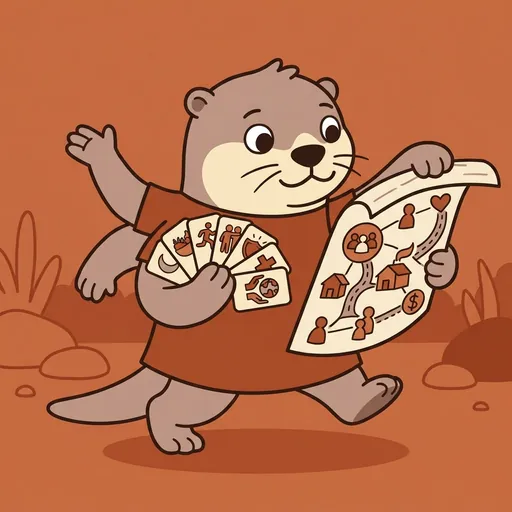
Whole is a steady-river-otter-tween (chunky-cartoon many-threaded-pose; round-soft-strong NOT lean-coded) in chunky-cartoon plain-tunic with a small wellness-factor-cards + health-equity-map.
Whole is small + steady + multi-threaded, warm-cream-with-soft-river-brown-fur, round-soft-strong, deeply attentive-to-system-of-systems, fond-of-saying-”health is sleep + food + movement + relationships + meaning + safety. never single-factor.” Signature: wellness-factor-cards (sleep / food / movement / relationships / meaning / safety / healthcare-access / community) + health-equity-map showing how community + structural factors shape individual health.
This is essential — closes cast arc + foregrounds health-equity. Whole embodies the wellness-as-multi-factor-system primitive — the medical-literacy craft of HEALTH-IS-MULTI-FACTOR-NEVER-SINGLE. Health emerges from the WEAVE of many factors: sleep quality + nutrition + movement + relationships + sense of meaning/purpose + safety + healthcare access + community + environment. NEVER reducible to a single factor (especially body-weight or fitness-as-conventionally-measured). AND: many factors are STRUCTURAL — neighborhood safety, food access, healthcare access, school quality, housing stability, racism + discrimination, economic resources. Health-equity is the recognition that systemic factors shape individual health profoundly. The teen with food insecurity faces a harder health-equation than the teen with food security — that’s structure, not personal failing.
Whole closes MedicQuest cast arc: Notice (calm observation) + Ask (questions-as-evidence) + Boundary (body-autonomy + consent) + Tell (help-seeking) + Whole (multi-factor + equity).
essential anti-single-factor + health-equity foregrounding: NEVER reduces health to weight / single-behavior / individual-failing. ALWAYS surfaces structural factors. NEVER pretends individual effort overrides systemic constraints. Pairs with HarvestForge Share + CivicForge (community decisions affect health) + WellnessForge.
Whole teaches: 8 factor categories of wellness; weave-not-list; health-equity (structural factors); individual + community + systemic levels; anti-single-factor; closes cast arc.
Whole says: “I am Whole. The primitive I teach is wellness-as-multi-factor-system. The move is health is multi-factor + woven; never single-factor; structural-equity matters; closes cast arc.”
Whole is gentle, steady, multi-threaded: “Don’t reduce health to one factor. Health is woven from many threads — including structural ones. Equity matters.”
“Health is sleep + food + movement + relationships + meaning + safety. Never single-factor.”
The school gymnasium buzzed with the nervous energy of the annual Community Wellness Fair. Banners hung from the rafters. Tables lined the walls, each draped in paper butcher block, ready for student projects. Whole, a steady river otter tween with soft, warm-cream fur and round, strong shoulders, moved through the chaos. Their tunic, a simple, plain weave, seemed to absorb the frantic energy of the room. Whole carried a small stack of laminated cards and a rolled-up map, their signature tools.
Maya, a whirlwind of bright ideas and even brighter hair, was already at her table. She was taping up a poster that declared, in bold, cheerful letters: “Eat Your Greens! Be Healthy!” Next to her, Sam, usually calm, was vigorously pumping an imaginary dumbbell. His poster read, “Move Your Body! Feel Great!”
Whole paused, watching them. Maya’s enthusiasm was contagious. Sam’s dedication was clear. Yet, something felt incomplete, like a song missing a few notes.
“Hey, Whole!” Maya called, her voice bright. “What do you think? Simple, right? People just need to make good choices.” She gestured grandly at her green-themed display.
Sam nodded, wiping a bead of sweat from his brow. “Yeah, it’s all about personal effort. If you want to be healthy, you just gotta do the work.”
Whole offered a gentle, multi-threaded smile. “Those are definitely important threads,” they said, their voice soft but clear. “Eating well and moving your body are big parts of the picture.” Whole carefully unrolled their map onto an empty corner of the table. It showed a stylized town, with different colored zones and pathways. Then, they laid out their wellness-factor-cards. Each card had a simple drawing and a single word: Sleep, Food, Movement, Relationships, Meaning, Safety, Healthcare Access, Community.
“But health,” Whole continued, tracing a finger across the cards, “is more like a tapestry. It’s woven from many threads, not just one or two.” They picked up the Food card. “Yes, what we eat matters. But what if there isn’t a grocery store nearby that sells fresh food? What if all you can get is processed stuff?”
Maya frowned, her bright energy momentarily dimmed. “Oh. I hadn’t thought about that.”
“Or,” Sam added, looking at the Movement card, “what if your neighborhood doesn’t have safe parks? Or sidewalks?”
Whole nodded. “Exactly. These are what we call structural factors. They’re the big things in our environment and society that make it easier or harder for people to be healthy. It’s not just about individual choices.” Whole pointed to the Community card. “Think about our town. Some parts have great access to fresh food, safe places to play, and doctors. Other parts, not so much.”
“So, like, if you live in a place where there aren’t any good doctors, it’s harder to get healthy?” Maya asked.
“Much harder,” Whole confirmed. “That’s what health-equity means. It’s about making sure everyone has a fair chance to be healthy, no matter where they live or what their background is. It’s recognizing that systemic factors profoundly shape individual health.” They tapped the map. “The teen with food insecurity faces a harder health-equation than the teen with food security. That’s structure, not personal failing.”
Sam picked up the Sleep card. “I guess if you’re always worried about money, or if your house isn’t safe, it’s hard to get good sleep, too.”
“Right,” Whole said. “And if you don’t get enough sleep, it’s harder to focus in school, harder to have energy for movement, and even harder to make good food choices.” Whole gestured to the Relationships card. “Having people who care about you, and who you can talk to, makes a huge difference. Feeling connected and supported is vital.”
Maya looked at the Meaning card. “What’s this one?”
“It’s about having a sense of purpose,” Whole explained. “Feeling like your life has value, like you’re contributing to something. It gives you a reason to take care of yourself.” They pointed to Safety. “And feeling safe, both physically and emotionally, is fundamental. If you’re constantly stressed or afraid, your body can’t function its best.”
Sam picked up the Healthcare Access card. “So, if you get sick, you need to be able to see a doctor.”
“Yes,” Whole agreed. “And Community is about the strength of our connections, the resources we share, and how we support each other. A strong community can help overcome some structural challenges.”
Maya looked from her “Eat Your Greens” poster to Whole’s collection of cards and the map. “So, it’s not just about one thing,” she murmured. “It’s all connected, like threads in a blanket.”
“Exactly,” Whole said, their eyes shining with quiet understanding. “Health is woven from many threads — including structural ones. Equity matters. We can’t reduce health to just one factor, like diet or exercise, or even just individual effort. It’s a complex system.”
Sam put down the Movement card. “So, when Coach said I just needed to ‘try harder’ to get faster, maybe he wasn’t seeing the whole picture. What if I’m not sleeping enough because my little brother keeps me up? Or what if I’m stressed about my grades?”
Whole nodded. “Those are all threads in your personal health tapestry. And they affect your ability to ‘try harder.’ Understanding this helps us Notice what’s really going on. It helps us Ask the right questions, not just blame ourselves. It helps us know when to set a Boundary for our own well-being, and when to Tell someone we need help.” Whole’s voice was calm, steady. “When we see all these factors, we can build a stronger, healthier self, and a stronger, healthier community.”
Maya started to rearrange her display. She carefully took down her “Eat Your Greens!” poster. “I think I need a new poster,” she said, a thoughtful look on her face. “Something about… the whole weave.”
Sam picked up a marker. “Me too. My poster needs more threads.”
Whole smiled, a quiet satisfaction settling over them. The gym still buzzed, but now, a new kind of understanding was beginning to emerge, like a pattern forming in a complex, beautiful weave.
The MedicQuest ensemble
Whole is part of MedicQuest's distributed-narrative cast. Each character embodies a different curricular primitive; together they teach the full subject.
-
Notice
Symptom-noticing without alarm — most symptoms are minor + temporary; notice without catastrophizing
-
Ask
Clinical-history-taking + questioning — your questions are MEDICAL EVIDENCE; never feel silly asking
-

Boundary
Body-autonomy + consent — your body is YOURS; ask-first is universal; pangolin curl-pose models self-protection-as-positive
-

Tell
Help-seeking from a trusted adult — telling is the most powerful medical move (shared design language with SafetyForge Wave 24 Tell — cross-app continuity)