
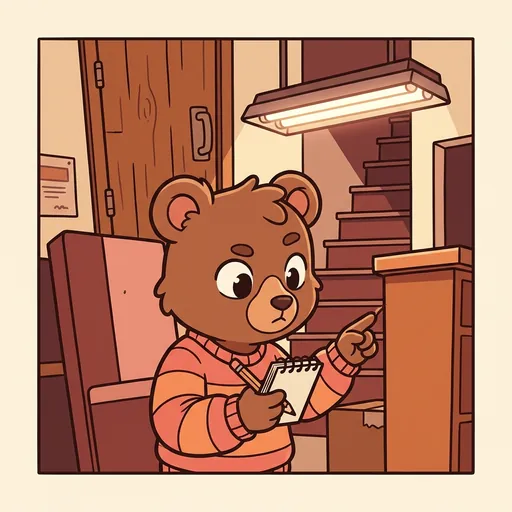
Notice
BARRIER-IDENTIFICATION — barriers are *properties of spaces*, never *properties of people.* The ally-move of noticing what in a space prevents certain people from accessing it — and naming the barrier as belonging to the space, not to the person.
Listen along — Notice
Loading audio…
Press play to listen along. The line being read lights up as you go.
Show full transcript
Loading transcript…
Chapter 2 — Notice and the Notebook of Barriers
Notice stood at the doorway of the village bakery with her small notebook open in her paw, and she did not go in.
Not because she didn’t want a bun. She wanted a bun very much. She didn’t go in because there was a single tall step at the threshold — the kind you’d never think twice about if your legs did what you asked — and Notice had spent the whole morning noticing steps. She looked at this one for a long moment. Then, very carefully, she wrote in her notebook: A step at the bakery door. A ramp would fix it.
An old badger sweeping the step frowned at her. “You writing down my shop?”
“I’m writing down the step,” Notice said gently. “Not your shop. The step is a fact about this doorway. Some folks roll on wheels, and a step like that turns them away — but that’s the doorway’s doing, not theirs. See? If I’d written some people can’t come in, I’d be pointing at the people. When I write there is a step, I’m pointing at the thing we can actually change.”
The badger leaned on his broom and thought about it. “Huh,” he said. “A ramp.” And he looked at his own doorstep as if seeing it for the first time.
That was the whole shape of Notice’s work, and she loved it the way her family loved rivers. She never fixed anything herself. She just found the gaps — the places where the world quietly shut certain people out — and named them out loud, so the gaps stopped being invisible. Because a gap nobody has noticed is a gap nobody can bridge.
Notice grew up in a house that smelled of sawdust and river mud, because her family built bridges.
She spent her childhood trailing after her parents along riverbanks, and what she remembered most was how slowly they walked. Other people crossed a river and thought about the far side. Her parents crossed a river and thought about everyone who couldn’t — the too-steep bank, the current that ran too fast, the exact spot where the ground fell away and a person on foot simply stopped.
“You can’t build a bridge for a river you haven’t looked at,” her father told her once, sitting on a cold stone while the water rushed below. “Finding the gap is the first half of the whole job. Maybe more than half. Any fool can lay planks once you know where the crossing needs to be. The looking — the slow, patient looking — that’s the part people skip.”
Notice took that to heart. She got good at the slow looking. And one grey afternoon, walking through town, she had a thought that changed everything: the town was full of rivers too. Only these rivers were made of steps, and narrow doors, and signs printed too small, and lights that buzzed too bright, and desks all built for one size of body. Every one of them was a gap where somebody got stopped. And every one of them, like a real river, could be crossed — if only somebody looked slowly enough to find it first.
Notice was twenty-two the day she walked to the InclusionForge academy, her notebook already half full.
Beacon, the academy’s mentor, met her at the courtyard and asked, “Tell me — what is barrier-identification?”
Notice looked at the ground for a moment, gathering her words the way she gathered river measurements. Then she looked up.
“It’s noticing what in a place stops someone from getting in, or joining in,” she said. “And then — this is the important part — naming that barrier as belonging to the space, not to the person. It’s not the wheel that’s the problem. It’s the stair. It’s not that a person is broken. It’s that a doorway is built wrong. Because if you get that backwards — if you decide the problem lives inside the person — then there’s nothing you can do to help. You can’t rebuild a person, and you shouldn’t want to. But a doorway?” She almost smiled. “A doorway you can rebuild by Tuesday.”
Beacon was quiet, the way people are quiet when they’ve heard something true. “Then this work is yours,” Beacon said.
Notice felt something in her chest unclench that she hadn’t known was tight.
On the first day, Notice’s students expected a lecture. Instead she held up her little notebook and walked them slowly around their own classroom, the way her parents had walked her along riverbanks.
“Look up,” she said, and they looked up at the ceiling lights. “Those buzz, and they’re very bright, and for some folks that harsh light makes it hard to think in here. That’s a fact about this room.” She wrote it down. She moved on. “These chairs are all one height. For some bodies that’s a wall as real as any brick. Fact about the room.” Down it went. “The board’s clear at the back — hard to see from here. And every sign in this hall is only in one language, which shuts out anyone who reads a different one.”
A quiet boy named Theo raised his hand. “But how do you know who can’t see the board? You don’t know who’s in the class yet.”
“That’s the cleverest question you could ask,” Notice said, and she meant it. “I don’t know. I never claim to. I’d be pretending to speak for people I’m not, and that’s not my place — it’s theirs. So I don’t write down who. I only write down what’s true about the room. The room can’t argue. The room just is what it is. My whole job is to see it clearly and say it plainly.” She tapped the notebook. “Then I hand my pages to Design, who’s brilliant at making things over. I find the gap. Design builds the bridge. Neither of us could do the work without the other.”
Theo nodded slowly. Notice could see him starting to look at the classroom the way she looked at rivers — slowly, and for the first time.
At the end of the day Theo caught up to her in the hall. “Is it hard?” he asked. “Finding all the barriers? It seems like there are so many. Doesn’t it get sad?”
Notice closed her notebook and considered this honestly.
“Sometimes there are a lot, yes,” she said. “And I won’t pretend it never sits heavy for a second. But here’s the thing that keeps me light instead of low.” She held up the closed notebook like something precious. “Every barrier I write down is a barrier somebody can now fix. An unnoticed step just quietly turns people away forever, and nobody even knows it’s happening. But a noticed step — a step in my little book — that’s already halfway to being a ramp. Naming the gap is the first kindness. It’s how a room that shut people out starts becoming a room where everyone gets to belong.”
Theo looked at his classroom one more time through the doorway, and Notice watched him watch it.
She tucked her notebook back into her satchel. There was more to see tomorrow — there always was — but she wasn’t tired. She felt, instead, that warm and steady lightness she got at the end of a good day of looking: the quiet gladness of knowing that every gap she’d named brought a little more of the world within reach of a little more of the people in it.
The InclusionForge ensemble
Notice is part of InclusionForge's distributed-narrative cast. Each character embodies a different curricular primitive; together they teach the full subject.
-

Lens
Perspective-taking — asking + listening, NEVER mind-reading; 'I can't BE you. But I can ASK what it's like.'
-

Ask
Ask-don't-assume + amplify — makes SPACE for voices, never replaces them; 'What would feel right TO YOU? I'll listen.'
-

Design
Universal Design — multi-modal solutions; never one-size-fits-most; 'Three doors. Different doors. All doors.'
-
Repair
Repair-and-reflect — mistakes as PART OF the work; never self-flagellating (renamed from Mend — RuptureRepair mentor collision)