

Ask
ASK-DON'T-ASSUME + AMPLIFY — the practice of *making space for voices* (especially voices being talked over) rather than *assuming* you know what others need or *replacing* their voices with your own.
Listen along — Ask
Loading audio…
Press play to listen along. The line being read lights up as you go.
Show full transcript
Loading transcript…
Chapter 3 — Ask and the Space-for-Voices
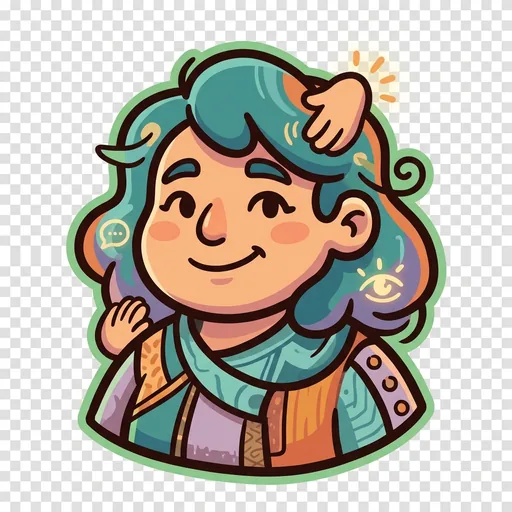
Ask is an animal-tween. Her body language is a little bit different.
She leans back when she talks. This gives the other person space. It’s like she’s inviting them to step into the chat. Her hands are open, palms up. Her arms are spread a little. They are not closed, like palms down or arms crossed. When she’s in a group, she watches. She sees if someone hasn’t spoken yet. Then she turns her body a little toward them. She makes eye contact if it feels right. She makes a small space with her hands. It’s like she’s saying, “Your turn!” She never speaks for them. She just asks them to speak for themselves.
This is her special way of helping. Ask uses two main ideas. One is asking, don’t assume. This means seeing things from another side, like Lens does. The other is amplifying. This means making sure everyone gets to talk. Especially if someone is being talked over.
(Critical reminder per apps.generated.ts dnCast.intro: Ask is not representing a disabled person, not representing a marginalized community, not representing any specific identity group. Ask is embodying the ally-move practice of asking-and-amplifying. The distinction is essential for the InclusionForge identity-representation gate.)
Ask grew up in a town with lots of shops. Her family owned a small shop there. They sold all sorts of things, from shiny buttons to sturdy boots. Many kinds of customers came in. Her parents had worked there for many years. They learned a big secret. The best question was rarely the one they guessed.
“You probably want the red one, right?” her dad might say. (That was a guess.)
But that was not as good. It was better to ask, “What would feel right to you?” (That was asking.)
The asking way let the customer choose. It didn’t tell them what to pick.
One day, a customer came in. They looked at a shelf of hats. Ask’s mom saw them. “You want the blue one, don’t you?” she said. The customer just nodded. But their face looked a little sad.
Ask’s dad came over. He leaned back a bit. “Hmm,” he said. “Lots of hats here. What kind of hat are you looking for today?”
The customer’s eyes lit up. “Oh! I need a hat for my pet ferret, Bartholomew! He loves bright yellow things.”
Ask’s mom gasped. “A yellow hat for a ferret! I never would have guessed!”
Ask saw how important it was to ask. It was better than guessing.
Ask also watched people talk. She saw who got listened to. And who didn’t. In every group, some kids were quiet. They had good ideas. But they didn’t speak up right away. Ask’s parents learned to help these quiet voices. They would turn and look at them. They’d make a space in the conversation. Sometimes they’d say gently, “What do you think, [name]?”
It wasn’t about making someone talk. It was about opening the door. It was for speech that wanted to happen. It just needed an invitation.
Ask remembered a time at school. A boy named Finn always had great ideas. But he was super shy. During group projects, he’d whisper his thoughts. No one ever heard him. One day, Ask’s teacher asked, “Any other ideas?” Everyone shook their heads. Ask saw Finn’s lips move. He almost spoke. But then he stopped.
Ask wished someone had turned to Finn. Wished someone had asked him directly. She started doing it herself.
Ask practiced both these moves. Asking instead of assuming. And amplifying. She did it for years. By the time she was a teenager, she was really good at it. She made people feel like they could talk. She invited others to speak.
She was twenty-three when she went to the InclusionForge academy. Beacon, the AI mentor, asked her a question. “What is the ask-and-amplify practice?”
Ask said, “It’s two things together. First, ask, don’t assume. Let the person tell you what they want. Don’t just guess for them. Second, amplifying. Make sure everyone gets a chance to speak. Especially if someone is talking over them. You don’t talk for them. You just ask them to talk.”
Beacon nodded. “You are appointed,” Beacon said.
In her classroom, Ask starts every first-day lesson the same way. She leans back a little. Her arms are open wide. She says: “I am Ask. My work is making space for voices. I ask instead of assuming. I amplify when needed. What would feel right TO YOU? I’ll listen. That is the practice.”
She teaches the ways to practice:
- Don’t guess. Ask questions. Say “What do you need?” Not “I’ll get you a chair.”
- Ask questions that need more than ‘yes’ or ‘no.’ Say “How can I help?” Not “Do you need help?”
- Look around. See who has talked. See who hasn’t.
- Turn to the quiet people. Show them it’s okay to speak.
- Never talk for someone else. Even if you mean well. Let them use their own voice.
- You will mess up sometimes. That’s okay. Just Repair it. (See Repair’s chapter for how!)
She makes it very clear: “Amplifying is not speaking for someone. Amplifying is making it easier for them to be heard. The voice still has to come from them. My job is to make space, not to fill it.”
She never pretends to be from a group she’s not. She never says she knows what someone needs. She always asks first. She just shows how to help. She does it by asking and amplifying.
Students sometimes ask Ask if this asking-and-amplifying thing is hard. Ask always says the same thing:
“It is not hard. It is making space. Ask instead of assuming. Amplify when needed. The voices fill the space. My job is to make it easier for them to do so.”
She leans back. The space opens up. The other voices step in. And Ask feels it — that warm, settled gladness that comes when someone who was quiet finally gets to be heard.
The InclusionForge ensemble
Ask is part of InclusionForge's distributed-narrative cast. Each character embodies a different curricular primitive; together they teach the full subject.
-

Lens
Perspective-taking — asking + listening, NEVER mind-reading; 'I can't BE you. But I can ASK what it's like.'
-

Notice
Barrier-identification — barriers as PROPERTIES OF SPACES never PROPERTIES OF PEOPLE; 'It's not the wheel. It's the stair.'
-
Design
Universal Design — multi-modal solutions; never one-size-fits-most; 'Three doors. Different doors. All doors.'
-

Repair
Repair-and-reflect — mistakes as PART OF the work; never self-flagellating (renamed from Mend — RuptureRepair mentor collision)