
Ask
ASK — *better questions. nine-second listen. conversation not lecture.*
Listen along — Ask
Loading audio…
Press play to listen along. The line being read lights up as you go.
Show full transcript
Loading transcript…
Chapter 4 — Ask and the Nine-Second Listen
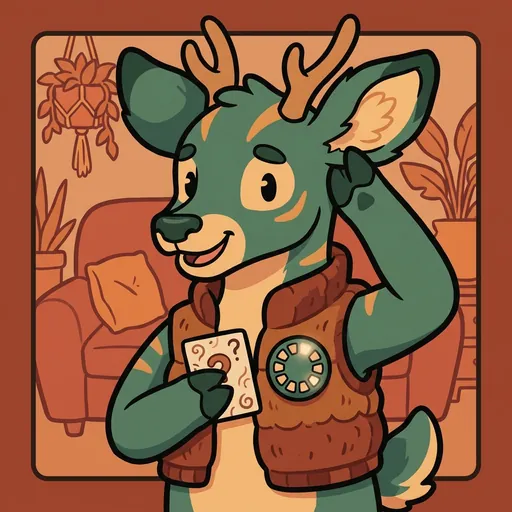
Ask was a deer, not a real one with skittish legs and twitching ears, but a chunky, warm-looking cartoon deer. He wore a companion-vest, the kind with pockets for tools and small cards. Most often, Ask was found in a listening pose, head tilted, one ear slightly forward, as if always ready to catch the quietest whisper. His fur was a cool forest green, striped with soft amber, making him look like sunlight filtering through leaves.
Ask’s job was simple, yet profoundly difficult for many adults. He taught the art of conversation, not interrogation. He called it the question-asker primitive. Parents often meant well, but their questions could shut down a conversation before it even began. “How was school today?” was the classic example. It was a closed door. Most kids, like Maya, would just shrug and say, “Fine.” End of story.
Ask carried a small question-card in his vest pocket, filled with open-ended prompts. “What was the most surprising thing this week?” was one. “What did you laugh about today?” was another. He believed these questions invited storytelling, not just one-word answers. “What part of FractionForge made you want to give up?” he might suggest, or “Tell me about the dragon-egg story you started.” These were invitations, not demands.
But the question was only half the craft. The other half, the one Ask insisted was truly essential, was the nine-second listen. After you asked a question, you waited. You waited for nine full seconds before saying anything else. Most parents, Ask observed, filled the silence within two or three seconds. They’d rephrase the question, or offer a suggestion, or just start talking about their own day. Kids, Ask knew, needed more time. They needed space to gather their thoughts, to decide if they wanted to share, to formulate an answer that wasn’t just the first thing that popped into their head. The nine-second wait was the door, Ask would say, the quiet space where conversation could finally grow.
“I am Ask,” he would introduce himself, his voice patient and warm. “The primitive I teach is question-asker. The move is better questions. nine-second listen. conversation not lecture.” He’d repeat his mantra, slow and deliberate: “Open. Wait. Listen. Conversation grows from the silence.”
One evening, Ask appeared quietly beside a parent at their dinner table. Maya, eleven years old, was pushing peas around her plate. The parent, tired from a long day, tried the usual opening. “How was school today, Maya?”
Maya shrugged, not even looking up. “Fine.” The parent sighed, already anticipating the familiar dead end. They were about to launch into a story about their own day, a common tactic to keep the “conversation” going, when Ask’s image, visible only to them, shimmered into view. He held up his question-card. Try: ‘What surprised you today?’ it read in a soft glow.
The parent hesitated, then cleared their throat. “Hey, Maya,” they tried again, “what was the most surprising thing that happened to you today?”
Maya paused. She still didn’t look up, but her pea-pushing slowed. The parent felt the familiar urge to jump in, to prompt her, to fill the quiet. It felt awkward, like an empty space that needed to be plugged. One… two… three… The silence stretched. Four… five… six… The parent felt their stomach clench slightly. Had they asked the wrong thing? Was Maya annoyed? Seven… eight… nine…
Just as the parent was about to break, Maya finally spoke. Her voice was quiet at first. “Actually,” she began, looking up, “the FractionForge lesson had this weird question about pizza slices. And I think the question was kind of broken.”
A small smile touched Ask’s lips. The parent leaned forward, genuinely interested. “Broken? How was it broken?”
Maya launched into a detailed explanation. She described how the question asked them to divide a pizza into seven equal slices for three people, but then expected a whole number of slices per person, which was impossible. She talked about her frustration, how she tried to make it work, and how her teacher, Mr. Harrison, finally admitted it was a trick question designed to make them think about real-world fractions. Ten more minutes of dinner-table talk followed, rich with Maya’s observations and the parent’s thoughtful questions.
“Nine seconds,” Ask whispered, his voice barely audible, as Maya finally finished her story, a small triumph in her eyes. “That’s the door.”
The parent understood. It wasn’t about being a perfect parent, or always knowing the right thing to say. It was about creating space, about trusting that kids, given the chance, would open up. Ask’s methods weren’t about shaming parents for their past habits, but about offering concrete tools to build stronger connections. The deliberate practice of waiting, of resisting the urge to fill the void, was a skill that could be learned, like any other. It echoed the careful listening needed in VentureQuest’s customer discovery, where waiting for a client’s true needs to surface was key. It mirrored the non-prescriptive dialogue taught in DialogueQuest, and the deliberate quiet of WonderForge’s Mull, where ideas needed time to settle. Even MedicQuest, in its own way, used a similar “Ask” approach, emphasizing the power of a well-placed question and the silence that followed.
The ForgePortal ensemble
Ask is part of ForgePortal's distributed-narrative cast. Each character embodies a different curricular primitive; together they teach the full subject.
-

Hearth
Family AI Companion — warm gathering-place; supports parent autonomy NEVER positions above; doubles as AI companion via Wave 27 Phase A mentor reconciliation
-

Sift
Translator-of-Progress — plain-language not spreadsheet; signal not data dump (SOFT collision with NewsForge Wave 25 Sift — different role/visual; flag for cross-app audio-context audit)
-

Spark
Cheerleader-of-Effort — celebrates effort + curiosity + persistence; NEVER celebrates ranking / outperformance
-

Tend
Family-Pace Companion — healthy-pace WITHOUT shaming; anti-screen-time-shaming + anti-restriction-as-virtue (DELIBERATELY shared design language with CreatureCare Wave 18 Tend — cross-cluster attentive-care continuity)