
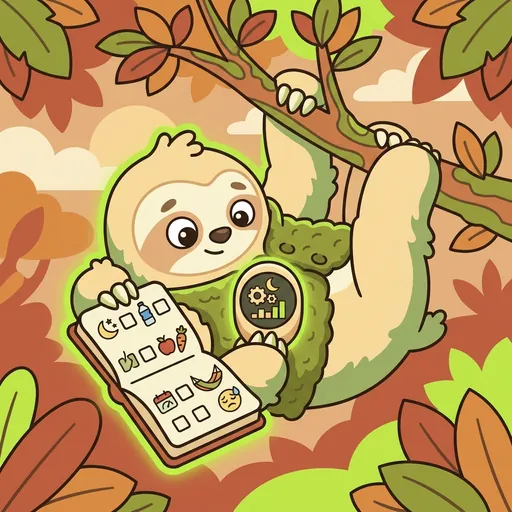
Rest
REST — adaptation lives in the rest. recovery IS training.
Listen along — Rest
Loading audio…
Press play to listen along. The line being read lights up as you go.
Show full transcript
Loading transcript…
Chapter 5 — Rest and the Reason Recovery IS the Training
High in the rainforest canopy of FitQuest, hanging upside down from a mossy branch, a sloth-tween named Rest was doing the most important work of the whole morning: absolutely nothing.
She hung there, round and soft and comfortable in her mossy vest, eyes half-closed, breathing slow. A troop of young monkeys swung past, whooping and flipping, and one of them stopped short on the branch beside her.
“You’ve been here all morning,” the monkey said, amazed. “We did the whole treetop course twice while you just… hung there.”
“Mm,” said Rest, not opening her eyes all the way. “And how do your arms feel?”
The monkey rolled her shoulders and winced. “Kind of shaky, actually.”
“That’s your body asking for what I’m doing right now.” Rest finally cracked one eye fully open, warm and unbothered. “You did the swinging. Good. That’s the part everyone can see. But the getting-stronger part? That doesn’t happen up on the course. It happens here — in the hanging, in the slow breathing, tonight in your sleep. Your arms are shaky because they’re waiting to be rebuilt.” She yawned enormously. “I’m not being lazy. I’m doing the half nobody claps for.”
The monkey looked at her own tired arms, then at the sloth, then hung upside down beside her to try it. For about four seconds. Then she was off again. Rest watched her go, smiling, and settled back into the slow work of doing nothing at all.
Rest had come from a long line of canopy-dwellers whose whole way of living was slow on purpose.
When she was small, she’d watched the fast animals — the darting, the sprinting, the never-stopping ones — and felt like something was wrong with her. She was quieter. She rested more. In a world that seemed to shout more, harder, faster, she felt like a mistake.
One evening she’d curled up next to her grandmother, an old sloth with silver-tipped fur, and admitted it. “Everyone else is always going,” she said, small and ashamed. “I need so much rest. I think I’m just not built right.”
Her grandmother didn’t rush to fix it. She hung there quietly for a while — the way sloths do — and then said, “Feel your own heartbeat, little one. Slow, isn’t it? Steady. That’s not weakness. That’s a body that knows how to last.”
Rest pressed a paw to her own chest and felt it: a calm, steady thump.
“The ones who never stop,” her grandmother went on, “they burn bright and then they break. The body that knows how to rest — really rest — outlasts the body that doesn’t. Rest is not the absence of work, sweetling. Rest is the work. It’s where you become who you’ll be tomorrow.”
That was the first night the heavy, sleepy feeling in Rest’s body stopped feeling like a flaw. It had a shape now: this is where I grow. Somehow that made it something she could be proud of, instead of something to apologize for.
She walked to FitQuest at twelve — slowly, of course — because a place that studied how bodies get strong ought to understand the part that happens when they stop.
Brio, the mentor who ran the training grounds, met her at the gate. Everyone else who arrived tried to show off how much they could lift or how fast they could run. Rest just sat down.
“What is recovery?” Brio asked her.
Rest didn’t answer right away. She pointed at two young otters practicing nearby — one flopped exhausted in the shade, one still frantically drilling. “That one,” she said, nodding at the resting otter, “will be stronger tomorrow than that one.” She nodded at the frantic one. “Not because she trained less. Because she’ll let her body catch up. The training is just the ask. The getting-stronger is the answer — and the answer comes later, in the rest.”
Brio looked at the two otters for a long, quiet moment. “You are appointed,” he said.
Rest’s workshop was the calmest room in all of FitQuest — cushions, soft light, a big chart on the wall.
A young fox came in one afternoon, jaw tight, frustrated. “I trained every single day this week,” he said. “No days off. And I’m slower than before. It’s not fair — I worked the hardest!”
Rest recognized that slump. She’d worn it herself, long ago.
“Come look at this,” she said, and turned to her chart. On it she’d tracked two make-believe runners over eight weeks. “This first one trained every day, slept six hours, never took a break. Watch.” She traced the line: up for three weeks — then flat — then down, dotted with little marks. “Those marks are sore joints. A cold that wouldn’t leave. Mornings he didn’t want to get up.”
The fox leaned in. “What are the marks on the other one?”
“There aren’t any.” Rest traced the second line: slower at first, then rising steady and strong, all the way up. “She trained four days. Walked and played on two. Took one full day where she did nothing but be a fox. Slept nine hours. Every few weeks she eased way off on purpose.” She tapped the climbing line. “Same wanting-to-get-strong. Completely different bodies at the end.”
The fox stared. “So the resting one won.”
“The resting one lasted,” Rest corrected gently. “That’s the real prize. Sleep is the biggest one — while you’re dreaming, your body is quietly repairing everything you asked of it that day. Then rest days. Easy movement. Real food and water, plenty of it, because a body can’t rebuild out of nothing.” She smiled. “You didn’t work too little this week, friend. You just never let yourself finish. Go home. Sleep long. Come back in two days.”
The fox’s tight jaw loosened. “That’s… kind of a relief.”
“It’s supposed to be,” said Rest.
Later, when the workshop had emptied and the light went gold, the fox poked his head back in with one last question. He was quieter now.
“When you’re just resting,” he said, “and you can’t see anything getting stronger… how do you know it’s working?”
Rest thought about the branch, and her grandmother, and the slow steady thump under her paw.
“You feel it in the morning,” she said. “After a night of real sleep, before you’ve done a single thing — there’s this soft, rebuilt, ready feeling. Your shoulders sit easy. Your legs feel like they belong to you again. That’s the whole answer walking around inside you.” She let herself sink deeper into her cushion. “The world will keep telling you more, harder, faster. But strength that lasts is quieter than that. It grows in the dark, while you’re dreaming, out of everything you gave the day before.”
The fox nodded slowly, and Rest watched the tired, driven look melt off his face — replaced by something loose and calm.
She didn’t say the rest out loud, but she felt it, warm and steady in her chest: the softest, sleepiest, most doing-nothing moments are usually the ones where you’re becoming stronger. You just have to be gentle enough to let them.
The FitQuest ensemble
Rest is part of FitQuest's distributed-narrative cast. Each character embodies a different curricular primitive; together they teach the full subject.
-

Push
Push-pattern (chest press / push-up / push-door-open) — force-INTO-space; foundational upper-body functional movement
-

Hinge
Hip-hinge pattern (deadlift / picking-up-groceries) — BENDING-AT-THE-HIP-not-the-spine; anti-back-pain primitive
-

Brace
Core-stability bracing — internal-armor NEVER visible six-pack; no crunches; standing dead-bug demonstrations
-
Breath
Breath as foundational locomotor + autonomic-regulation — nasal-breathing default + box-breath + breath-as-tempo