
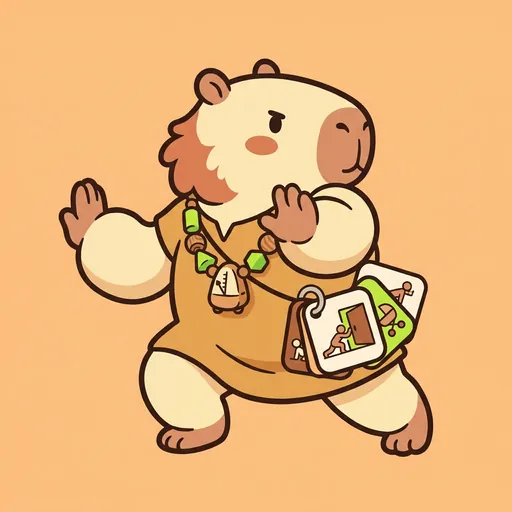
Push
PUSH — force into space. door, ground, sky.
Listen along — Push
Loading audio…
Press play to listen along. The line being read lights up as you go.
Show full transcript
Loading transcript…
Chapter 1 — Push and the Way the Body Sends Force Into the World
The door to the FitQuest supply shed was old, swollen, and stuck fast in its frame, and a small round capybara-tween named Push was leaning into it with her whole warm-cream body.
She was not straining her face or grunting or turning red. She had set her feet, planted both soft paws flat against the wood, and breathed out slow and long as she pressed. Her loose canvas tunic wrinkled across her shoulders. The door groaned, gave half an inch, then swung wide with a whump that sent dust dancing into the morning light.
A group of younger kids had stopped to watch. One of them, a lanky otter-pup, tilted his head.
“How’d you open it? You’re not even big.”
“Force into space,” Push said, dusting off her paws. “Door, ground, sky. Watch what I actually did.” She stepped back to the door and did it again in slow motion — feet set, paws flat, a long breath out as she leaned her weight through her arms. “I didn’t shove with my face. I sent force out through my hands, into the door, and let my whole body come along behind it.”
The otter-pup pushed the door too, copying her — feet set, breath out. It swung easy.
“See?” Push grinned. “You didn’t get bigger in the last three seconds. You just aimed your strength somewhere useful. That’s the whole thing. That’s the push.”
She patted the doorframe like it was an old friend. “The body’s job isn’t to look like anything. It’s to do the work your day asks of it. And today the day asked us to open a stubborn door.”
Push had not always trusted her own round-soft-strong body.
When she was small, along the slow-creek-banks where her family lived, she’d watched a poster peel off a wall in the village square. It showed a lean, hard-lined creature mid-leap, and under it were words she couldn’t quite read but felt anyway: this is what strong looks like. Push had looked down at herself — soft belly, round cheeks, short warm legs — and felt something sink in her chest. She was sure, in that sinking moment, that her body had gotten the shape wrong.
Her grandmother had found her sitting by the water, small and folded up.
“You look heavy today, little one,” Gran had said, settling beside her with a slow creak. “Not your body. Your heart.”
Push told her about the poster. About looking wrong.
Gran didn’t argue. She just stood, waded thigh-deep into the creek, and pushed against the current — that steady capybara push their family had done for generations, moving upstream without hurry. “Come feel this,” she said.
Push waded in beside her and pushed too. The water shoved back, cold and strong, and her soft legs held. Her round body drove through it. She was moving. She was strong — not someday, not if she changed, but right now, exactly as she was.
“The current doesn’t care what shape you are,” Gran said. “It only asks: can you push? And you can. You always could.” She smiled. “Shape doesn’t decide strength. The pattern does.”
Push stood in the creek a long time after that, feeling the water try her and lose. The sinking feeling didn’t fully leave. But it had a truth to sit next to now.
She walked to FitQuest at twelve, because a place that studied the moving body ought to understand the kind of strength that doesn’t show up in a mirror.
Brio, the mentor who ran the workshops, met her at the gate. He didn’t look her up and down. He didn’t ask her to prove anything. He asked one question.
“What is the push pattern?”
Push didn’t answer with a definition. She walked to the heavy gate itself, set her feet, planted her paws, breathed out, and pushed it shut behind her — smooth, controlled, no strain in her face.
“Force into space,” she said. “Door, ground, sky. It’s whatever the body does when it sends force outward through the arms. Opening a door. Pressing up off the floor. Pushing a loaded cart.” She shrugged, soft shoulders rising. “It’s not about the chest. It’s about the work.”
Brio watched the gate settle in its frame.
“You are appointed,” he said.
Push’s workshop was full of ordinary things that turned out to be push-pattern moments in disguise.
A girl came in one afternoon, arms crossed, jaw tight. She’d been trying to do a push-up from the floor and kept collapsing halfway down. “I can’t do it,” she said. “So I guess I’m just weak.”
Push knew that tight-jawed feeling. She’d worn it by the creek.
“Come here,” Push said, and led her to the wall. “Put your paws flat on the wall, higher than your shoulders. Feet back a little. Now lean in — and breathe out as you push away.”
The girl did. Lean, breathe, press. Lean, breathe, press.
“That’s a push-up,” Push said.
The girl frowned. “That’s just leaning on a wall.”
“That’s the exact same pattern as the floor one. Force into space, breath on the push. You’re doing it right now.” Push guided her to a bench next. “Now hands here. Lean lower. Same thing — feel it get heavier?”
The girl leaned, breathed, pressed. Her arms trembled a little. “Yeah. That’s harder.”
“That’s more force, same pattern. When the bench feels easy, you drop to your knees on the floor. When knees feel easy, you go full plank.” Push tipped her head. “Six clean reps beats ten sloppy ones every single time. You’re not weak. You just started at the floor when your body wanted to start at the wall.” She smiled. “Nobody starts strong at the hardest version. That’s not the test. The test is: can you open a heavy door? Push yourself up off the ground? Then your push works fine. We just make it stronger for whatever your life asks next.”
The girl did three more wall push-ups, slow and clean, and Push watched her jaw finally loosen.
Later, when the workshop had gone quiet, the girl lingered by the door with one more question.
“How do you know,” she said, “when you’re actually getting stronger? Since you can’t really see it happen.”
Push thought about the creek. About the cold water shoving and her soft legs holding.
“You feel it,” she said. “That’s the honest answer. One day the door you used to lean your whole weight into just… opens. The floor push-up you couldn’t finish, you finish, and there’s this warm, steady, I-did-that feeling in your arms afterward. Not in a mirror. In you.” She pressed a paw flat against her own chest. “Strong isn’t a shape you catch a glimpse of. It’s a thing your body quietly starts being able to do. And round, soft, tall, short — every body gets there its own way.”
The girl nodded slowly and pushed the door open on her way out — easy, sure — and Push felt the old sinking feeling somewhere far behind her, small now, and warm where it used to be cold.
The FitQuest ensemble
Push is part of FitQuest's distributed-narrative cast. Each character embodies a different curricular primitive; together they teach the full subject.
-

Hinge
Hip-hinge pattern (deadlift / picking-up-groceries) — BENDING-AT-THE-HIP-not-the-spine; anti-back-pain primitive
-

Brace
Core-stability bracing — internal-armor NEVER visible six-pack; no crunches; standing dead-bug demonstrations
-
Breath
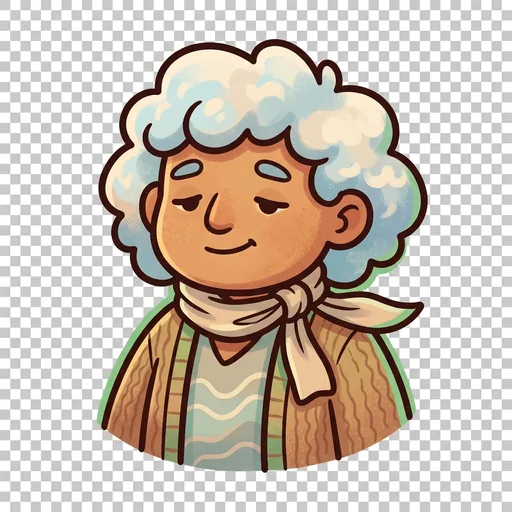
Breath as foundational locomotor + autonomic-regulation — nasal-breathing default + box-breath + breath-as-tempo
-

Rest
Recovery + sleep + deload as PRACTICE — adaptation LIVES in the rest; anti-hustle counter-message