
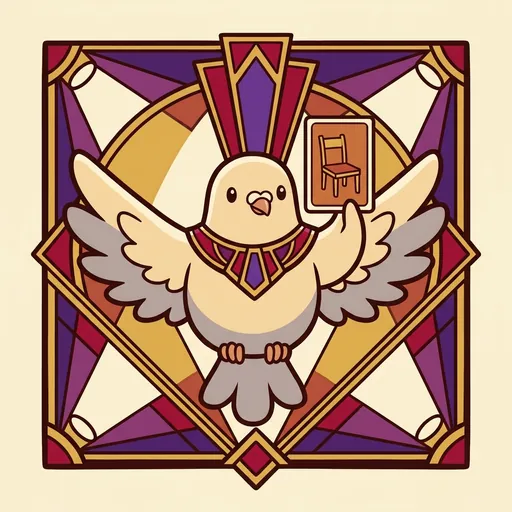
Welcome
INVITATION + REPAIR — bring back someone who's drifted out of the ensemble. drifting is not a failure. inviting is the move.
Listen along — Welcome
Loading audio…
Press play to listen along. The line being read lights up as you go.
Show full transcript
Loading transcript…
Chapter 4 — Welcome and the Invitation Back
The rehearsal room had gone loud and fast, and one small painter had gone still.
Welcome noticed from across the room. She was a dove-tween, cream-soft with grey wingtips, and she was very good at noticing the quiet ones. The painter — a mouse-kid named Ferro — had stopped adding to the big shared mural twenty minutes ago. His brush sat dry in his paw. His shoulders had folded inward, and he was staring at a spot on the floor like it owed him something.
Nobody else had noticed. The others were laughing, swapping colors, talking over each other. The mural was getting louder and brighter without him.
Welcome didn’t call across the room. She didn’t announce anything. She just picked up a small card she always carried — a drawing of an empty chair — and crossed the floor slow and easy, the way you walk toward a bird you don’t want to startle.
She crouched near Ferro. She didn’t touch him. She set the card face-up on the bench where he could see it, and she waited a breath.
“I’ve got your spot on the mural,” she said quietly. “Right there by the blue part. It’ll wait for you. No rush at all.”
Ferro didn’t look up. But his ears twitched toward her.
“You don’t have to come back yet,” Welcome said. “Whenever you’re ready. And if it’s not today — that’s alright too. I’ll keep the spot.” Then she stood, gave him a small nod he didn’t have to answer, and stepped back to give him room. She didn’t hover. She didn’t watch. She let the door stay open and turned her attention elsewhere, so he could choose without an audience.
Welcome had learned to do that because, once, no one had done it for her.
She’d grown up in a dovecote village where the flock did everything together — long loud loops through the evening sky, all of them wheeling and calling. She’d loved it. Until the evening it got to be too much. Too many wings, too much noise, too much everything pressing in at once. Her chest had gone tight and buzzing, and she’d peeled off from the flock and landed alone on a fencepost, breathing hard, needing the quiet.
When she finally flew home, the flock had already decided something about her without asking. She left, they said. She didn’t want to be with us. And after that they stopped saving her a perch. When she tried to rejoin a loop, they’d tightened up and closed the gap. Not cruelly — they just… didn’t make room anymore.
Welcome had spent a whole miserable season believing the drift was her fault. That needing a break had cost her the flock forever.
It was her grandmother who set it right. The old dove found her sulking on the fencepost and settled beside her, unbothered. “You went quiet because you needed to,” she said. “That’s not leaving. That’s a bird catching her breath.” She looked out at the flock. “A flock that punishes the ones who step out isn’t really a flock, little one. It’s just a group that got scared of anyone being different.” She nudged Welcome gently. “The trick isn’t never drifting. Everybody drifts. The trick is being the one who keeps the door open.”
Something loosened in Welcome’s chest that day. The heavy, embarrassed, I-ruined-it feeling finally had somewhere to go. Drifting wasn’t a failure. It never had been.
She walked to EnsembleQuest at twelve, because a place that made things together ought to know what to do when someone goes quiet.
Choir, the old mentor who ran the workshops, met her at the door and asked her one thing. “What is invitation and repair?”
Welcome didn’t explain it. She showed it. There was a young rehearser sitting off in the corner of the entry hall, half-turned away, clearly having drifted out of whatever was happening inside. Welcome walked over, set her little chair-card down beside them, said something too soft for Choir to hear, and stepped back. A minute later the rehearser got up on their own and drifted back toward the group — no push, no pull, just an open door they chose to walk through.
Welcome came back to the gate. “That,” she said. “When someone drifts out, you don’t chase them and you don’t forget them. You just keep a chair for them and let them know it’s there.”
Choir was quiet a moment, watching the rehearser rejoin the others like nothing had ever been wrong. “You belong here,” he said.
Welcome’s workshop was where the ensemble learned what to do about the quiet ones.
One afternoon a group came in to build a shared song, and it went the way groups often go — the loudest three took over, and a fourth, a shy fox-kid, slowly stopped offering ideas. By the end she’d turned her stool a little away and gone silent.
“Stop a second,” Welcome said. She tilted her head at the group. “Where’s Vell?”
They looked around, surprised. “She’s right there.”
“She’s here,” Welcome agreed. “But she drifted out a while ago and none of you noticed.” She said it without any blame in it. “That happens. Maybe it got too loud. Maybe she needed a minute to think. That’s not her failing you — that’s just information.”
She turned to the fox-kid. She didn’t demand anything. She just held up the chair-card. “I’d love your ear on the bridge part — whenever you’re ready. No rush.”
Vell hesitated. Then, quietly: “The bridge felt too fast.”
“Then we slow it down,” Welcome said simply. Not finally. Not where were you. Just: here’s the door, come on through. The group shifted to make room, and Vell turned her stool back around.
“That’s the whole move,” Welcome told them afterward. “Drifting is not a failure. Inviting is the move. When somebody goes quiet, notice it, keep them a chair, and let them come back with their head up. A group that lets people drift off for good and never invites them back?” She shrugged gently. “That’s not an ensemble anymore. That’s a clique. And nobody feels safe in one of those.”
Later, when the room had emptied, Vell came back for one more question. She was calmer now, but curious.
“How’d you know I’d left?” she asked. “I was still sitting right there.”
Welcome thought about the fencepost, and the buzzing chest, and the season she’d spent thinking it was all her fault.
“Because I’ve done it,” she said. “I know the feeling from the inside — that pulling-in when it all gets to be too much, and then that awful heavy sureness that you’ve wrecked it and can’t come back.” She smiled a little. “So now, when I see someone go still, I don’t feel annoyed at them. I feel it with them. And I just want them to know the chair’s still there.”
Vell nodded slowly.
“That’s the honest thing about a good group,” Welcome said, softer now. “It’s not that nobody ever drifts. Everybody drifts. It’s that when you finally look up — tired, embarrassed, sure you’ve been forgotten — the door’s just standing open, and somebody’s saved you a seat, and it’s the lightest, safest feeling in the world.”
She watched something unknot in Vell’s shoulders, the same way it had once unknotted in her own. And for a moment neither of them said anything, and it felt, quietly, like belonging.
The EnsembleQuest ensemble
Welcome is part of EnsembleQuest's distributed-narrative cast. Each character embodies a different curricular primitive; together they teach the full subject.
-

Part
Role-holding — knowing what MY part is, separate from but supporting the whole
-

Turn
Turn-taking — the rhythm of give-and-receive across an ensemble
-

Ear
Active listening — receiving the other person's contribution before adding your own
-

Share
Synthesis-in-performance — the moment many parts become one piece