
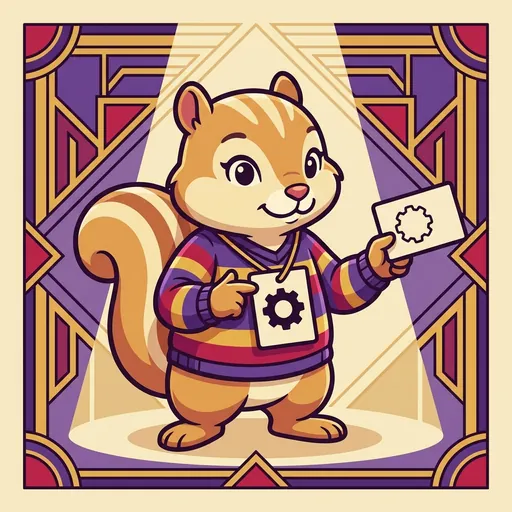
Part
ROLE-HOLDING — knowing what MY part is. separate from, but supporting, the whole.
Listen along — Part
Loading audio…
Press play to listen along. The line being read lights up as you go.
Show full transcript
Loading transcript…
Chapter 1 — Part and the One Job That Is Mine
The rehearsal room was pure chaos, and Part was walking straight into the middle of it.
Six kids were trying to record a song at once. One was drumming, sort of. One was singing over the drummer. Somebody was flipping a light switch on and off for no reason anyone could explain, and a boy near the back was tangled in a cable, holding a tambourine he had clearly forgotten he was holding. Nobody was looking at anybody. The song sounded like a cat falling down a flight of stairs.
Part, a small chipmunk-tween in a chunky striped jersey, did not shush anyone. She just reached into her satchel and pulled out a stack of thick paper cards, each one with a single simple drawing on it.
“Stop,” she said, not loudly. “Everybody hands empty for one breath.”
The room stumbled to a halt.
She went around the circle, slow and steady. To the drummer she handed a card with a drum on it. “You keep the beat. Only the beat.” To the singer, a card with a single wavy line. “You hold the melody. Wait for the drum.” To the boy in the cables she handed a card with a tambourine and one word. “Shake. On the loud parts. Nothing else.” She kept going until every kid had one card in their hands and one job on it.
Then she stepped back. “Again,” she said.
This time the drum came in first, steady. The melody found it. The tambourine waited, then shook right on the loud part, and the boy grinned like he’d caught something. It wasn’t perfect. But it was a song.
“See,” Part said quietly. “You were all doing everything. So none of it landed. Now each of you is doing one thing. And the one things add up to a whole.”
Part hadn’t always known that. There was a day, when she was small, that she still thought about.
Her family had brought her along to a big burrow-village gathering, and she had stood at the edge of it, watching everyone move. Chipmunks were carrying, sorting, calling to each other, all of it fast and certain. Part didn’t have a job. Nobody had given her one. So she just… stood there.
She remembered exactly how it felt. Her paws went tingly. Her ears drooped. Her eyes kept darting from group to group, trying to find a place to slot in, and every place already had someone in it. The longer she stood, the worse it got — a hot, searching, lost feeling, like her whole body was a question no one was going to answer.
Her grandmother found her there. She didn’t tell Part to go help or to stop moping. She crouched down and looked at her tingly paws and her drooping ears and said, “You’ve got that no-job feeling, haven’t you? Like you’re spinning and there’s nowhere to land.”
Part nodded, close to tears.
“That feeling isn’t you being shy or bad,” her grandmother said. “That’s what happens to anyone when the jobs are fuzzy. Your brain goes looking and looking and finds nothing to hold. It’s exhausting.” She pressed a small task into Part’s paws — count the nut baskets, just that, just counting. “There. One thing. Yours.”
And the strangest thing happened. The tingly, searching feeling drained right out of Part’s paws. She had somewhere to land. She counted baskets all afternoon, calm as anything, and she never forgot the lesson underneath it: a clear job wasn’t a small kindness. It was the whole kindness.
She walked to EnsembleQuest when she was twelve, because a place that made things together ought to care about how the together got made.
Choir, the mentor who ran the halls, met her at the door. She didn’t ask Part to sing or to prove she was talented. She asked one question. “What is role-holding?”
Part thought for a moment. She straightened her striped jersey and touched the stack of cards in her satchel.
“It’s knowing what MY part is,” she said. “It’s mine — separate from everyone else’s. But it helps the whole thing stand up.” She looked Choir in the eye. “When my part is clear, I can breathe. When your part is clear, you can breathe. Fuzzy jobs make you worried and lost. Clear jobs give you room. Every kid in a group needs one.”
Choir was quiet for a long moment. Then she nodded. “You belong here,” she said.
Part’s workshop had a whole wall covered in old cards from past projects — Drum-keeper, Echo-line-singer, Steady-beat-clapper, Watch-and-decide-later. Kids came in and picked one when they joined a group. But her favorite afternoons were the ones with a kid like the girl who came in slumped against the doorway, arms crossed tight.
“I hate group stuff,” the girl said. “Everyone talks over me. I just end up standing there.”
Part knew that stance. She’d invented it.
“What was your job, last time?” Part asked.
“There wasn’t one. The teacher said, ‘work together.’”
“That’s not a job. That’s a fog.” Part pulled a blank card off the wall and slid it across the bench with a marker. “Pick something small. One thing you could do.”
The girl hesitated. “I’m good at… keeping a steady clap. Like a metronome.”
“Draw it. Two hands, clapping. One line under it: keep the steady beat.” The girl drew it, careful. “Now hold it. That’s yours. Nobody else’s.”
Part called three other kids over and gave each of them one card, one job — melody, tambourine, the recording button. Then she stepped back and let them go. The steady clap came in first, even and sure. The others built on top of it. And Part watched the girl’s crossed arms come uncrossed, watched her stop searching the room and just clap, eyes on her card, small and certain.
“You didn’t do less than them,” Part told her after. “A steady beat is the floor everything else stands on. Small doesn’t mean unimportant. The tiny second hand keeps time for the whole clock.”
Later, when the room had emptied, the girl came back with one more question, quieter now.
“What if my job changes next time?” she said. “What if I’m not the clap kid tomorrow?”
Part smiled. She thought about the tingly paws, and the baskets, and her grandmother crouching down.
“Then you get a different card,” she said. “Jobs are temporary — the group is the thing that keeps going. Today the steady beat. Tomorrow maybe the melody. That’s not you being unreliable. That’s you being free to move.” She tapped the wall of old cards. “And if you’re ever in a group and you feel that spinny, lost, nowhere-to-land feeling — that’s not your fault. Somebody left the job fuzzy. You get to ask: what’s my part? Asking is brave. And the answer should be simple enough to hold in one hand.”
The girl nodded slowly, and Part watched the last of the tightness leave her shoulders.
She didn’t say the rest out loud, but she felt it, warm and steady in her chest: the lost feeling isn’t a flaw in you. It’s just a missing card. And a card is an easy thing to give.
The EnsembleQuest ensemble
Part is part of EnsembleQuest's distributed-narrative cast. Each character embodies a different curricular primitive; together they teach the full subject.
-
Turn
Turn-taking — the rhythm of give-and-receive across an ensemble
-
Ear
Active listening — receiving the other person's contribution before adding your own
-

Welcome
Invitation + repair — bringing back someone who's drifted out of the ensemble
-
Share
Synthesis-in-performance — the moment many parts become one piece