
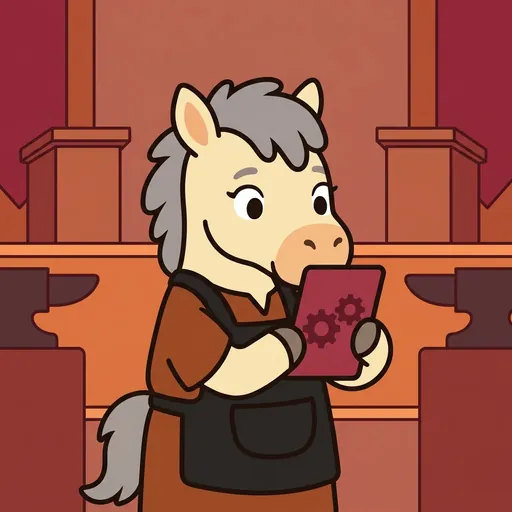
Steel
STEELMAN — the strongest version of what the other side would say. before you argue with a view, make it as strong as it can be.
Listen along — Steel
Loading audio…
Press play to listen along. The line being read lights up as you go.
Show full transcript
Loading transcript…
Chapter 3 — Steel and the Strongest Version of What They Would Say
In the middle of the DebateForge courtyard, two students were arguing about whether recess should be longer, and Steel — a small cream-colored horse-tween in a scuffed blacksmith apron — was picking up a card with both hooves.
She did this before she said a single word. She lifted the card that had the other side written on it, held it up where everyone could see, and read it out loud, slowly, like it mattered.
“Before I tell you what I think,” Steel said, “let me say your side as strong as I can. You think a longer recess means less time for lessons, and there’s already barely enough. You think kids who don’t like recess would just be stuck outside longer. And you think teachers need that time to reset.” She lowered the card. “Did I get it right? Did I make it strong?”
The student who’d said recess should stay short blinked. “That’s… yeah. That’s actually better than how I said it.”
“Good,” said Steel. “Now I’ll disagree with you. And when I do, I’m not knocking over a wobbly little version of your idea. I’m arguing with the best one you’ve got.” She smiled. “If I beat the strongest version, that means something. If I beat a weak one, it means nothing — I just picked on the easy version and called it a win.”
The other student frowned. “Why help the side you’re against?”
“Because it’s the only way anybody learns anything,” Steel said. “And because it’s fair.”
Steel had grown up in the smith-village, where her family had made steel for as long as anyone could remember.
She used to think the work was just banging on hot metal. But her grandfather, an old gray horse with singed whiskers, showed her the truth of it one evening at the forge. He held up a bar of raw iron. “This,” he said, “is weak. Bend it and it stays bent. It cracks. It’s soft.”
Then he heated it until it glowed, and hammered it, and folded it, and heated it and hammered it again, over and over, until Steel’s arms ached just watching. “This,” he said, holding up the finished piece, “is steel. Same iron. But we put it through something. We didn’t protect it from the heat and the hammer — we used them.”
Little Steel had asked why the hammering made it stronger instead of breaking it.
“Because iron that’s never been stressed has never found out what it’s made of,” her grandfather said. “You want strong? You have to test it against something hard.”
She thought about that for years. And one day, sitting quietly while two grown-ups had a shouting match that went nowhere — each of them punching at a silly, flimsy version of what the other one meant — she understood it wasn’t only about metal. An argument you never let get stressed by the real other side stays raw. Soft. Cracks the moment it’s pushed. But an argument that’s been heated and hammered against the strongest opposing view — that one holds. That one is steel.
The idea settled into her chest like something warm and solid. It felt less like winning and more like building.
She walked to DebateForge when she was thirteen, apron and all.
The mentor, Rhetor, met her at the gate and asked her one question. “What is steelmanning?”
Steel didn’t rush. “It’s saying the other side’s view as strong as it can be — the strongest version they’d say if you let them — before you argue with it.” She paused. “The opposite is picking the weakest, silliest version and knocking it down. That’s easy. It’s also useless. You don’t change anyone’s mind by beating a version they never believed.”
Rhetor studied her for a moment. “And why does the strong version matter?”
“Because you can’t really disagree with someone until you’ve understood them,” Steel said. “Beating the weak version just makes you feel good. Engaging the strong one might actually get somewhere.” She shifted the card she was, out of habit, already holding in both hooves. “And it’s fair. People can tell when you’ve taken them seriously. It earns you the right to disagree.”
Rhetor nodded slowly. “You belong here.”
Steel’s workshop was quiet and full of paired cards, one side of an argument on each.
A boy came in one afternoon, buzzing and pleased with himself. “I won an argument today,” he announced. “My cousin said video games rot your brain, so I said ‘oh, so you think ALL games are bad and everyone who plays them is stupid,’ and he couldn’t answer.”
Steel tilted her head. “Did your cousin actually say all games are bad and everyone who plays is stupid?”
”…No. He said too much gaming.”
“So you argued against something he didn’t say.” Steel picked up a blank card and slid it across the bench. “Write down what your cousin really meant — the strongest, fairest version. Not the silly one. The one he’d nod at.”
The boy chewed his lip. “That… too much of anything crowds out other stuff. Sleep. Homework. Being outside.”
“That’s a good point, isn’t it?” Steel said gently.
“Yeah. It kind of is.”
“Now that’s the thing to argue with, if you disagree. Maybe you say most kids self-regulate, or that games teach real skills, or that his ‘too much’ is vague.” She set the strong card between them. “See how much better the whole conversation is now? You’re not scoring off a version he never held. You’re meeting the actual him.”
The boy looked at the card for a long time. “But it was easier to win the other way.”
“Winning the easy way didn’t change his mind, though, did it? He just felt tricked.” Steel picked up her hammer-shaped paperweight and turned it over. “Raw iron’s easy to bend. Steel’s harder. But steel’s the one that holds. And here’s the part nobody tells you —” she leaned in — “when you make his side strong and he sees you do it, he stops fighting you. He starts thinking with you. That’s the whole trick. There’s no crushing. There’s no destroying. We’re not here to wreck each other. We’re here to get clear.”
The boy came back at the end of the day, quieter now.
“I texted my cousin,” he said. “I told him the real version of his point back to him, the strong one. And then I said what I thought.” He scuffed the floor. “He didn’t get mad this time. He actually answered.”
Steel felt something loosen in her, the way it did every time.
“That’s the feeling,” she said. “That warm, steady, un-clenched feeling — like you set down something heavy you didn’t know you were carrying. That’s what it feels like when you stop trying to beat someone and start trying to understand them first.” She looked out toward the forge she still visited on weekends. “People think a good argument leaves you fired up, fists ready. But the best ones leave you calm. Like the metal after the hammering stops — hot, worked, and finally, quietly strong.”
The boy nodded, and Steel watched the buzzing settle out of him, replaced by something slower and better. Not the itch to win. The ease of being fair.
The DebateForge ensemble
Steel is part of DebateForge's distributed-narrative cast. Each character embodies a different curricular primitive; together they teach the full subject.
-
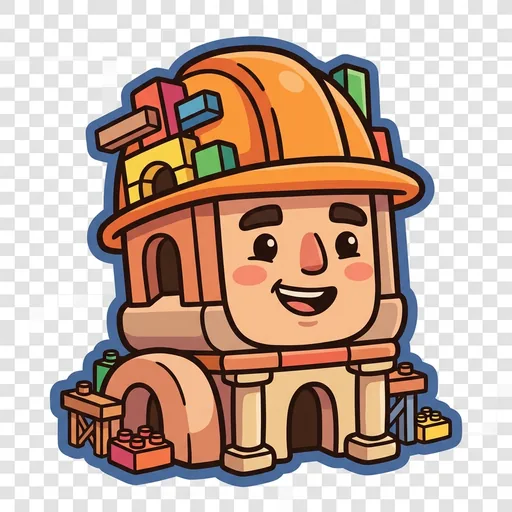
Build
Case-construction — claim + warrant + evidence as architecture; what does your case REQUIRE to stand?
-

Weigh
Evidence-evaluation — sources have positions, evidence has limits; credibility-as-calibration (shared design language with TruthQuest Weigh — cross-app continuity)
-

Reply
Civil-rebuttal-not-rebuke — 'I disagree because' not 'you're wrong because'; address the ARGUMENT not the PERSON
-

Yield
Changing-your-mind-in-light-of-evidence-as-strength — concession is craft + intellectual courage; visibly carries 'updated' badge (shared design language with TruthQuest Update — cross-app continuity)