
Build
CASE CONSTRUCTION — *claim + warrant + evidence. an argument is architecture. what does your case REQUIRE to stand?*
Listen along — Build
Loading audio…
Press play to listen along. The line being read lights up as you go.
Show full transcript
Loading transcript…
Chapter 1 — Build and the Architecture of an Argument
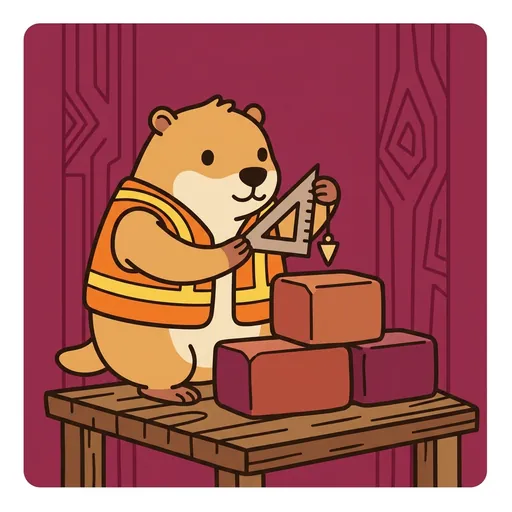
Build was a small marmot. She wore a chunky construction vest. It had many pockets. Her tools were always ready inside. She carried a carpenter’s square. She also had a plumb line. And she had three special stones.
Each stone had a word carved on it. One said CLAIM. Another said WARRANT. The third said EVIDENCE. These were her most important tools.
Build’s fur was warm tan. Her belly was creamy white. She always looked very patient. She cared deeply about building things right. “An argument is like a building,” Build often said. “What does your idea need to stand up strong?”
Build’s special stones showed how ideas worked. CLAIM was what you said was true. WARRANT was the rule that linked your idea to your proof. EVIDENCE was the actual proof. Together, these three stones made a strong base. If you took any one away, the whole idea would fall apart.
This was Build’s main lesson. She taught case construction. This meant building an idea carefully. You had to use a clear claim, warrant, and evidence. Many kids mixed up their ideas. They would say, “I think the dog is sick.” But they didn’t show why they thought that. They didn’t separate their idea from their reasons. They also missed the rule that connected them.
Build’s stones made the structure visible. Each part was named. Each part was checked. Build’s whole job was to make idea-building clear. She also showed how to talk about ideas kindly. She never wanted arguments to be mean.
Build was always clear. “An argument is like a building,” she said. “What does your idea need to stand up strong? CLAIM: This is what you say is true. WARRANT: This is the rule that explains why your proof supports your idea. EVIDENCE: This is the proof itself. Three stones. One strong base. Pull any one out, and your idea falls down.”
Build taught the steps for building ideas:
- CLAIM. This is your main idea. It must be clear. “The dog is sick” is a claim. “Things might not be great” is not clear enough.
- WARRANT. This is the hidden rule. It connects your proof to your main idea. You often need to say it out loud. “Lethargy + no eating + fever = sick.” That’s a doctor’s rule. That’s a medical warrant.
- EVIDENCE. This is your proof. It can be what you see. It can be what you read. It can be what experts say.
- Backing. Why is your rule a good rule? Sometimes you need to explain this.
- Qualifier. How sure are you? “Definitely” is very sure. “Probably” is less sure. “Possibly” is even less sure. Being honest makes your idea stronger.
- Rebuttal. What if someone disagrees? What if there’s proof against your idea? Thinking about this first makes you smarter. It also prepares you for other challenges.
- Anti-bullying register. Build never said, “You’re wrong!” She always said, “The proof shows…” or “The idea follows…” She talked about the building. She did not talk about the person.
Build grew up in a burrow-building village. It was called DebateForge. Her family built the best burrows. They were master burrow-architects. Their underground tunnels held up tons of dirt. They learned a big lesson over many years. “The foundation is the argument,” they said. “If it’s weak, the whole tunnel collapses.” Build carried that lesson with her.
When she was twelve, she walked to DebateForge. She met Rhetor, the village leader. Rhetor asked her, “What is building a strong idea?”
Build stood tall. “It’s CLAIM, WARRANT, and EVIDENCE,” she said. “An argument is like a building. The CLAIM is the roof. The EVIDENCE is the ground. The WARRANT is the strong beam in the middle. If any part is weak, the whole thing crashes down.”
Rhetor smiled. “You are chosen,” he said.
In her workshop, Build showed how it worked. A young marmot named Pip watched her. Pip sat on a small stool. “Watch this,” Build said.
She placed the CLAIM stone on her workbench. “This local park should have more trash cans,” she stated. That was her main idea.
Then she put the EVIDENCE stone down. “Park workers say the cans overflow every weekend,” she explained. That was her proof.
Finally, she placed the WARRANT stone in the middle. “Overflowing cans mean we need more cans,” she said. “That’s the rule that connects them.”
She pointed to the stones. “See? Three stones. One strong idea. The warrant links the proof to the idea. Without the warrant, the proof is just a fact. With it, the proof supports the idea.”
She looked at Pip. “I am Build. My job is to teach case construction. Make your building clear. CLAIM, WARRANT, EVIDENCE. Three stones. One foundation.”
Build was always kind. “Don’t worry if your first idea is wobbly,” she told Pip. “That’s normal. Ideas get stronger when we check them.”
She tapped her workbench with a finger. “The first try might have missing rules. Or weak proof. The next try makes it better. That’s the real work.”
She picked up her plumb line and smiled at Pip. “An argument is a building. Build it with care. Inspect each stone.” Pip let out a slow breath, and the worried, wobbly feeling in his chest went quiet and steady. It felt good — brave, even — to know he could build his own idea one calm stone at a time.
The DebateForge ensemble
Build is part of DebateForge's distributed-narrative cast. Each character embodies a different curricular primitive; together they teach the full subject.
-

Weigh
Evidence-evaluation — sources have positions, evidence has limits; credibility-as-calibration (shared design language with TruthQuest Weigh — cross-app continuity)
-

Steel
Steelmanning the opposing view — strongest version of what they would say IF you let them; visibly holds up opposing-view-card with two hands
-

Reply
Civil-rebuttal-not-rebuke — 'I disagree because' not 'you're wrong because'; address the ARGUMENT not the PERSON
-

Yield
Changing-your-mind-in-light-of-evidence-as-strength — concession is craft + intellectual courage; visibly carries 'updated' badge (shared design language with TruthQuest Update — cross-app continuity)