
Spot and Snap
recognize-then-respond — Spot reads which known case the cube is in; Snap performs the single response that case calls for. Neither works alone: recognizing a case with no response is useless, and firing a response without recognizing the case is guessing. Together they are the look-up loop that turns the last steps of a solve from thinking into knowing.
Press play to listen along. The line being read lights up as you go.
Show full transcript
Loading transcript…
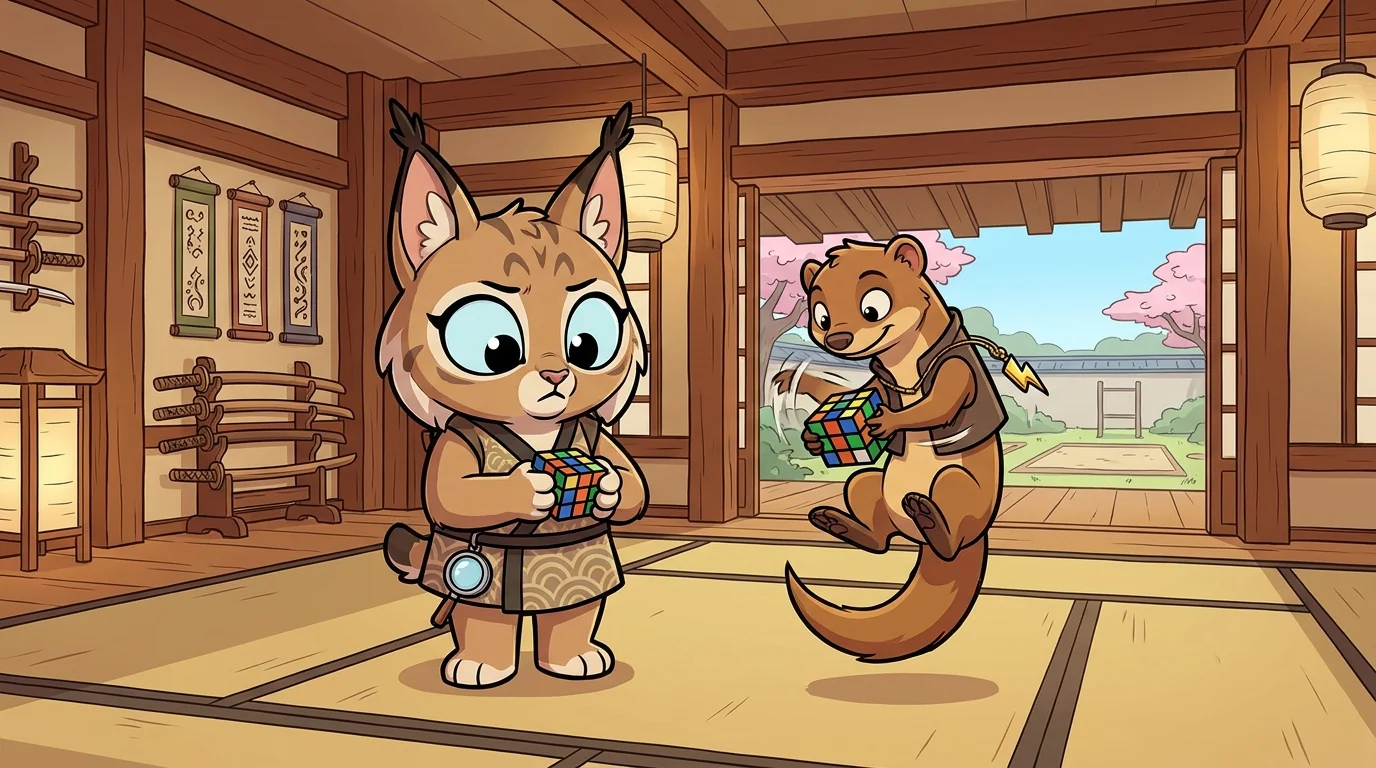
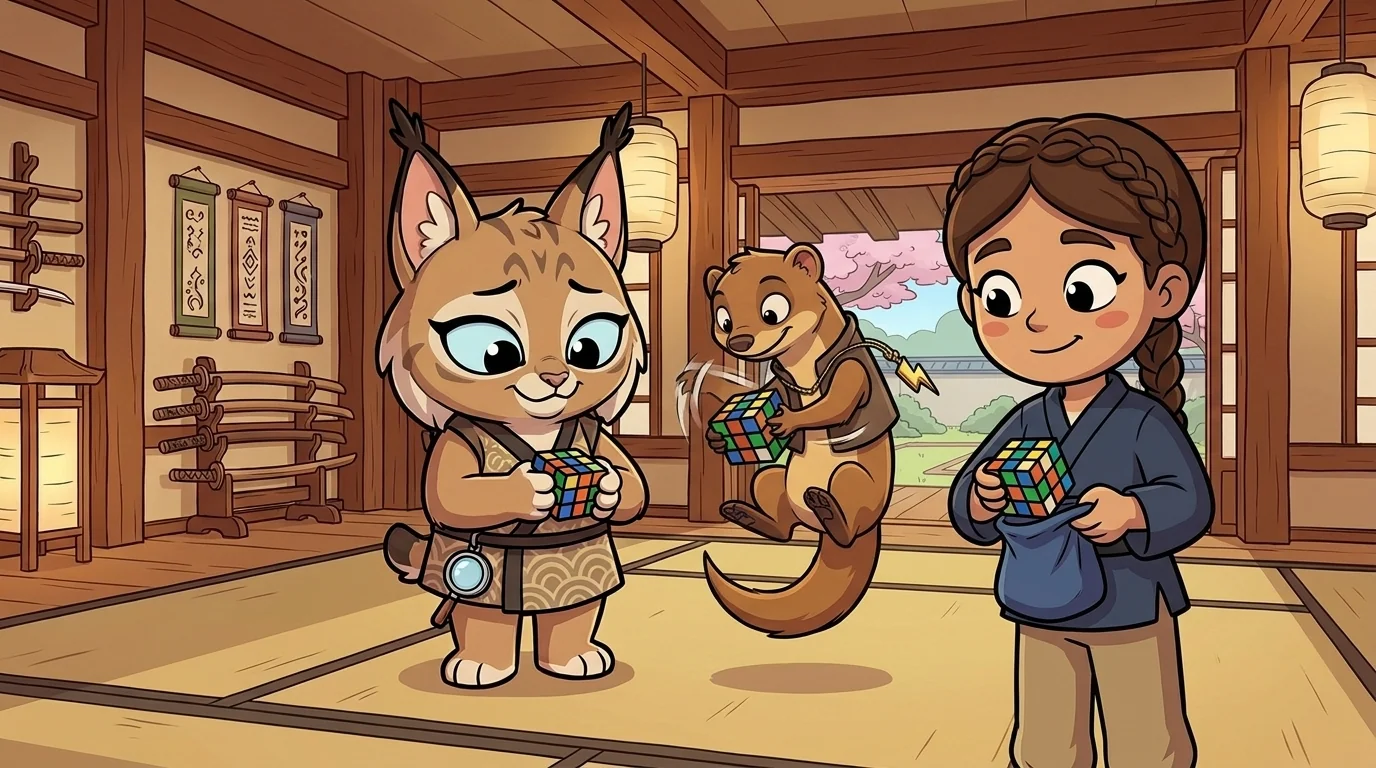
The training room always smelled of worn plastic and finger-grease, a low hum of clicking tiles filling the air. In the corner, Spot sat so still she might have been carved from salt. She was a lynx with tufted ears and enormous, pale eyes that never seemed to blink. On her vest hung a tiny brass magnifying-charm that caught the dusty light. Next to her, Snap was a constant blur of brown fur and nervous energy. He was a mongoose who couldn't stand still for a single second, and a small silver lightning-bolt charm swung from his collar.
They were almost never apart. When Spot went quiet, her eyes narrowing at a scrambled cube, Snap hovered right at her shoulder. He stayed half-crouched, his claws twitching on the tabletop, waiting for her to speak.
"That's the fish case," Spot would say, her voice calm as water in a deep well.
"Snap," Snap would chirp.
Before the word even finished leaving his mouth, his paws blurred through the moves. The cube clicked three times, a sound like dry twigs snapping, and the yellow face was complete.
Together, they taught the final, fastest part of a speedsolve. This was the moment near the end where the cube showed a familiar pattern, and a trained cuber didn't stop to think. They had to *recognize-then-respond* without a single beat of hesitation. Spot was the recognizing part of the brain, while Snap was the responding part of the hands. It was the difference between a beginner sounding out letters and an expert simply reading the page.
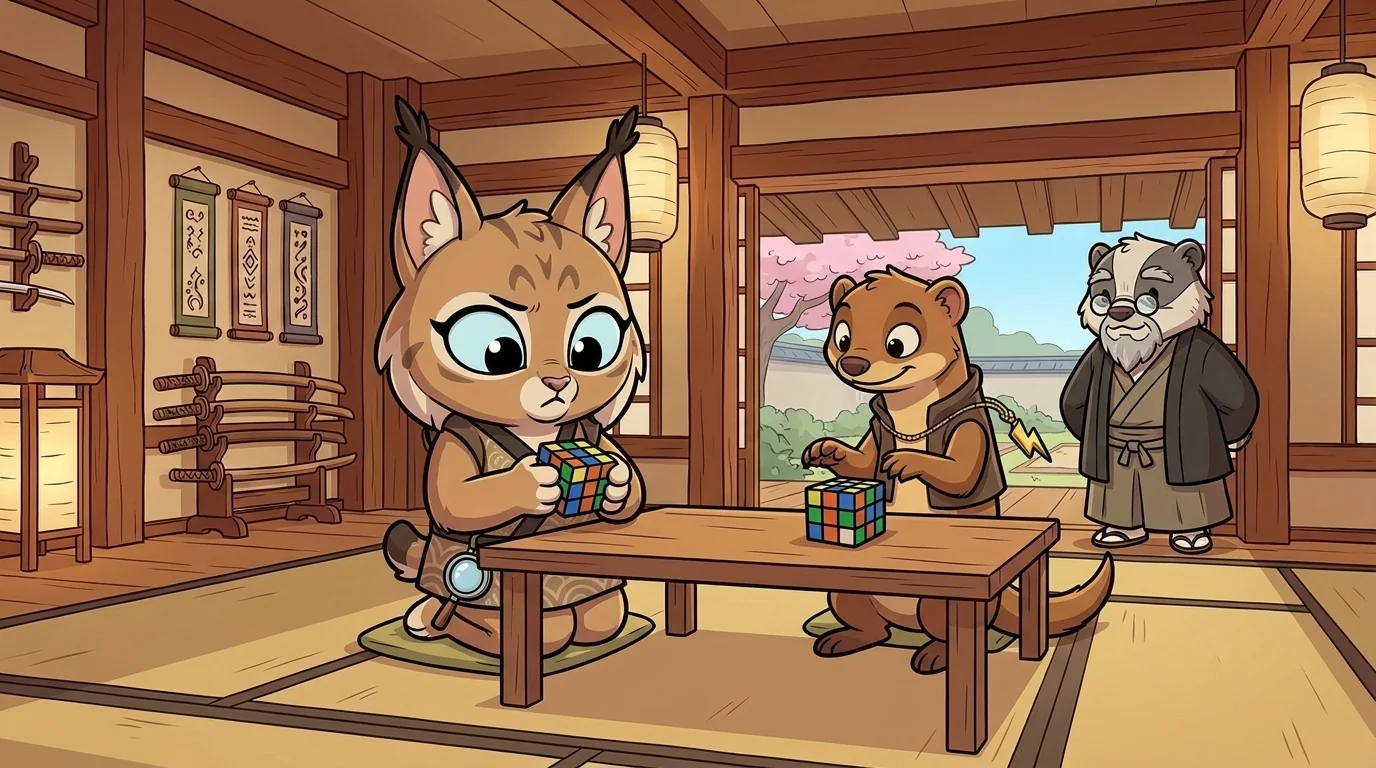
They hadn't always worked as a team. Years ago, Spot had been a brilliant but deeply frustrated solo cuber who knew every single last-step case by heart. She could spot the fish, the cross, the T, or the two-corner-swap in a millisecond. But the moment she had to turn the faces, her brain locked up. Her hands would hover over the plastic, trembling slightly as she second-guessed the sequence. She would wonder if she should turn the front face or the back face first, and the timer would tick away her advantage.
Snap had the exact opposite problem. His paws were the fastest in the entire valley, able to spin a cube so quickly the colors turned into a blur. But Snap couldn't identify a pattern to save his life. He just fired off random sequences, hoping for a lucky break, which usually ended up scrambling the cube worse than before. He would throw his hands up in frustration, his lightning-bolt charm rattling against his chest.
An old coach watched them both flail for a week. He was a wise grizzly with gray fur around his muzzle, and one rainy afternoon, he dragged two chairs to a small wooden table. He made Spot sit on one side and Snap on the other.
"You," the coach said, pointing a thick claw at Spot, "will only look and name the pattern."
Then he turned to Snap, telling him he would only listen and turn the faces. Neither of you will do the other's job.
At first, it felt strange and a little insulting, as if they were being told they were only half-good. Spot stared at the scrambled yellow top face and whispered, "T-case."
Snap's hands blurred instantly, executing the sequence without a single thought. The cube clicked into place, perfectly solved, and they both froze as they stared at the puzzle. It was like a key turning in a lock, two separate halves suddenly becoming one perfect machine.
When Spot and Snap came to the academy, they took over the very end of the curriculum. The other instructors handled the earlier, slower parts of the solve. Cross showed how to lay the foundation, while Layer built the middle sections up block by block. Look kept his eyes moving ahead to track the pieces, and Chart planned the entire route before the timer started.
But the final flurry—the lightning-fast sequence that finishes the solve—belonged entirely to Spot and Snap.
The younger students found them mesmerizing to watch. During demonstrations, Spot's eyes would flick to a scrambled cube for a tenth of a second.
"Sune," she would whisper.
Before the sound of the 'S' left her lips, Snap's hands were already done. There was no pause, and there was no time spent thinking it through. It was just see and do, two steps happening so fast they looked like a single movement.
"We aren't actually faster than you," Spot told a group of wide-eyed beginners one morning. "We just don't spend any time figuring things out because we already know what to do."
"The whole secret is turning that slow process of figuring-out into simple, instant knowing."
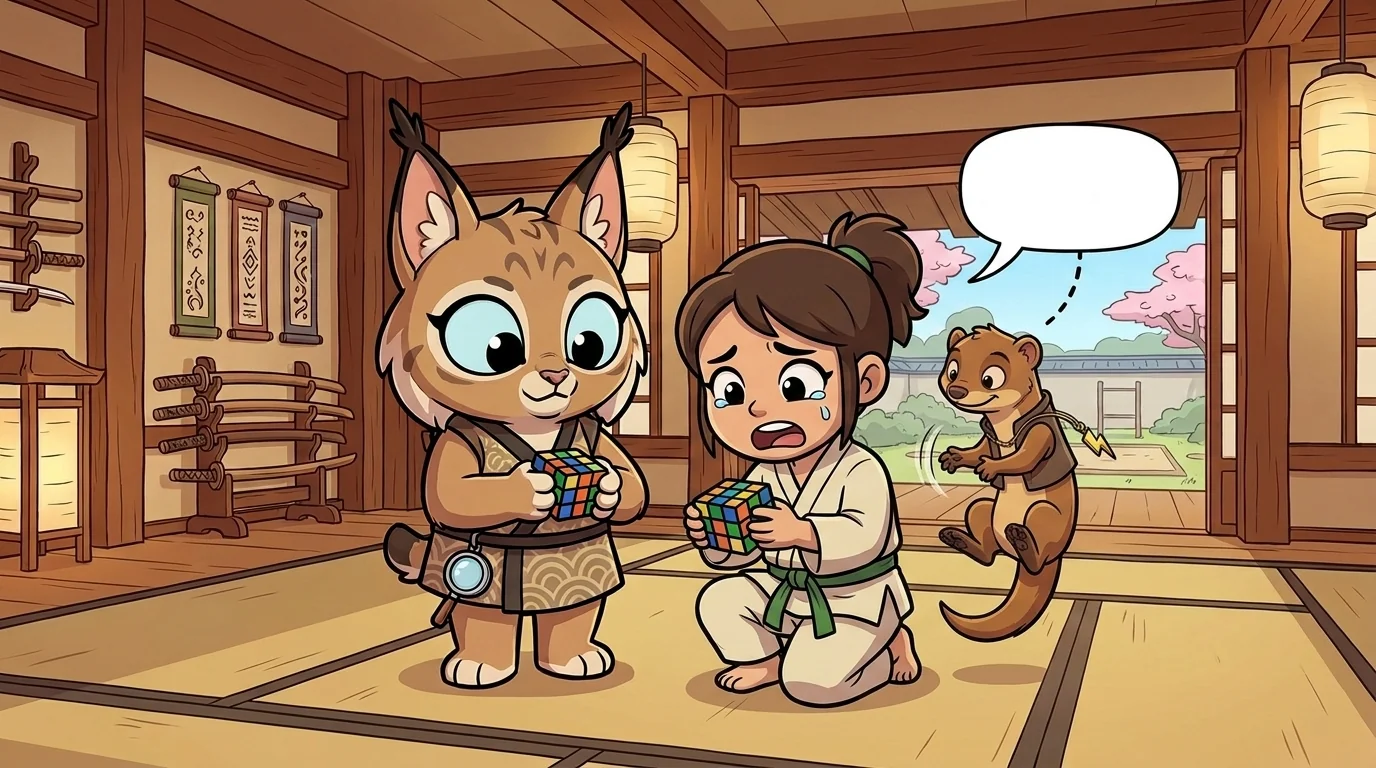
A young cuber named Devi had a painful problem, despite being incredibly smart and memorizing every single pattern. If you held up a scrambled cube, she could instantly name the headlights, the bar, or the flying fish. But the moment she started a real solve, her confidence vanished and everything fell apart.
On a Tuesday afternoon, Devi sat at a practice table with her hands shaking and the timer running. She completed the first two layers smoothly, but when she looked at the top face, her eyes widened. Her hands hovered two inches above the plastic, frozen in mid-air like they were glued.
"I know what it is," she whispered, her face growing hot as tears of frustration welled in her eyes. "It's a U-turn case, but my fingers won't move, and I just freeze up."
The timer beeped to mark a failed solve, and Devi slumped back in her chair with a sigh.
Spot padded over and crouched beside her, her large, pale eyes warm and patient. "You already have my half of the skill, and you can see the pattern instantly."
"That is a very hard thing to learn, and you are genuinely great at it."
"But it doesn't matter if I can't finish," Devi said, wiping her sweaty palms on her jeans.
"You're trying to do too much at once," Snap said, bouncing up onto the bench beside them with a flick of his tail. "You're trying to recognize the pattern and perform the moves at the exact same time."
"That's like trying to swallow your food before you chew it, which only jams the system."
"How do I unjam it?" Devi asked, looking between the two of them.
"You split the job instead of trying to think and move together," Spot said. "When you see the pattern, say its name out loud first."
"Do not let your hands touch the plastic until the word is out of your mouth."
Devi took a deep breath, scrambled her cube, and started the solve again. She solved the cross and the middle layers, and finally, the top face came into view. She wanted to spin the sides immediately, but she forced her hands to stay back.
She stared at the yellow stickers and said, "Fish case," out loud.
Because she had already named it, there was nothing left for her brain to decide. Her hands didn't have to think, since they only had to answer the name. Her fingers moved, clumsy at first, but she didn't freeze and the terrible hesitation never came.
"Again," Spot said softly. "Name it first, then let your hands answer."
Devi scrambled the cube, whispered "T-case," and watched her hands move without her permission.
"Two-swap," she said on the next run, and the yellow face resolved instantly.
Each time she spoke, the spoken word cut through her hesitation and separated the seeing from the doing. It was Spot's job, then Snap's job, and they never tried to crowd into the same second. By her tenth solve, Devi's hands were flowing through the final turns without a single pause.
She looked up at the two instructors, her eyes wide with surprise. "It's not one big skill," she said. "It's two smaller skills holding hands."
"Exactly," Snap chirped, doing a quick spin on the bench.
Later that evening, Devi packed her cube into her backpack, noticing the heavy knot in her stomach had finally loosened. For weeks, she had dreaded the end of every solve, fearing that terrible moment of knowing without moving.
Now she realized her problem had never been a lack of knowledge. She simply hadn't trusted her own eyes enough to let her hands do their job. Splitting the task had felt like a step backward, like admitting she wasn't fast enough to do both. But as she walked out into the cool evening air, she realized it was actually a massive relief. It was like carrying a heavy box with two hands instead of balancing it on one palm.
She reached into her pocket, her fingers brushing the cold plastic of her cube. Under her breath, she whispered the name of the last pattern she had solved. In the darkness, her fingers twitched, eager to answer.
The CubeSensei ensemble
Spot and Snap is part of CubeSensei's distributed-narrative cast. Each character embodies a different curricular primitive; together they teach the full subject.
-
Layer
Beginner method — layer-by-layer steward; 'Bottom first. Always.'
-

Cross
CFOP method — speedcubing steward; 'Cross, F2L, OLL, PLL — that's the road.'
-
Block
Roux method — block-building steward; 'Build the blocks. Skip the cross.'
-
Edge
ZZ method — edge-orientation steward; 'Orient first. Then everything's faster.'
-
Pair
Ortega method — 2x2 specialist; 'Two-by-two has its own rules.'
-

Look
Cross-method look-ahead coordinator; 'Eyes ahead. Hands following.'
-
Chart
Lessons-layer cast (inspection planner — the fifteen-second pre-solve read)
-

Parity
Lessons-layer cast (the big-cube even-odd special case)