
Spot and Snap
recognize-then-respond — Spot reads which known case the cube is in; Snap performs the single response that case calls for. Neither works alone: recognizing a case with no response is useless, and firing a response without recognizing the case is guessing. Together they are the look-up loop that turns the last steps of a solve from thinking into knowing.
Press play to listen along. The line being read lights up as you go.
Show full transcript
Loading transcript…
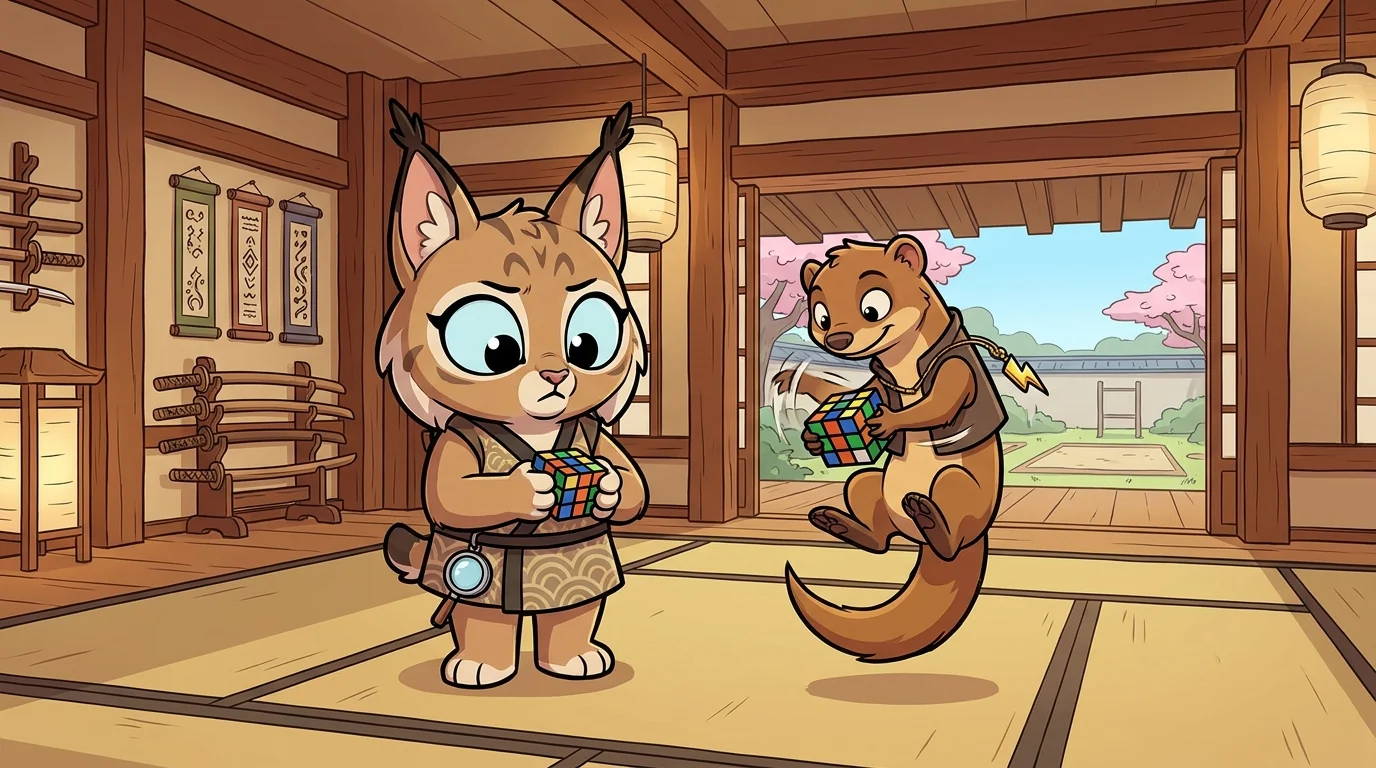
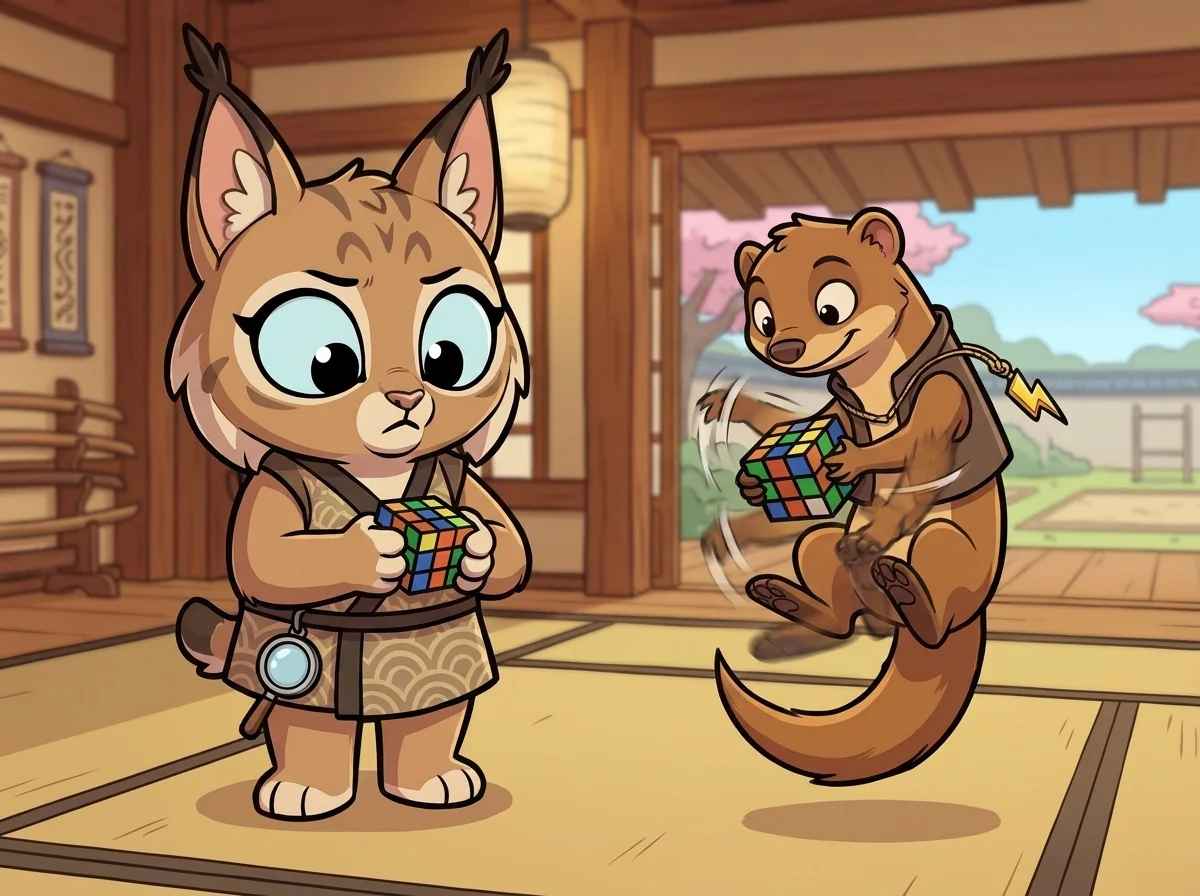
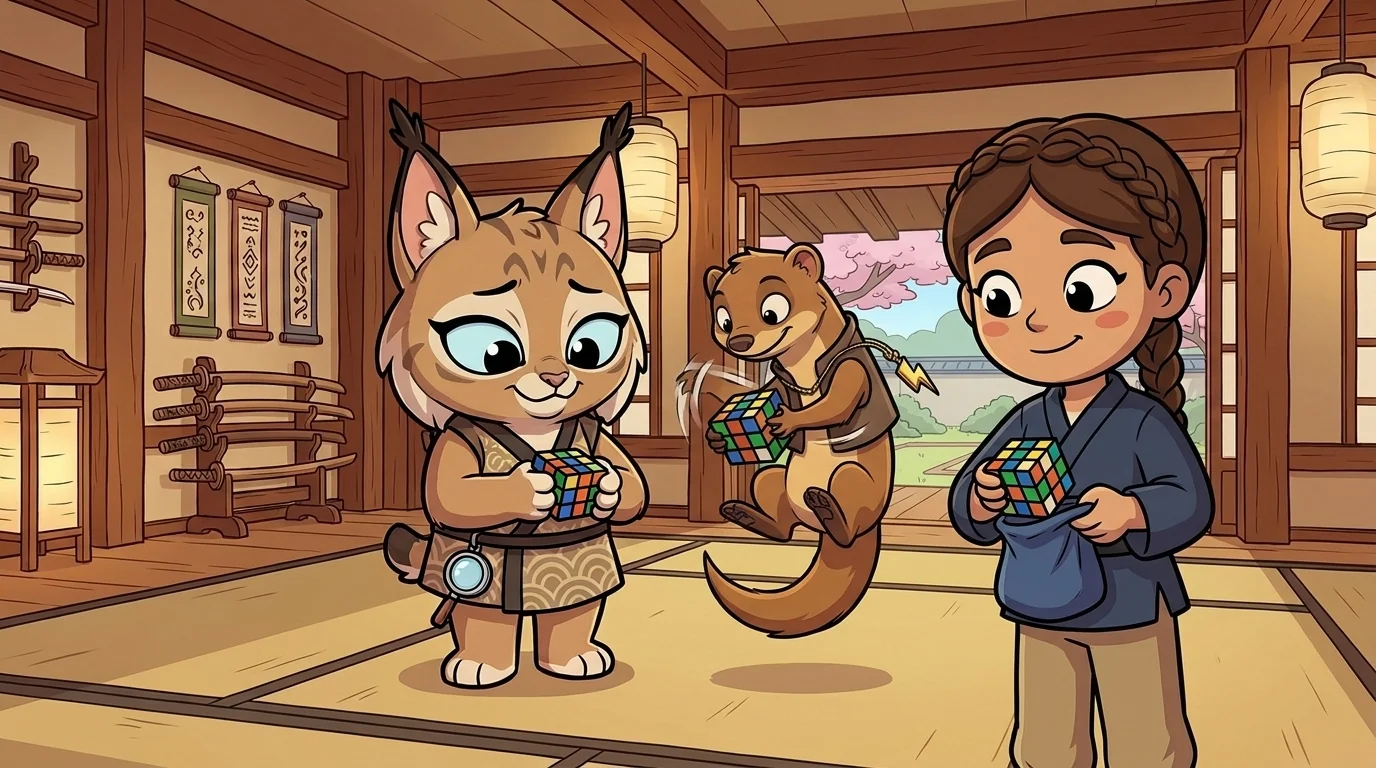
Spot was a still, watchful lynx with tufted ears and enormous pale eyes, and a magnifying-charm on her dojo vest. Snap was a mongoose who never seemed to hold still for even a second, all coiled spring and quick paws, with a tiny lightning-bolt charm that swung when he moved. They were almost never apart. Where Spot went quiet and narrow-eyed, studying, Snap hovered at her shoulder, already half-crouched, waiting for one word.
"That's the fish case," Spot would say, calm as still water.
"Snap," said Snap — and his paws would blur through a sequence before the word finished leaving him.
Together they taught the last, fastest part of a speedsolve: the moment near the end where the cube shows you one of a set of known patterns, and a trained cuber doesn't think — they recognize and respond. Spot was the recognizing. Snap was the responding. It was the craft called *recognize-then-respond, and it was the difference between a beginner sounding out each move and an expert who simply knew*.
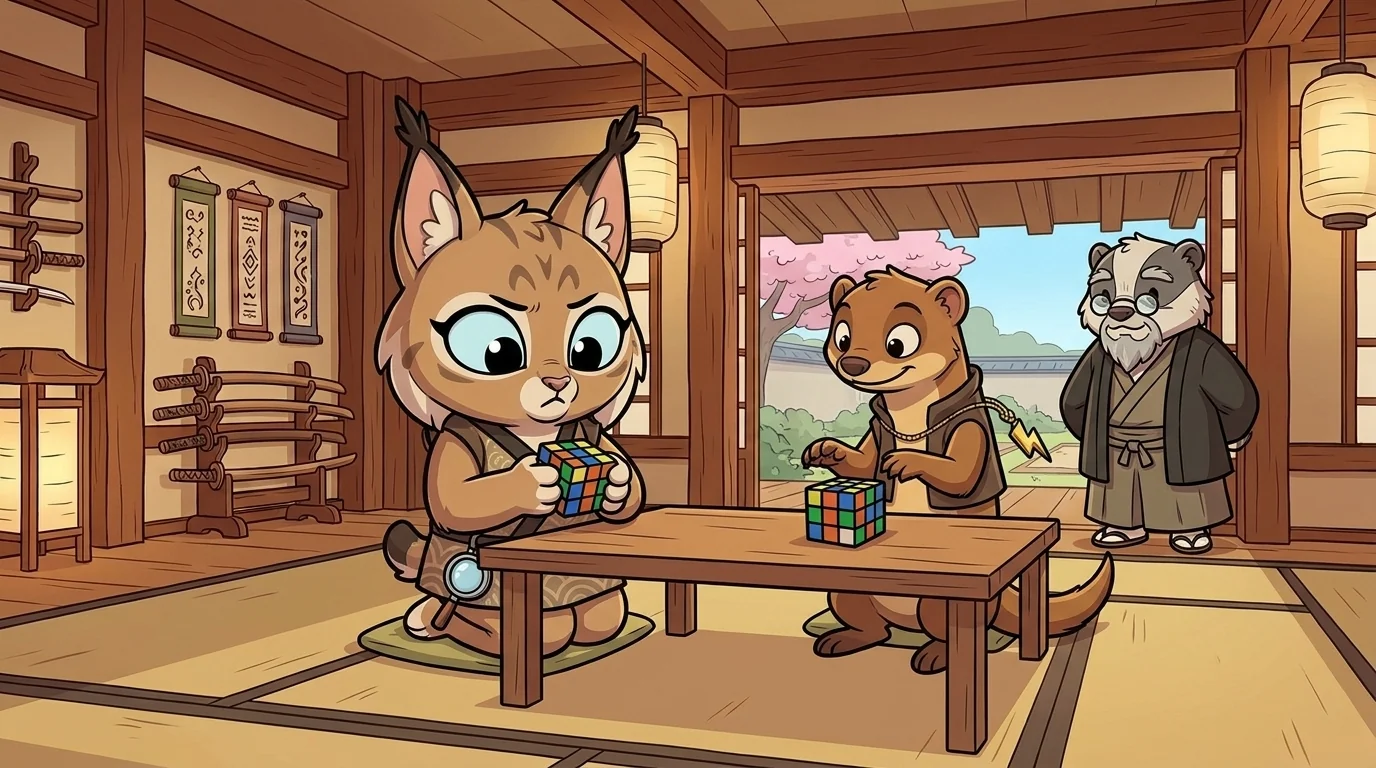
They hadn't started as a pair. Spot had been a brilliant, frustrated solo cuber who could name every one of the last-step cases on sight — the fish, the cross, the T, the two-corner-swap — but she froze when it was time to act. She'd recognize the pattern instantly and then just... hover, her hands stalling while she second-guessed which turns came in which order.
Snap had the opposite problem. His hands were the fastest in the dojo, but he couldn't tell one case from another to save his life, so he fired responses at random and wrecked half his solves.
An old coach watched them both flail for a week and then, one afternoon, sat them at the same table. "You," he said to Spot, "will only look and name. You," to Snap, "will only listen and do. Neither of you does the other's job." It felt strange and a little humbling — like each of them was only half a cuber. But the first time Spot said "T-case" and Snap's hands answered before she'd even finished, they both felt it: a click, two halves becoming one working thing.
When Spot and Snap came to the academy, the other cast members taught the earlier stretches of the solve. Cross laid the road. Layer built up. Look kept his eyes ahead. Chart planned it all before the timer. But the very last steps — orienting the top, then permuting it, the flurry that finishes a solve — that was Spot and Snap's territory.
The young cubers found them mesmerizing. Spot's eyes would flick to the cube for a fraction of a second, she'd name a case in a word, and Snap's hands would already be done. No pause. No thinking-it-through. Just see and do, so fast the two steps looked like one.
"We're not faster than you," Spot told a wide-eyed beginner. "We just don't stop to figure it out. We already know. That's the whole trick — turning figuring-out into knowing."
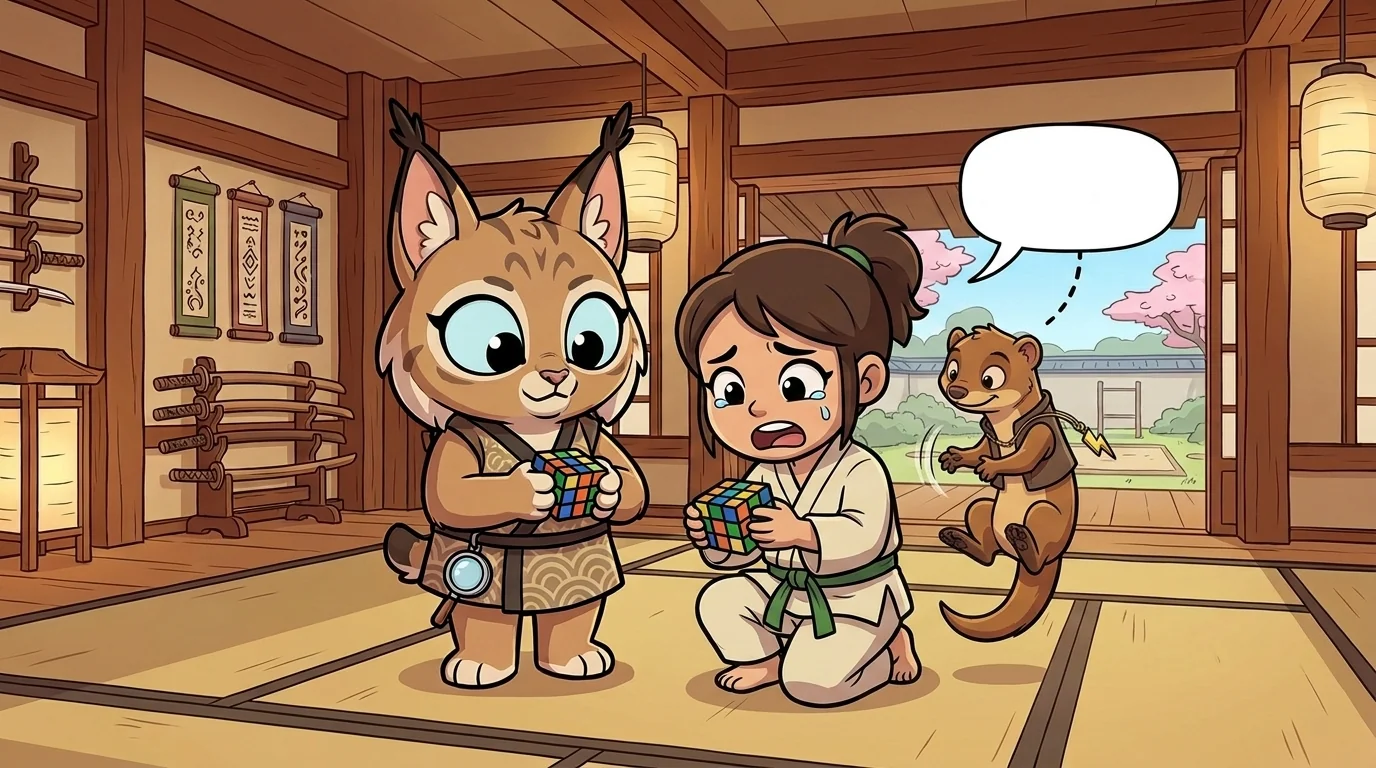
A cuber named Devi had a peculiar, painful problem: she could recognize every single case. Quiz her and she'd name them all — the fish, the headlights, the bar. But the instant it was her turn to act, she froze. Her hands hovered over the cube, and the knowing curdled into second-guessing, and the seconds bled away.
"I know what it is," she said, near tears. "I just can't do it. Knowing doesn't help if I freeze."
Spot crouched beside her, calm. "You've got my half already," she said. "You can see the case. That's genuinely hard, and you're good at it. The part you're missing is Snap's half — you don't trust the seeing enough to just move."
"How do I fix that?"
"You split the job," said Snap, bouncing. "Don't try to recognize AND perform at the same time — that's what jams you. Say the case out loud first. Just name it. Then your hands only have one job left: answer the name."
Devi tried. She stared at her cube. Her voice came out small: "...fish case." And then — because there was nothing left to decide, only a name to answer — her hands moved. Clumsy, at first. She fumbled it. But she'd moved, and the freezing hadn't happened.
"Again," said Spot gently. "Name it, then answer it."
"Fish case." Move. "T-case." Move. "Two-swap." Move. Each time, saying the name first cut the knot of hesitation, because it separated the seeing from the doing — Spot's job, then Snap's job, never both at once. By the tenth solve Devi's hands were flowing through the last steps without a single frozen pause. She wasn't recognizing and performing simultaneously and jamming. She was recognizing, then performing — the loop, running clean.
She looked up, astonished. "It's not one skill. It's two skills holding hands."
"That's us," said Snap, delighted.
Later, packing up, Devi realized the frozen, panicky feeling that used to grip her at the end of every solve — the I-know-this-but-I-can't-move dread — had loosened into something steadier. She thought about how strange it was that her problem had never been not-knowing. It had been not-trusting the knowing enough to let her hands answer it. Splitting the job in two, letting the seeing finish before the doing began, had felt at first like admitting weakness. Now it just felt like relief — like she'd been trying to carry something with one hand that was always meant for two. She smiled, tucked her cube away, and, under her breath, named the last case she'd solved, just to feel her hands want to answer.
The CubeSensei ensemble
Spot and Snap is part of CubeSensei's distributed-narrative cast. Each character embodies a different curricular primitive; together they teach the full subject.
-
Layer
Beginner method — layer-by-layer steward; 'Bottom first. Always.'
-

Cross
CFOP method — speedcubing steward; 'Cross, F2L, OLL, PLL — that's the road.'
-
Block
Roux method — block-building steward; 'Build the blocks. Skip the cross.'
-

Edge
ZZ method — edge-orientation steward; 'Orient first. Then everything's faster.'
-
Pair
Ortega method — 2x2 specialist; 'Two-by-two has its own rules.'
-

Look
Cross-method look-ahead coordinator; 'Eyes ahead. Hands following.'
-

Chart
Lessons-layer cast (inspection planner — the fifteen-second pre-solve read)
-

Parity
Lessons-layer cast (the big-cube even-odd special case)