
Tempo and Tone
rhythm-timbre pair — Tempo is speed (BPM, pulse, push and pull of time). Tone is timbre (which instrument, which sound color, which feel). Together they teach that a song has both how-fast and what-it-sounds-like.
A story read by Tempo and Tone
Press play to listen along. The line being read lights up as you go.
Show full transcript
Loading transcript…
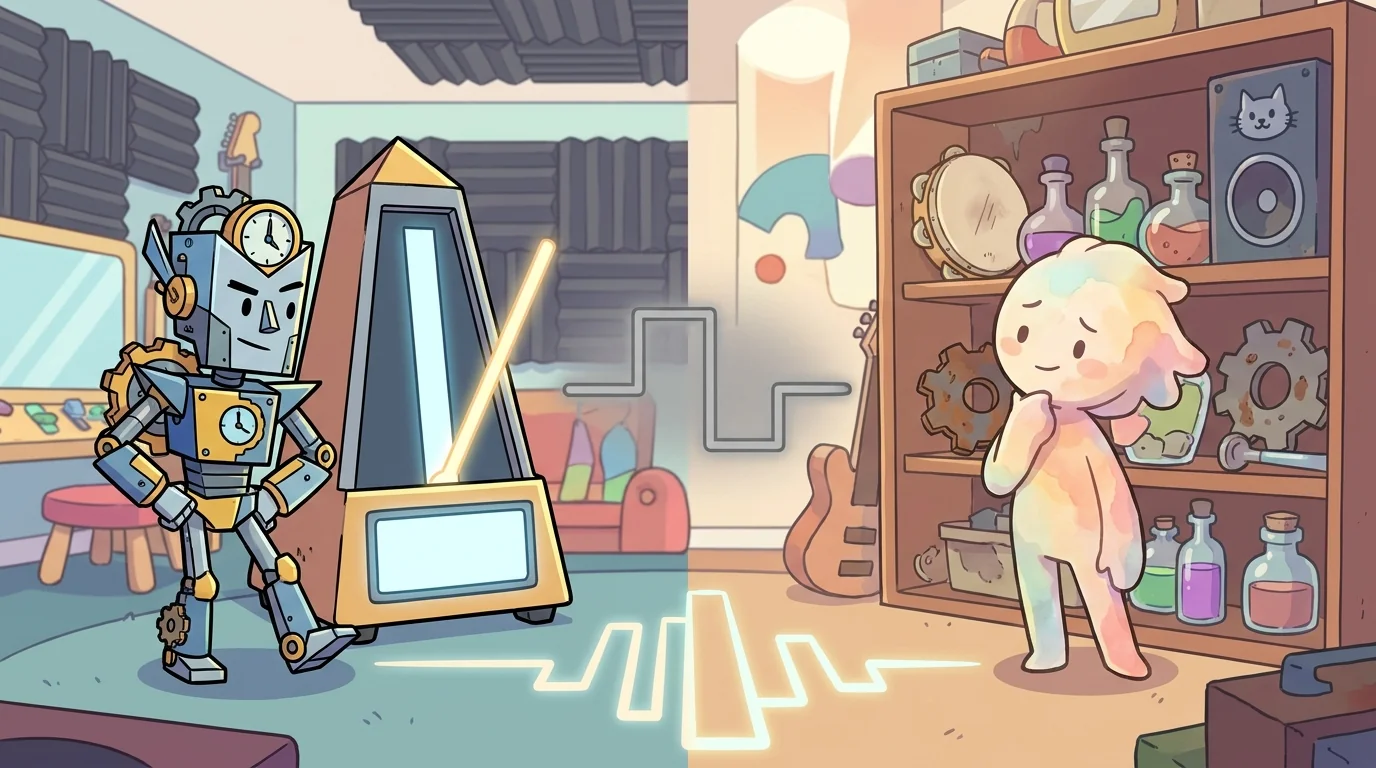
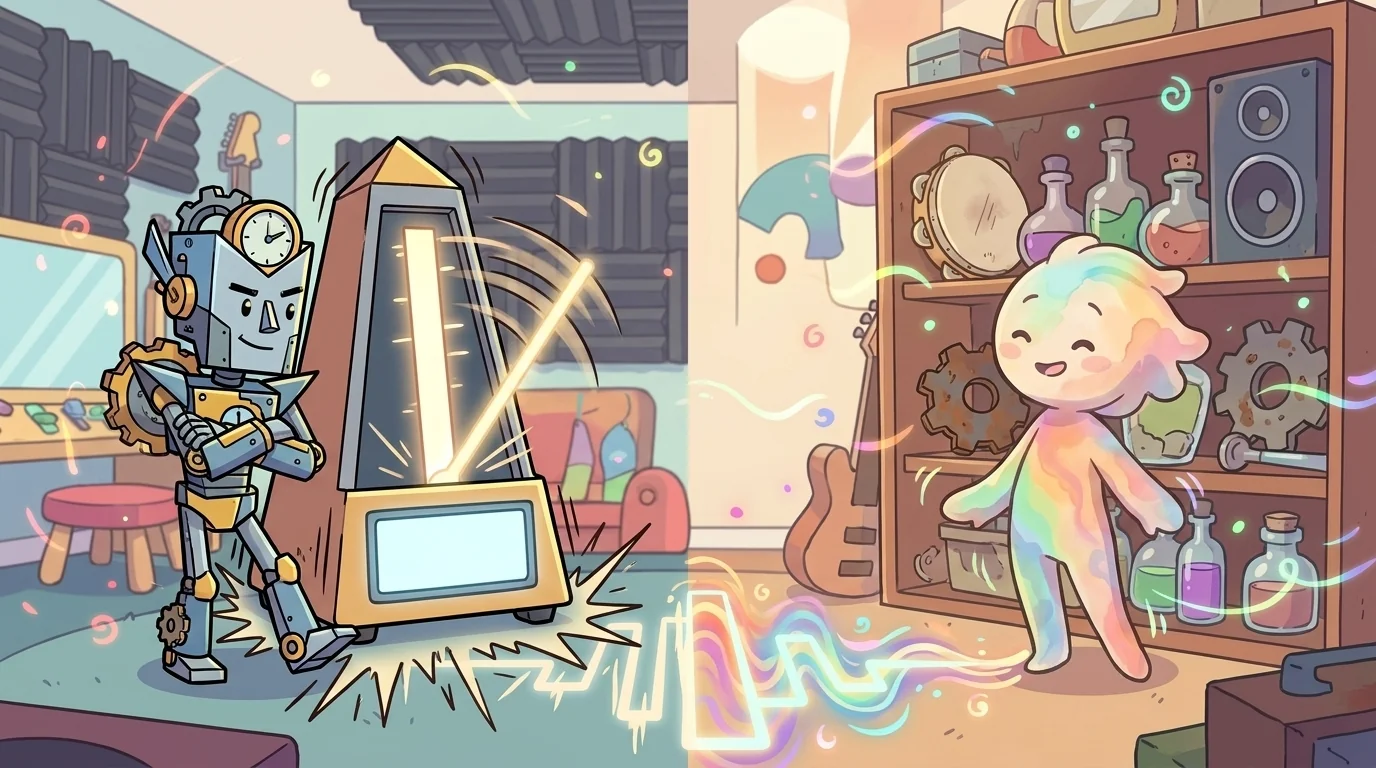
The rhythm you had just created echoed through the vast studio, bouncing off the polished chrome of Tempo’s domain and the softly glowing textures of Tone’s. Tempo’s side of the room was a symphony of sharp angles and shimmering metal. A colossal, luminous metronome dominated one wall, its silent pendulum of light sweeping back and forth. Its digital display glowed with a steady "90 BPM," a silent, constant heartbeat. Across the studio, Tone’s wall offered a stark contrast. Shelves sagged under the weight of peculiar treasures: a tarnished tambourine, a line of glass bottles holding varying levels of colored liquid, a rusted gear, and a small, unassuming speaker marked with the words cat purr. The air itself seemed to hum with the potential of sound.
Your beat played on, a simple sequence of sounds. The kick drum thumped, the snare snapped, and a basic melody plinked along. It wasn't bad, exactly. But it felt… unremarkable. Like a gray piece of cardboard, folded flat and left forgotten. It lacked any real spark.
Tempo, a being crafted from sharp lines and clicking clockwork parts, tapped a metal foot perfectly in time with your track. Their voice was crisp and even, each word delivered with the precision of a well-oiled machine. “It is mathematically correct,” Tempo stated, their gaze fixed on the glowing metronome. “The notes land exactly on the grid. One, and, two, and, three, and, four, and. But the pulse is weak. It has no urgency.”
Tone, who appeared softer and seemed to shimmer with a gentle, resonant hum, tilted their head. Their form was less defined than Tempo’s, like a living watercolor painting, constantly shifting hues. “It has no color,” Tone murmured, their voice a low, melodic sound that seemed to drift rather than speak. “The sounds are just… sounds. They don't evoke anything. They don't tell a story.”
Tempo pointed a slender finger at the glowing number on the metronome. “The problem is the when.”
Tone gestured with an open hand toward the shelves of oddities. “No, the problem is the what.”
They both looked at you, waiting. The plain beat looped again, a repetitive, uninspired cycle. Thump-snap. Thump-thump-snap. You felt a familiar knot of frustration tighten in your stomach.
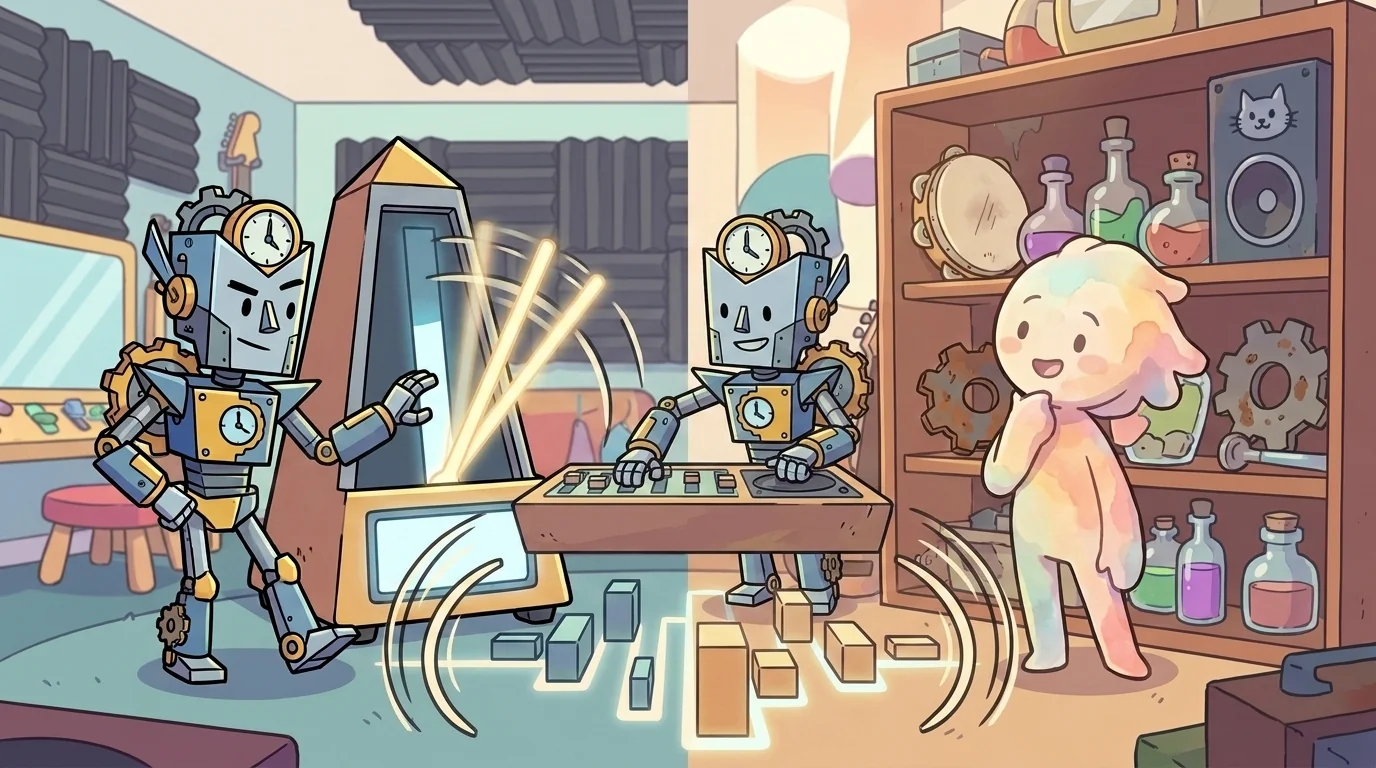
“Let’s simplify,” Tempo said, striding over to the main console with a purposeful, rhythmic gait. With a few precise clicks, they muted your melody, leaving only the drums. Thump-snap. Thump-thump-snap. “Forget the sounds for a moment. Just listen to the pattern. The engine.”
Tempo’s hand went to the giant slider next to the metronome. The air grew thick and heavy, as if resisting, as they dragged it down. The light-pendulum slowed, its sweep becoming ponderous, and the beat followed, stretching out with each passing second. The digital counter dropped: 80… 70… 60 BPM.
Thump... snap... Thump... thump... snap...
“See?” Tempo said, their voice still even, but with a hint of satisfaction. “Now it’s a giant, lumbering through a swamp. It’s heavy. It’s sleepy. The feeling is completely different, but the pattern is exactly the same.” This, you realized, was the essence of *tempo*: the speed at which a piece of music moves, dictating its energy and mood.
Then, with a sudden, decisive shove, Tempo sent the slider rocketing upward. The pendulum blurred into a streak of light. 100… 120… 140 BPM!
Thump-snap. Thump-thump-snap. But now it was fast, frantic, and full of an almost manic energy. It made you want to tap your own feet, a nervous twitch of excitement. “Now it’s a squirrel in a coffee shop!” Tempo declared, a rare spark of something akin to humor in their voice. “It’s jittery! It’s exciting! The speed—the tempo—changes the story. Is your song a sleepy giant or a caffeinated squirrel? You have to decide how fast its heart should beat.”
“A fine choice,” Tone hummed, a soft, approving sound, as you set the tempo to a peppier 110 BPM. “But even a fast squirrel is boring if it’s gray.”
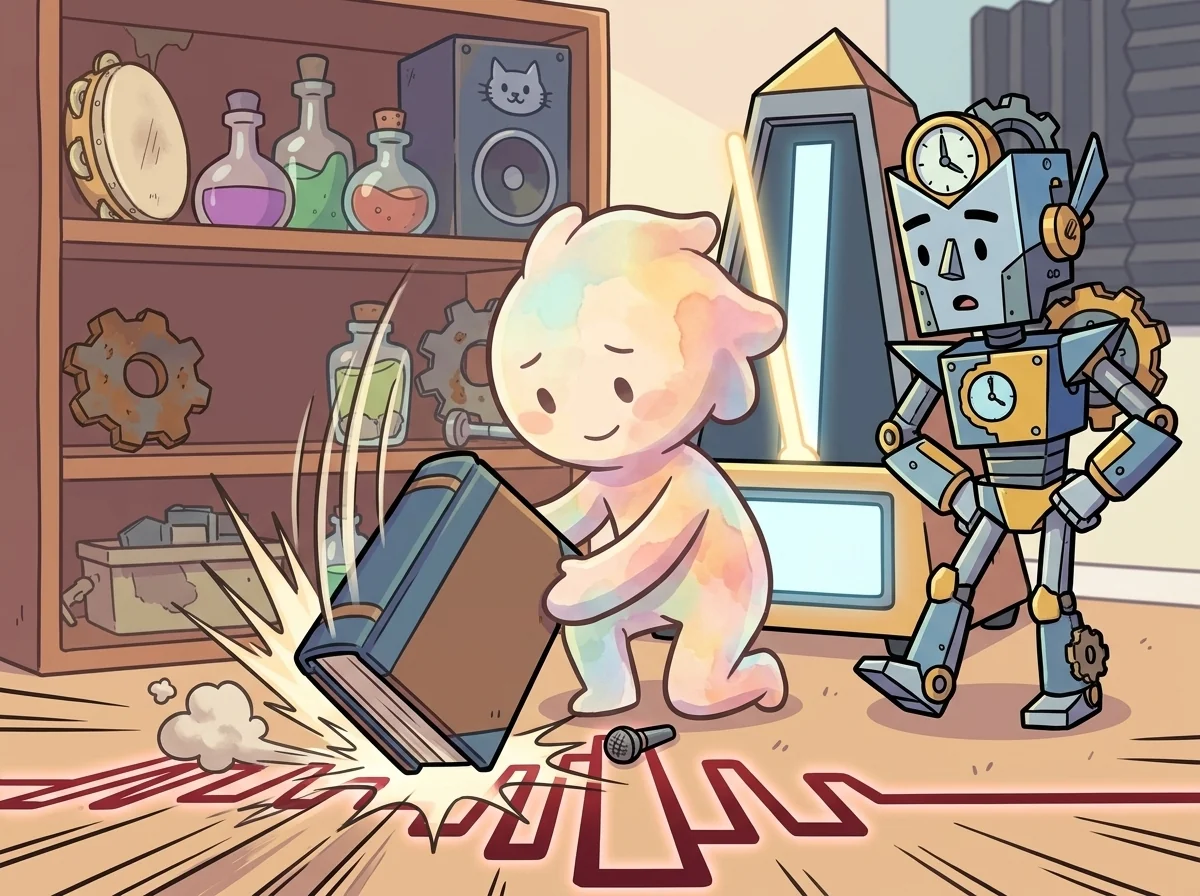
Tone drifted over to their wall of wonders. They ignored the drum machine icon on your screen, which showed a generic kick drum, and instead picked up a large, heavy book from a low shelf. Its cover was worn, its pages thick. “A kick drum should have weight. It should move the air,” they explained, holding a small microphone near the book. Then, with a gentle, deliberate motion, they let the book fall flat onto the floor.
THWUMP.
With a gentle wave of their hand, the deep, resonant sound replaced your old kick drum. You played the beat again. THWUMP-snap. THWUMP-THWUMP-snap. Whoa. It sounded bigger, more real, like something truly substantial had just landed.
“Better,” Tone whispered, a smile playing on their lips. “Now, the snare.” They scanned the shelves, their eyes passing over the bottles and gears, before pointing to a small, unlabeled speaker tucked away behind a stack of dusty sheet music. “That polite little snap isn't cutting it. We need something with more attitude.” They tapped the speaker, and a sharp, sizzling CRACKLE-POP, like bacon in a hot pan, jumped out. Tone smiled again, a soft, encouraging gesture, and swapped the sound.
You hit play. THWUMP-CRACKLE. THWUMP-THWUMP-CRACKLE. It was weird, and surprising, and a thousand times more interesting than before. “See?” Tone said softly. “The sounds are the clothes the rhythm wears. You can dress it up to be serious, or silly, or anything in between. The tone—the quality and character of the sounds themselves—gives the beat its personality.” This, you understood, was *tone*: the unique sound quality of an instrument or voice, shaping how we perceive it.
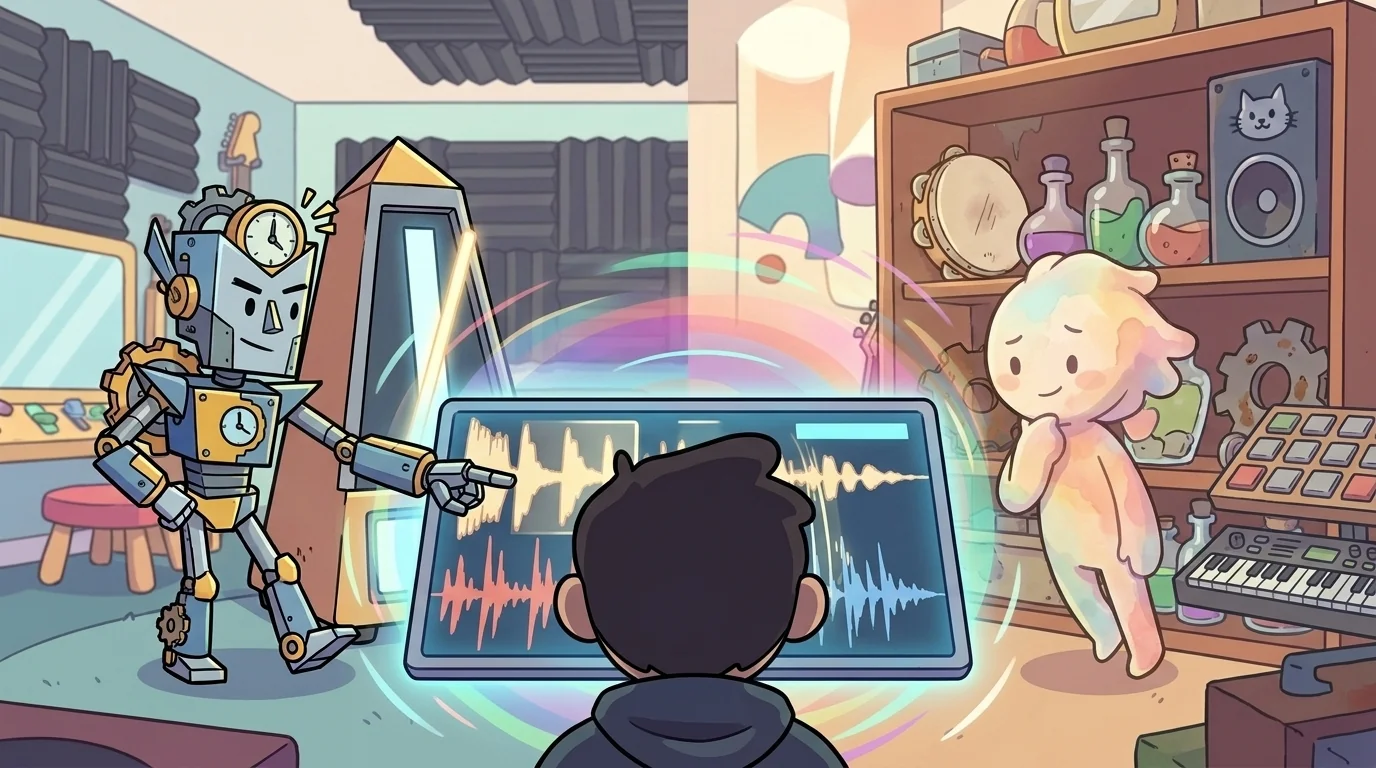
Your beat was so much better now. The powerful book-slam kick and the energetic bacon-sizzle snare, set at a lively 110 BPM. You played it loud, letting the new sounds fill the studio, but you frowned. Something was still a little… off. The sounds, for all their new personality, felt like they were tripping over each other, a bit clumsy.
“Ah,” Tempo said, their clockwork head clicking almost imperceptibly as it analyzed the rhythm. “I see the issue. The what and the when are fighting.” They pointed to the screen, where the visual representations of the sounds were slightly misaligned. “That wonderful THWUMP is a big, heavy sound. It needs a split-second more room to breathe before the next sound happens. And that bacon-sizzle is quick and sharp, but our beat is still marching like a little soldier, too rigid for its character.”
Tone drifted closer, nodding in agreement, their form swirling with soft, approving colors. “The sounds have their own rhythm,” they explained, their voice a gentle current. “A big splash needs more time to resonate than a tiny drip.”
This, you realized, was the tricky part. Tempo nudged the timing of the kick drum back just a tiny bit, so it landed a fraction of a second later, a little heavier. It was a change so small you could barely see it on the screen, but you could distinctly feel the difference in the rhythm. It gave the beat a lazy, powerful groove. Then, they took the bacon-sizzle snare and pushed it a fraction of a second earlier.
“It needs to lead the charge,” Tempo stated, their voice firm.
“It gives it that impatient, exciting feel,” Tone added, their voice a melodic counterpoint.
They weren't just changing the speed or the sounds anymore. They were making them dance with each other, fitting the unique shape of each sound to the precise flow of time. It was a delicate, intricate balance.
You pressed play.
THWUMP… CRACKLE. THWUMP-THWUMP… CRACKLE.
It was perfect. The heavy book-slam now had its space, making it feel truly powerful. The bacon-sizzle snare was sharp and edgy, pushing the beat forward with an almost impatient energy. The speed felt just right for the sounds, and the sounds felt like they were born to live at that speed. It was a real groove now, a living thing. It had a personality. It wasn't gray cardboard anymore; it was vibrant, alive, and utterly compelling.
Tempo stood with their arms crossed, a rare, small smile on their face. The giant metronome pulsed in perfect, unwavering time with your beat. “There it is,” Tempo said, their voice laced with a quiet satisfaction. “The pulse is strong.”
Tone swayed gently, a rainbow of colors swirling in their form, reflecting the richness of the sound. “And it has a beautiful voice,” they hummed, their eyes shining.
“You see,” Tempo began, looking at you, their gaze direct and clear.
“You can’t have one without the other,” Tone finished, their voices overlapping for just a moment, a perfect harmony. “A beat needs a heart. And it needs a voice to sing. The how-fast and the what-it-sounds-like are a team. Now, you’re the one leading it.”
The BeatForge ensemble
Tempo and Tone is part of BeatForge's distributed-narrative cast. Each character embodies a different curricular primitive; together they teach the full subject.
-

Throb
The steady pulse — the underlying clock every other rhythm hangs from
-

Snap
Subdivision — splitting a beat into equal smaller parts (eighths, sixteenths, triplets)
-

Hammer
Accent — emphasis on specific beats (the downbeat, the backbeat, polyrhythmic emphasis)
-

Tilt
Syncopation — placing weight off the expected beat to create pull and forward motion
-
Spin
Groove — the looping pattern that emerges when pulse + subdivision + accent + syncopation cohere; the thing that makes a beat feel like a particular genre