
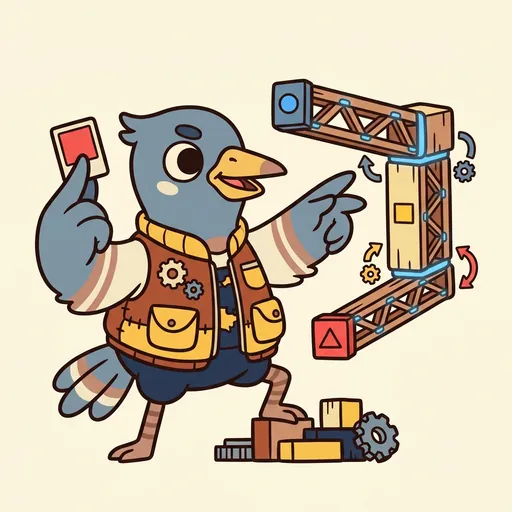
Truss
TRUSS — *claim. then proof. then why. that's the structure that holds.*
Listen along — Truss
Loading audio…
Press play to listen along. The line being read lights up as you go.
Show full transcript
Loading transcript…
Chapter 4 — Truss and the Three-Beam Argument
Truss was a careful kid. She loved to build things. Not with wood or metal, but with ideas. She wore a special vest with many pockets. Inside, she kept her argument-card and a structure-tracker. Truss was small, but her brain was always busy. She liked things to be neat and strong.
Her favorite colors were cool blue and soft brown. She always paid close attention to how people talked. Especially when they tried to convince someone of something. “Claim. Then proof. Then why. That’s the structure that holds,” she’d often say. She drew every argument like a three-beam truss. One beam for the claim. That was the main idea. One for the evidence. That was the proof. And one for the reasoning. That was the “why” the proof mattered.
Truss called this argument structure. It was like building a bridge with words. A weak argument was just a claim. “School should start later,” someone might say. That was it. Not very strong. It was like a single pole in the ground. It could fall over easily.
A medium argument had a claim and evidence. “School should start later because teenagers need more sleep.” Better, Truss would nod. That was two poles. But they still wobbled. They weren’t connected well. They might lean over in a strong wind.
A really strong argument needed all three parts. A claim, evidence, and reasoning. Truss would show them on her tracker. She used the school example. “School should start later,” she’d say. That’s the claim. “Studies show that teenagers’ bodies want to stay up late. They need to sleep in later.” That’s the evidence. “So, if school starts when their brains are still sleepy, they won’t learn as well. Starting later helps them learn better.” That’s the reasoning.
The reasoning beam connected the claim to the evidence. It made the argument strong. Without it, the evidence just floated there. It didn’t hold up the claim. The whole thing would collapse. Just like a bridge with missing supports.
One afternoon, the group was getting ready. They had to give a big presentation. It was about changing a school rule. The rule was about starting school so early. Pitch was excited. He bounced on his toes. He loved talking. But sometimes his ideas were a bit… floaty. The other kids, like Bolt and Spark, were looking worried. They knew Pitch had good ideas. But they also knew he sometimes forgot the “why.”
“Okay, my turn!” Pitch declared. He puffed out his chest. He grabbed a marker. He wrote “School Starts Later!” on the big whiteboard. “That’s our main point!”
Truss held up her argument-card. She looked at Pitch. “That’s just the claim,” she said. Her voice was calm. “It’s a good claim. But where’s the evidence? And the reasoning?”
Pitch stopped bouncing. He blinked. He looked at the whiteboard. “Uh. Evidence?” He looked around the room. Bolt shrugged. Spark chewed on her lip. Pitch scratched his head. “Well, everyone knows teenagers are tired in the morning. I’m tired. You’re tired. Even Resonance looks tired sometimes!”
Truss shook her head gently. “That’s an idea, Pitch. It’s what you feel. Not strong evidence.” She tapped her structure-tracker. “Evidence needs to be something others can check. Something solid.”
Pitch thought harder. He stared at the floor for a long time. His brow was furrowed. He tapped the marker against his chin. “Oh! I remember reading something!” he finally burst out. “Studies show teenagers need more sleep. Their bodies are just wired that way. They can’t fall asleep early. So they need to wake up later.”
Truss nodded slowly. She drew two beams on her tracker. “Good,” she said. “That’s CLAIM plus EVIDENCE. You have two beams now. Much better.” She tapped the empty space for the third beam. “But where’s the REASONING?”
Pitch frowned. He paced a small circle. He mumbled to himself. “Hmm. So… because teenagers need more sleep…” He trailed off. He looked at the ceiling. He looked at his shoes. He looked at Truss. “And school starts super early… before their bodies are ready…”
Truss waited. She watched him. She didn’t rush him. She just held her tracker. The missing beam seemed to glow faintly.
“So,” Pitch continued, his eyes widening as the idea clicked. “If school starts when teenagers are still tired, their brains aren’t ready to learn. They’re still in sleep mode. They just sit there. Not really taking things in.” He snapped his fingers. “Starting later means their brains are awake! They can learn better! They’ll get better grades!”
Truss beamed. She drew the third beam on her tracker. It looked strong and complete. “Yes!” she said. “Now you have a TRUSS! All three beams are there. It’s a solid argument.” She pointed to each part. “The audience can follow your argument easily. The reasoning is the beam that holds the whole thing up. Without it, the evidence just floats. With it, the bridge stays standing.”
Pitch grinned. He grabbed the marker and wrote the full argument on the whiteboard — claim, evidence, reasoning — each on its own line. The whiteboard looked sturdy now. Like something you could walk across.
Bolt and Spark looked at each other and smiled. The presentation would be ready.
Truss tucked her structure-tracker back into her vest pocket. “Claim. Then proof. Then why,” she said softly, more to herself than to the room. “That’s the structure that holds.” She looked at the sturdy whiteboard, and something warm and quiet settled in her chest — the calm, happy feeling of watching a wobbly idea grow strong enough to stand on. That feeling, she thought, was the best part of all.
The SpeakForge ensemble
Truss is part of SpeakForge's distributed-narrative cast. Each character embodies a different curricular primitive; together they teach the full subject.
-

Pose
Posture / presence / stance — 'Stand. Then speak.'
-

Pitch
Voice projection + tone variation — 'Your voice is a road. Not a wall.'
-

Hark
Active listening — 'Listen all the way through.'
-

Echo
Audience awareness + tone calibration — 'Who's listening? Speak to THEM.'
-

Easel
Visual aids / multimedia displays — show, don't just tell; one clear picture beats a hundred words (SL.5)
-

Waypoint
Signposting — the verbal roadmap; 'first, next, finally' so listeners never get lost (SL.4)
-

Volley
Q&A — fielding and answering questions; catch it, breathe, send it back clean (SL.1)
-

Mosaic
Building on others' ideas — synthesizing a discussion; 'you said X, and building on that…' (SL.1c-d)
-

Usher
Turn-taking & discussion norms — everyone gets a seat at the talk; make room for the quiet voice (SL.1b)