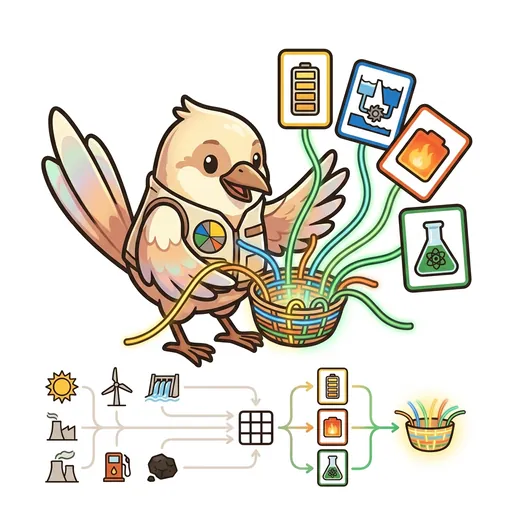
Mix
MIX — no single source carries the whole grid. blend; store; resilience.
Listen along — Mix
Loading audio…
Press play to listen along. The line being read lights up as you go.
Show full transcript
Loading transcript…
Chapter 5 — Mix and the Grid That No Single Source Can Carry
Mix was a magpie-tween with cream feathers that caught the light in little rainbow flecks, and she was, at this exact moment, arguing with a lightbulb.
“You want to stay on all night,” she told it, screwing it into a lamp on her workbench. “Fine. But you can’t ask the sun to do that. The sun clocks off at dusk.” She wired the lamp to a small panel, a tiny windmill, and a boxy battery, all at once. “So we bring friends.”
She flicked a switch. The bulb glowed. Then she cupped her wing over the little solar panel — cutting off its sun — and the bulb flickered but did not go out. The wind-toy and the battery had quietly picked up the slack.
“See?” she said, satisfied. “No single one of you carries the whole night. But together—” she uncovered the panel and all three pitched in “—nobody even notices when one of you naps.”
Mix’s whole family had been nest-weavers, and they’d learned the hard way why you never build with one thing.
When she was small, Mix had made her first nest out of a single kind of long silver grass, because it was pretty and she was proud. It looked wonderful. Then a dry spell came, the silver grass went brittle all at once, and her beautiful one-material nest crumbled in a single afternoon. She’d sat in the wreckage, chest aching, feeling like she’d done everything right and been punished for it anyway.
Her mother had landed beside her, carrying a scrappy-looking bundle of twigs, moss, wool, and wire. “Ugly, isn’t it,” she’d said cheerfully, holding up her own tangled nest.
Mix had sniffled. “Mine was prettier.”
“Yours was one thing,” her mother said gently. “When the one thing fails, everything fails at once. Mine’s a mess — grass and wool and wire and moss — and that mess is exactly why it holds. The dry spell got the grass, but the wool didn’t care, and the wire held it all together.” She’d nudged the wreckage. “No single thread holds a nest, love. The strength is in the blend. The trick is knowing which thread to add when.”
That word — blend — had stayed with Mix ever since. Not as a rule. As a kind of safety.
She walked to Powerforge at twelve, because a whole valley’s worth of lights was really just a very large nest that couldn’t be allowed to fall.
Volt met her at the gate. “What is grid-mix?”
Mix didn’t lecture. She pulled a hand-drawn pie chart out of her vest, sliced into wedges — sun, wind, water, a couple of others. “This is a valley’s power on a good day,” she said. Then she smudged out the sun wedge with her thumb. “Now it’s night. If the sun was the whole pie, the valley just went dark. But it isn’t the whole pie.” She pointed to the wind and water wedges, and to a little battery drawn in the corner. “So the others grow to fill the gap, and nobody sits in the dark. Different mix, same lights. That’s the blend.”
Volt studied the smudged, patched-up little chart. “You belong here,” he said.
Mix’s workshop had a whole wall of blinking panels showing where the valley’s power came from, minute by minute.
A boy marched in one morning, certain. “Solar,” he said. “Just do solar. It’s clean. Why complicate it?”
Mix loved a good certain.
“I love solar,” she said, and meant it. “Watch what it does at noon.” She spun a dial to midday-summer, and the sun-wedge swelled huge across the board. “Look at that. On a bright day it does almost everything. Barely need anything else.” The boy nodded, vindicated.
“Now watch what it does at 2 a.m. in December.” She spun the dial. The sun-wedge vanished to nothing. The lights on the board should have died — but they didn’t. The water-wedge held steady, the wind-wedge flickered up, and a fat battery-wedge poured out everything it had stored from the sunny afternoon. “Solar didn’t fail us,” Mix said. “It’s just asleep. And the blend covered for it — including a battery that saved up this afternoon’s extra sunshine to spend tonight.” She turned to him. “One source is a beautiful nest of one silver grass. Add the others and the whole thing stops being able to fall over.”
The boy frowned at the board, then, slowly, un-frowned. “So it’s not one best answer.”
“It’s never one best answer,” Mix said. “It’s a good mix, and knowing which thread to add when.”
At the end of the day the boy came back, quieter, watching the wedges shift as evening came on.
“Doesn’t it stress you out?” he asked. “All those pieces, all changing, any of them could dip. I’d want one thing I could count on.”
Mix thought about the brittle silver grass, and the crumbled nest, and the ache of doing everything right with only one thing.
“It used to,” she admitted. “When I was little and I only had one thing, I was always a little scared — because if that one thing went, I had nothing. But a blend is the opposite of scared.” She swept a wing at the calm, humming board. “Any single piece can have a bad day, and the lights don’t even flicker, because the others are right there. That’s not stress. That’s the most settled feeling I know — knowing that no single failure gets to decide how the story ends.”
The boy watched the sun-wedge fade and the others quietly rise to meet the night, and something in his shoulders loosened.
Mix didn’t say the last part aloud, but she felt it, warm as a well-woven nest: the things that last aren’t the ones made of a single perfect thread. They’re the ones with enough different threads that no bad day can take them all at once.
The PowerForge ensemble
Mix is part of PowerForge's distributed-narrative cast. Each character embodies a different curricular primitive; together they teach the full subject.