
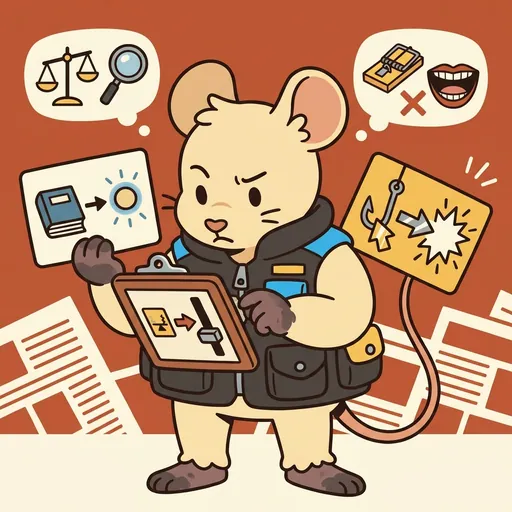
Frame
FRAME — *the headline is a summary, not a hook. counter-clickbait.*
Listen along — Frame
Loading audio…
Press play to listen along. The line being read lights up as you go.
Show full transcript
Loading transcript…
Chapter 3 — Frame and the Headline That Tells the Story
The newsroom was in a state, and Frame was the only one not panicking.
He was a small typewriter mouse — cream-colored paws with soft ink-stained tips, a chunky press vest, and a stack of headline cards under one arm. The story on the big board was about a new park opening in Willow Creek, and a frantic young reporter had just slapped a headline above it: “YOU WON’T BELIEVE WHAT THEY BUILT!”
“It’ll get so many clicks,” the reporter said, hopeful.
Frame read it and winced, the way you wince at a too-loud noise. “But what did they build?” he asked.
“A park.”
“Then say a park.” Frame hopped up onto the desk and tapped the reporter’s keyboard, key by careful key. The screaming words dissolved. In their place: “New Park Opens in Willow Creek — Kids Love the Giant Slide.”
The reporter frowned. “But that just… tells them.”
“That’s the whole point,” Frame said, patient. “A headline is a promise to the reader. This one says: here is what happened, decide if you want more. The other one says: I’m hiding something, chase me to find it.” He straightened the card on his stack. “One of those respects the reader. One of those tricks them. We don’t trick readers here.”
He climbed down and looked at the two headlines side by side. “Same park. Same slide. Same true story. Completely different promise.” He nodded at the honest one. “That one keeps its word.”
Frame had grown up in the back of an old print shop, in a family of typewriter mice who’d been setting headlines longer than anyone could count.
His grandmother worked the biggest press, and she had a saying she repeated so often that Frame heard it in his sleep: The headline is the reader’s first promise. Always keep the promise. She set every headline slowly, one heavy metal letter at a time, and she’d make young Frame read each one back to her before it went to print.
“What did you learn from this headline,” she’d ask, “before you read one word of the story?”
If he could answer — where, when, who, what — she’d nod and lock the type in place. If he couldn’t, she’d pull the letters out and start over. “A headline you have to read the whole story to understand,” she said, “is a headline that failed at its one job.”
One busy night, tired and rushing, Frame set a headline that read only: The Shocking Truth About the Bridge! He thought it was clever. It made you curious.
His grandmother read it, then set it back in the tray, letter by letter, until the drawer was empty. “Curious isn’t informed,” she said gently. “You made them want to click. You didn’t tell them anything. That’s a headline that takes from the reader instead of giving.” She handed him the blank tray. “Try again. This time, keep the promise.”
Frame set it again. Old Willow Bridge to Close for One Week of Repairs. His grandmother locked it in without a word, which was how he knew he’d finally done it right.
When Frame was twelve, he carried his headline cards into the NewsForge newsroom to meet his mentor, Scoop, a rumpled and thoughtful old editor.
Scoop was staring at a wall of the day’s headlines, half of them shouting. “Everyone wants clicks,” Scoop said, without turning around. “Clicks pay the bills. So the headlines get louder and say less.” He finally looked at Frame. “How do you write one that’s honest and still worth reading?”
Frame set a card on the desk. “You make the honesty do the work,” he said. “You don’t have to yell if you actually tell people something.” He tapped the card. “A real headline answers the reader’s first questions right up front. Where. When. Who. What. Enough that they could stop reading and still know the main thing that happened.” He looked up. “The click isn’t the point. The reader is the point. If the story’s worth their time, an honest headline will tell them so. If it isn’t, no amount of yelling should make them think it is.”
Scoop was quiet a long moment. Then a small, tired smile crossed his face. “That’s the job,” he said, and slid the newsroom’s headline board over to Frame’s corner. “It’s yours.”
In Frame’s corner of the newsroom, a young reporter named Willa brought him a headline she was proud of. It read: “This Will Make You FURIOUS!”
“What’s the story about?” Frame asked.
“The town’s fixing the potholes on Maple Street.”
Frame tilted his head. “Is anyone actually furious about the potholes getting fixed?”
Willa deflated. ”…No. I just thought it’d get more clicks.”
“Let’s try it my grandmother’s way,” Frame said, and pulled her chair up to the keyboard. “Read me the story and tell me the four things I’d want to know first.”
Willa read. “The town. This week. Maple Street. Potholes.”
“Now put those in the headline. Just those.” Frame watched her type, key by key.
Willa’s new headline appeared: “Town Begins Pothole Repairs on Maple Street This Week.”
“Read it back,” Frame said. “If you knew nothing else — did the headline do its job?”
Willa read it out loud. “Town, potholes, Maple Street, this week.” She blinked. “It… told me the whole thing. I don’t even have to click to know what happened.”
“And if you do click,” Frame said, “it’s because you want more, not because you got tricked into it.” He tapped the card between them, a picture of a mouth and a thought bubble pointing at an idea, not a person. “See the difference? The first one took something from the reader — their attention, for nothing. This one gives something. That’s the only kind we write.”
Willa looked at her honest headline for a while. “It’s not as exciting.”
“It’s more trustworthy,” Frame said. “And that lasts longer than exciting.”
At the end of the day, Frame stood in front of the board and read down the row of the newsroom’s headlines. Every one of them told him something true before he read a single line of the story.
Willa came and stood beside him. “Nobody’s headline is yelling anymore,” she noticed.
“They don’t need to,” Frame said. He tucked his cards away, one careful key-tap at a time. “A headline that keeps its promise doesn’t have to shout. The reader trusts it, so it can just… say the thing.”
He read the board once more, slow and satisfied, and a warm, steady quiet settled over him — the calm, proud feeling you get when you’ve kept your word to someone who trusted you with it. It felt, he thought, like handing a friend exactly what you promised, and watching their shoulders relax because they knew they could count on you.
The NewsForge ensemble
Frame is part of NewsForge's distributed-narrative cast. Each character embodies a different curricular primitive; together they teach the full subject.
-

Source
Source-quality evaluation — who would KNOW this best? who has a stake? source-card-comparison the routine
-

Tilt
Bias-and-perspective detection — every story has a frame; name the frame, then read; structural NOT partisan
-

Verify
Verification + lateral-reading discipline — SIFT (Stop, Investigate, Find, Trace); open four tabs, never one
-

Serve
Community-information-needs framing — what does my reader NEED to know to DO something? agency-foregrounding; counter-doomscroll